- What makes toddler toothbrushing feel like a battle and how can you change the script?
- When should you start brushing baby teeth and what tools do you need?
- How much fluoride toothpaste should toddlers use and why does it matter?
- What is the simplest step by step routine to brush a toddler’s teeth without tears?
- Which gentle toothbrushing techniques help if your child resists?
- How can you turn toothbrushing into a game and build a routine toddlers love?
- What if your toddler bites, gags, or refuses to open their mouth?
- When should you start flossing and how do you make it easier for small hands?
- Do electric toothbrushes help toddlers and are they safe to use?
- How do diet, bottles, and sippy cups affect toddler cavities?
- What local and national guidelines should Laguna Niguel parents know?
- How do you choose a kids dentist in Laguna Niguel and what should the first visit include?
- When should you call a pediatric dentist about toothbrushing concerns?
- How can caregivers with special circumstances adapt these tips safely?
- Why choose Kidz Modern Dentistry for your child’s smile in Laguna Niguel?
- References
What makes toddler toothbrushing feel like a battle and how can you change the script?
Many parents tell us that brushing a toddler’s teeth feels like a wrestling match. You are not alone. Toddlers crave independence, have sensitive gums, and are still learning to tolerate new sensations. The good news is that small changes can shift the mood from struggle to success.
Start by resetting expectations. A toddler is exploring, not misbehaving. Keep sessions short, predictable, and positive. Consistency matters more than perfection. Twice a day brushing with fluoride toothpaste is recommended for young children to help prevent cavities, which remain one of the most common chronic conditions in childhood in the United States [1][2].
From a prevention standpoint, daily home care paired with regular dental visits forms the foundation of Pediatric preventive dental care. This teamwork approach helps you care for your child’s smile while keeping visits encouraging and informative.
When should you start brushing baby teeth and what tools do you need?
Begin brushing as soon as the first tooth erupts. A soft infant toothbrush or silicone finger brush works well for early teeth and tender gums. The American Academy of Pediatric Dentistry encourages parents to schedule a first dental visit by the first birthday so you can learn hands on techniques for home care and get an early check of growth and development [8].
Which toothbrush and bristles should you choose?
Choose a child sized brush with soft bristles and a small head. Brushes with the American Dental Association Seal are independently evaluated for safety and effectiveness, and soft bristles help protect enamel and gums [12].
How long should you brush and who should do the brushing?
Brush for about 2 minutes, twice a day. Parents should do most or all of the brushing until a child can reliably clean all tooth surfaces alone, which typically happens years after toddlerhood. Supervised brushing is recommended so fluoride is used correctly and all areas are reached [1][7].
How much fluoride toothpaste should toddlers use and why does it matter?
Fluoride strengthens enamel and reduces the risk of tooth decay. For toddlers, amount is key. Professional organizations recommend a smear the size of a grain of rice for children under age 3, and a pea sized amount for ages 3 to 6 [3][4]. Using the right amount supports cavity prevention while minimizing the risk of fluorosis during tooth development.
Which fluoride advice should you follow at home?
Place the toothpaste on the brush yourself and keep the tube out of reach. Coach your child to spit instead of swallow as skills develop. When in doubt, ask your pediatric dentist to demonstrate the right amount at your next visit [4].
Is fluoride varnish recommended for toddlers?
For many infants and children younger than 5, in office fluoride varnish is recommended by the United States Preventive Services Task Force as an additional measure to reduce the risk of caries. Your pediatric dentist can advise based on your child’s risk and needs [5].
What is the simplest step by step routine to brush a toddler’s teeth without tears?
Use a calm, repeatable routine that your toddler can learn to expect. This structure reduces anxiety and builds cooperation over time.
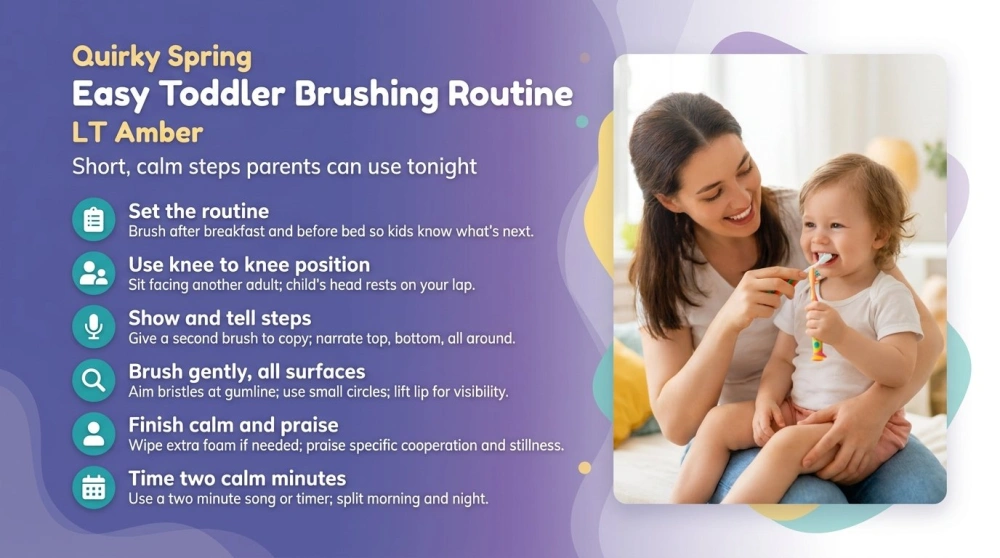
What is a parent tested routine you can follow tonight?
- Set the stage: Choose a consistent time after breakfast and before bedtime so your toddler knows what comes next [1].
- Use the right position: Try the knee to knee position. Sit facing another adult, knees touching, and lay your child’s head on one lap. This position is widely used in pediatric dental care and lets you see all teeth while supporting your child’s head [8].
- Show and tell: Let your toddler hold a second toothbrush and copy your motions. Narrate with simple steps like top teeth, bottom teeth, and all around [6].
- Brush gently and systematically: Aim the bristles at the gum line and make small circles on the outside, inside, and chewing surfaces. Lift the lip to see upper front teeth clearly [7].
- Finish and praise: Wipe extra foam with a clean cloth if needed and offer specific praise such as you stayed so still while I counted your back teeth [6].
How can you keep the routine under 2 minutes without rushing?
Use a song or a timer for about 2 minutes. Many parents find it easier to brush for one minute in the morning and one minute at night, rather than trying to compress the process too quickly at one time [7].
Families in Orange County often combine home care with regular checkups to keep small issues small. If you have not yet scheduled a first visit, consider doing so to align home routines with Pediatric preventive dental care in Laguna Niguel.
Which gentle toothbrushing techniques help if your child resists?
Brushing resistance often signals a need for predictability and comfort. These techniques are designed to help your toddler feel safe while you get the job done.
What comfort strategies can you try right away?
- Use a preview: Tell your child what will happen in simple steps. Many pediatric dentists use a tell show do approach that you can copy at home [6].
- Offer choices that do not change the task: Pick the blue brush or the green brush and choose the dinosaur song or the bubble song. Small choices build cooperation.
- Stabilize the head gently: If your child wiggles, use your forearm to cradle the forehead while brushing. Keep movements slow and predictable.
- Switch locations: If the bathroom feels stressful, try brushing while your toddler lies on the couch or your lap under a bright lamp.
- Add a mirror moment: Briefly let your child watch in a handheld mirror so they understand where the brush is going.
How can you protect tender gums while removing plaque?
Use a soft brush with a light touch at a 45 degree angle toward the gum line. Small circles are gentler than scrubbing back and forth. Rinse the brush as needed so paste and plaque do not collect and feel gritty [7].
How can you turn toothbrushing into a game and build a routine toddlers love?
Play is your superpower. Toddlers learn best through songs, pretend play, and predictable rituals.
Which simple games work for most toddlers?
- Two brushes game: Your child holds one brush while you brush with another. Ask for a turn swap to clean tricky parts.
- Tooth counting adventure: Count teeth in a happy voice and celebrate each section you finish. You can use stickers to track progress.
- Animal helper story: Pretend a friendly animal needs to find all the sugar bugs. Celebrate when the animal helps you clean each tooth.
- Music timer: Play a favorite 2 minute song so your toddler knows brushing starts at the beat and ends when the song is over.
What reward systems are healthy and effective?
- Sticker charts with tiny milestones: Reward cooperation, not perfection. Five checkmarks can earn a high five celebration or a special book at bedtime.
- First this then that: First we brush, then we read your favorite story. Keep the order consistent so expectations are clear.
- Modeling and praise: Brush your own teeth together and narrate what you are doing. Praise effort and calm body rather than results.
What if your toddler bites, gags, or refuses to open their mouth?
These common hurdles have practical solutions. Aim for comfort and good technique instead of force. Brief pauses and calm coaching often make the biggest difference.
How do you handle biting on the brush?
- Use a second brush as a spacer: Gently place one brush sideways between back teeth to keep space, then brush with the other. Remove the spacer often to rest the jaw.
- Try a silicone finger brush briefly: Some children tolerate the feel of silicone better while you work up to a bristle brush.
- Give a safe chew before brushing: A clean, cool teething toy for one minute can calm sore gums.
What if gagging makes brushing hard?
- Start with outer surfaces: Brush front teeth first and move toward the back later in the session.
- Use tiny amounts of toothpaste: Less foam means less swallow reflex. A smear or pea size based on age is enough [3][4].
- Adjust head and chin: A slightly down chin can reduce the gag reflex compared with tipping the head back.
How can you prompt opening without fear?
- Practice open and say ah as a game: Use a stuffed animal to model opening wide for a quick look.
- Try a counting cue: Count to three for each area and pause for a breath. Predictable pauses help children stay calm.
- Use positive scripts: We open big so we can tickle sugar bugs away. Keep language upbeat and simple.
When should you start flossing and how do you make it easier for small hands?
Begin flossing as soon as any two teeth touch. Tight contacts between molars trap food and plaque, and floss reaches areas a brush cannot. Your pediatric dentist can show you age appropriate flossing methods and tools to reduce fuss. Flossers with handles are often easier for caregivers to maneuver.
What technique should you use for toddler flossing?
- Guide the floss gently: Slide down between teeth, curve into a C shape around each tooth, and move up and down a few times. Be gentle at the gum line.
- Keep it brief: One or two minutes is usually enough for the few contacts that need it during toddler years.
- Make it a story: Pretend the floss is a tiny rope that helps clean the spaces where the brush cannot go.
Do electric toothbrushes help toddlers and are they safe to use?
Powered toothbrushes can help remove plaque more effectively than manual brushes in many users, which may benefit families who struggle with cooperation or technique. Evidence in broader populations shows reduced plaque and gingivitis with powered brushes over time compared with manual brushing. For toddlers, choose a child designed model with soft bristles and use it under close supervision [11][12].
How can you introduce a powered brush without fear?
- Use a slow rollout: First, let your child explore the brush while off. Then turn it on away from the mouth, and finally touch a back tooth for a second and pause.
- Pair with a song: Match gentle vibrations with a calm tune to keep the experience predictable.
- Switch back if needed: There is no one right tool. If a powered brush causes worry, a soft manual brush works well when used correctly.
How do diet, bottles, and sippy cups affect toddler cavities?
Cavities form when sugars feed bacteria that produce acids, which weaken enamel over time. Frequent sipping on sweet drinks and grazing on sugary snacks can raise risk. Public health guidance encourages limiting free sugars and avoiding putting a child to bed with a bottle that contains anything other than water [1][13].
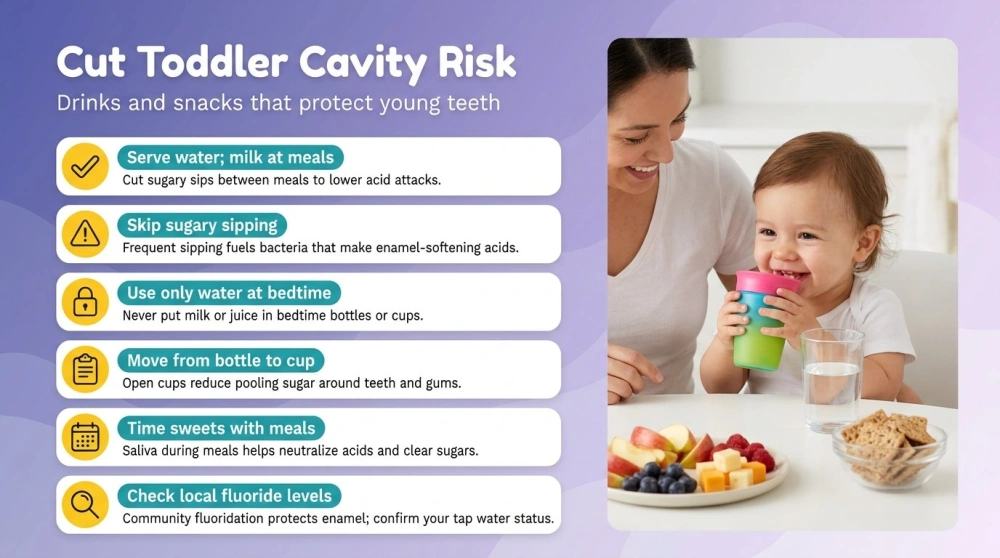
Which changes have the biggest impact on cavity risk?
- Reserve juice and sweet drinks: Offer water most of the time and milk with meals. Avoid frequent sipping on sugary beverages [1].
- Move from bottle to cup: Transition from bottles toward open cups as skills allow, and do not allow bottles or sippy cups with sugary liquids during naps or bedtime [1].
- Time sweets with meals: If sweets are offered, serve them with meals so saliva flow helps neutralize acids.
How does community water fluoridation support families?
Community water fluoridation is recognized as a safe and effective public health measure that helps reduce tooth decay across all ages. Check your local water provider to learn about fluoride levels in your area [9].
What local and national guidelines should Laguna Niguel parents know?
Parents in Laguna Niguel, California benefit from national recommendations and local resources that support children’s oral health. The Centers for Disease Control and Prevention, the American Dental Association, the American Academy of Pediatric Dentistry, and the United States Preventive Services Task Force publish guidance on brushing, fluoride use, and early dental visits [1][3][4][5][7].
Where can you confirm local water fluoride information?
Laguna Niguel is served by regional water agencies that publish water quality reports and fluoride information. The Moulton Niguel Water District provides public updates on fluoridation levels and compliance. Reviewing your water district’s current notices can help you understand the baseline protection in your tap water [10].
Which California state resources support families?
The California Department of Public Health Oral Health Program offers education, prevention initiatives, and information on community water fluoridation and school based activities. These resources can guide families who want to learn more about statewide oral health efforts and services [15].
Combining home routines with regular visits aligns your home care with Pediatric preventive dental care. Professional exams and coaching support healthier habits and catch concerns early.
How do you choose a kids dentist in Laguna Niguel and what should the first visit include?
Look for a pediatric dentist with training in child growth, behavior guidance, and prevention focused care. A first visit typically includes a gentle exam, cleaning if appropriate, fluoride varnish when indicated, and parent coaching on brushing and diet. Choose a practice that welcomes questions and demonstrates techniques like knee to knee positioning so you can use them confidently at home [5][6][8].
What questions should you ask during your visit?
- How should I brush my child’s teeth based on their spacing: Ask to review brushing and flossing around tight contacts.
- What toothpaste amount should we use at this age: Confirm the smear or pea sized amount and practice applying it [3][4].
- Do we need fluoride varnish or other prevention options: Review caries risk and in office preventive treatments [5][14].
How do online reviews and credentials help you decide?
Look for membership in reputable professional organizations and an approach that prioritizes prevention and parent education. For many families seeking a children’s dentist in Laguna Niguel, a welcoming team that coaches you through daily brushing steps can make home care much easier.
When should you call a pediatric dentist about toothbrushing concerns?
Contact a pediatric dentist if your toddler has persistent bleeding gums, white or brown spots that look like chalky areas on teeth, tooth pain, or if brushing remains impossible despite routine and coaching. An early exam can identify the cause and provide tailored strategies. Cavities and gingivitis can develop quickly when plaque is not removed, and early help can prevent progression [1][2].
What if you are unsure whether a spot is a stain or a cavity?
When in doubt, schedule a quick check. Photographs can be misleading. An exam allows your dentist to assess enamel and provide specific advice about brushing technique, fluoride use, and diet tailored to your child’s risk [14].
If you live near Laguna Niguel and prefer a prevention focused home care plan, ask about Pediatric preventive dental care in Laguna Niguel so your routine at home and your dental visits reinforce each other.
How can caregivers with special circumstances adapt these tips safely?
Every family is unique. The core principles remain the same. Keep brushing twice daily with fluoride toothpaste, make small predictable steps, and ask your dental team to personalize strategies for your child. Pediatric dentists use evidence based behavior guidance and can adapt positioning and tools for children with sensory preferences, developmental differences, or medical needs [6].
Which practical adaptations can you discuss with your dentist?
- Alternative positions: Side lying on a couch, knee to knee with two caregivers, or semi reclined on pillows can all work.
- Desensitization steps: Practice touching the lips and cheeks with the toothbrush handle before brushing starts, and add brief brush contact in tiny steps.
- Tool swaps: Try different brush head sizes, silicone brushes, or powered brushes introduced gradually if tolerated [11][12].
- Short sessions with breaks: Two short sessions may be more successful than one long effort. Praise cooperation often and end on a calm note.
Why choose Kidz Modern Dentistry for your child’s smile in Laguna Niguel?
At Kidz Modern Dentistry, our focus is on prevention, comfort, and practical coaching for families. We serve children of all ages in Laguna Niguel, California and nearby communities, and we believe every visit should help you feel more confident at home. Our team helps parents practice toddler brushing and flossing techniques chairside so the bedtime routine feels easier the same night you leave the office.
How do our services support your next steps at home?
- Hands on coaching: We demonstrate knee to knee positioning, the grain of rice smear and pea sized toothpaste amounts by age, and simple games you can use immediately.
- Risk based prevention: We assess diet, tooth spacing, and enamel risk to tailor guidance, fluoride varnish, and interval timing for follow up visits in a way that fits your family [5][14].
- Whole child approach: Our behavior guidance methods are designed for comfort and collaboration so kids learn to trust dental care at a young age [6].
Where do we operate and what sets our approach apart?
We care for families in Laguna Niguel, California with a modern, child friendly office and same day support for urgent needs. We offer kid friendly options when appropriate and focus on prevention and education at every visit. If a challenge arises, our dentists provide clear pathways for treatment that respect your child’s comfort and developmental stage. You can reach our front desk at +1 949 273 0110 for scheduling and questions.
What experience and results can you expect from our team?
- Experienced pediatric focus: Our clinical team brings years of combined experience in prevention centered care for children, from infants to teens.
- Personalized plans: We align your home routine with practical goals and review progress at each visit so tiny wins add up over time.
- Positive stories: Parents often report that brushing becomes calmer within days after we teach positioning, pacing, and choice based cooperation during a visit.
As a local kids dentist in Laguna Niguel, we love helping parents build confident habits that last. If you have questions about tools, timing, or your child’s specific needs, our team is here to guide you with clear, child centered steps.
References
- Children’s Oral Health – CDC
- Dental Caries and Sealant Prevalence in Children and Adolescents, United States 2011 to 2016 – CDC NCHS Data Brief
- ADA Recommends Fluoride Toothpaste for All Children – American Dental Association
- Policy on Use of Fluoride – American Academy of Pediatric Dentistry
- Prevention of Dental Caries in Children Birth to Age 5 – United States Preventive Services Task Force
- Behavior Guidance for the Pediatric Dental Patient – American Academy of Pediatric Dentistry
- Toothbrushing Oral Health Topic – American Dental Association
- Policy on Perinatal and Infant Oral Health Care – American Academy of Pediatric Dentistry
- Community Water Fluoridation – CDC
- Fluoride in Drinking Water – Moulton Niguel Water District
- Powered versus Manual Toothbrushing for Oral Health – Cochrane Review
- Toothbrushes Oral Health Topic – American Dental Association
- Guideline: Sugars Intake for Adults and Children – World Health Organization
- Policy on Caries Risk Assessment and Management – American Academy of Pediatric Dentistry
- California Oral Health Program – California Department of Public Health
Common Questions About This Topic
Find answers to frequently asked questions related to this article.