
Finding a pediatric dentist for children with autism who truly understands your child’s world is one of the most meaningful things you can do for their long-term health. Oral health is not separate from overall well-being. Untreated dental problems can lead to pain, sleep disruption, difficulty eating, and behavioral changes that are especially hard on children who already process the world differently. Yet many families across Orange County report that routine dental visits are among the most stressful appointments they navigate each year.
If you are a parent in Laguna Niguel, Mission Viejo, Aliso Viejo, Laguna Hills, Laguna Beach, or San Juan Capistrano, this guide is written with you in mind. We have pulled together verified clinical information, practical guidance, and clear criteria to help you find an autism-friendly pediatric dentist in Orange County who can make dental visits feel manageable, and maybe even positive, for your child.
Why Autism-Friendly Dental Care Matters for Your Child
Autism Spectrum Disorder (ASD) affects an estimated 1 in 31 children aged 8 years in the United States, according to the most recent data from the Centers for Disease Control and Prevention’s Autism and Developmental Disabilities Monitoring (ADDM) Network. [1] ASD is reported to occur across all racial, ethnic, and socioeconomic groups, and is more than three times as common among boys than girls.
Oral health in children is already an area of significant public health concern. The National Institute of Dental and Craniofacial Research (NIDCR) reports that approximately 23% of children ages 2 to 5 years had dental caries in their primary teeth in 2011–2016, and that figure rises to roughly 52% for children ages 6 to 8 years. [2] For children with ASD, these figures are often higher due to barriers to dental care access, difficulty tolerating dental procedures, and certain medication or dietary factors that can affect oral health.
Children with autism may experience higher rates of dental disease not because of the autism itself, but because of the conditions that commonly accompany it. Sensory sensitivities can make tooth brushing and flossing difficult at home, and anxiety around dental visits can lead families to defer care until a problem becomes urgent. Early, consistent, and compassionate dental care breaks this cycle.
What Makes Dental Visits Challenging for Children with Autism?
It helps to understand the specific reasons why a dental office environment can feel overwhelming to a child with ASD before trying to solve for it. Most challenges fall into a few connected categories.
Sensory Processing Differences
Many autistic children experience sensory processing in ways that are qualitatively different from neurotypical children. The dental environment is dense with sensory input: bright overhead lights, the hum and vibration of equipment, the taste and texture of dental materials, the sound of suction and drills, and the physical sensation of instruments in the mouth. Each of these inputs, which a typical child may ignore or barely notice, can feel painfully intense or deeply distressing for a child with ASD.
Challenges with Communication and Comprehension
Some children with autism are non-verbal or have limited expressive language, making it harder for them to tell a provider where they feel pain or discomfort, or to signal that they need a break. Children who rely on augmentative and alternative communication (AAC) devices may need a dentist who is familiar with, or at minimum respectful of, these tools.
Difficulty with Change and Unpredictability
A predictable routine is often central to the well-being of a child with ASD. A dental visit is, by nature, a departure from routine. The unfamiliar room, unfamiliar people, unfamiliar sensations, and uncertain timeline can all trigger anxiety or dysregulation before a single instrument is picked up.
Behavioral Responses to Anxiety
When a child with autism feels overwhelmed, they may respond in ways that complicate treatment: pulling away, crying, biting, or becoming completely non-compliant. These are not deliberate acts of defiance. They are the child’s way of communicating distress. A provider trained in working with children who have special needs will understand this and have strategies in place.
What Should You Look for in an Autism-Friendly Pediatric Dentist?
Not every pediatric dentist is equally equipped to serve children with autism. Here are the qualities and credentials worth looking for when evaluating a practice.
Does the dentist have documented experience with children with ASD?
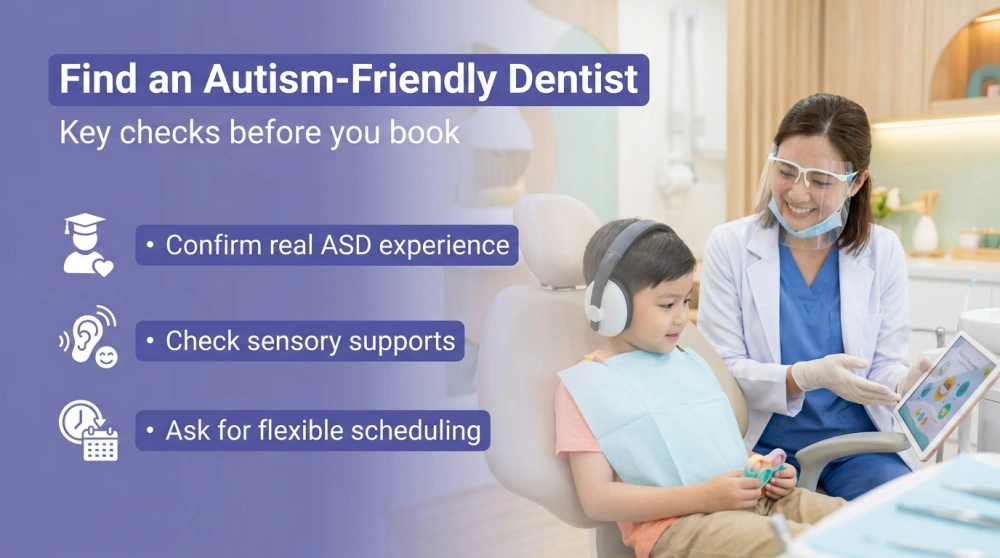
This goes beyond a friendly attitude. Ask specifically whether the dentist has treated children with autism before and at what frequency. Practices that regularly serve children with developmental differences will have adapted workflows, trained staff, and equipment or accommodations already in place. You should not be the first autistic child they have treated.
Is the dental team trained in behavior management techniques?
The American Academy of Pediatric Dentistry (AAPD) recognizes a range of behavior management approaches for children with special health care needs. [3] These include tell-show-do, desensitization, positive reinforcement, distraction, and in appropriate cases, protective stabilization or pharmacological approaches. Ask whether the team has specific training in applied behavior analysis (ABA) principles or trauma-informed care.
Does the practice offer pre-visit accommodations?
An autism-informed dental office will often offer the opportunity for a pre-visit or “desensitization visit” where your child can explore the waiting room and operatory, meet the staff, and sit in the dental chair without any treatment taking place. This kind of gradual exposure is supported by behavioral research and can dramatically reduce anxiety over time.
Is the physical environment thoughtfully designed?
Look for offices that offer quieter waiting areas, dimmed lighting options, weighted blankets or sensory tools, noise-reducing headphones, or other accommodations. A practice that has thought carefully about the sensory environment has likely thought carefully about much more.
Are scheduling accommodations available?
Many families of autistic children find it helpful to schedule the first appointment of the day when the office is quietest, or to have extended appointment times so no one feels rushed. Ask whether these options are available.
How Does a Sensory-Friendly Environment Support Children with ASD?
The concept of sensory-friendly dental care is built around the idea that the environment itself is part of the treatment. When we remove or reduce sensory barriers, we reduce the anxiety that can make every other aspect of care harder.
Comprehensive pediatric dental care for autistic children may incorporate several environmental adaptations. Here is what a thoughtful practice might offer:
- Dimmed or adjustable overhead lighting to reduce visual overstimulation and fluorescent glare.
- Noise-reducing headphones or earbuds so the child can listen to preferred music or stories during treatment.
- Sunglasses to block procedure lighting from the child’s eyes.
- Weighted blankets or lap pads, which many sensory-seeking children find calming during dental procedures.
- Flavor-neutral or preferred-flavor dental products like toothpaste and polish, which avoid triggering aversions.
- Quiet appointment times that reduce the number of other patients and sounds in the office.
- Visual supports such as picture schedules or social stories posted or printed so the child can follow what will happen next.
None of these accommodations require expensive equipment. They require a team that has listened carefully to families and is committed to making the experience workable. When you call a dental office and describe your child’s needs, the response you receive in that first conversation tells you a great deal about whether this is a good fit.
What Communication Strategies Help Children with Autism at the Dentist?
Communication is at the heart of a successful dental experience for any child, and even more so for children with ASD. A skilled dental team will adapt their communication approach based on each child’s profile.
Tell-Show-Do
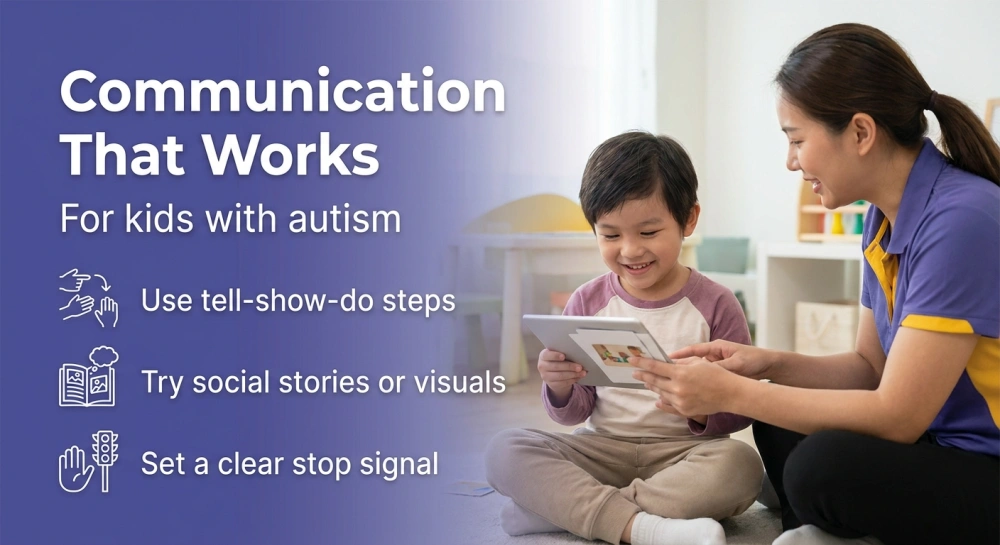
This foundational pediatric dentistry technique involves telling the child what will happen in simple language, showing them the instrument or action at a safe distance, and then doing the procedure. It transforms the unknown into the predictable, which is enormously reassuring for children who find unpredictability distressing.
Social Stories and Visual Schedules
Developed within the autism support literature, a social story is a brief, illustrated narrative that walks a child through a scenario step by step. A dental social story might describe arriving at the office, meeting the dentist, sitting in the chair, opening their mouth, and leaving with a sticker. Parents can read these with their child multiple times before the appointment to build familiarity.
First-Then Boards and Token Systems
A first-then board is a simple visual tool: “First teeth cleaning, then iPad.” It pairs a less preferred activity with a preferred reward and gives the child a concrete reason to tolerate the procedure. Token systems operate similarly, allowing the child to earn tokens toward a reward as they complete steps of the visit.
Using the Child’s AAC Device
If your child uses a speech-generating device or a picture exchange communication system (PECS), bring it to the appointment and ask the dental team to allow the child to use it throughout the visit. A provider who respects this communication method signals respect for the child.
Agreed-Upon Stop Signals
Establishing a simple, reliable stop signal, such as a raised hand, gives the child a sense of control over the experience. When children feel they have some agency, their compliance and cooperation often increase substantially.
When Is Sedation Dentistry an Option for Autistic Children?
For some children with autism, behavioral strategies and environmental modifications are sufficient to complete dental treatment. For others, particularly those with significant anxiety, severe sensory sensitivities, multiple dental needs, or limited ability to cooperate with treatment, sedation may be the most humane and appropriate path forward.
Sedation dentistry in Orange County encompasses a spectrum of options, and the right choice depends on the individual child’s needs and the complexity of the dental work required.
Nitrous Oxide (Laughing Gas)
Nitrous oxide is a mild sedative inhaled through a small mask placed over the nose. It produces a relaxed, slightly euphoric state while the child remains awake and responsive. It is typically the first sedation approach considered because it is safe, fast-acting, and wears off quickly. However, it requires that the child tolerate the mask, which some autistic children find difficult.
Oral Conscious Sedation
A liquid or pill medication taken by mouth before the appointment produces a deeper state of relaxation. The child remains conscious but is significantly calmer and often has little memory of the procedure afterward. This approach is useful for children with moderate anxiety or multiple dental needs.
IV Sedation or General Anesthesia
For children with complex dental needs or those who cannot cooperate with treatment even with lighter sedation, treatment under general anesthesia allows comprehensive care to be completed in a single appointment while the child is fully asleep. This option is conducted with an anesthesiologist present and carries a different risk profile that must be carefully discussed with the dental and medical team.
The AAPD provides guidance on pharmacological behavior management for pediatric patients with special health care needs, emphasizing that any sedation decision should be individualized and based on a thorough assessment of the child’s medical and behavioral profile. [3] A parent considering sedation for their child should discuss the full range of options, associated risks, and benefits with the dental provider in detail before proceeding.
How Can Parents Prepare Their Child for a Dental Visit?
The work of making a dental visit successful does not begin in the waiting room. It begins at home, often weeks in advance. Here are practical steps families have found helpful.
Start with a practice run at home
Let your child practice opening their mouth wide, lying back in a chair, and having a gentle touch around their face and mouth. Use a flashlight and a toothbrush during these practice sessions to simulate the sensory experience. Pair this practice with a preferred reward and keep sessions short and positive.
Use video modeling
Many children with ASD learn effectively through video. Search for child-friendly dental visit videos online and watch them together. Some dental offices provide their own video walkthroughs. Familiarity with what the office looks like and what will happen reduces the element of surprise.
Create a dental social story specific to the office
Call ahead and ask if the practice can share photos of the waiting room, the operatory chair, and the team. Use these to create a personalized social story your child can read repeatedly before the visit. Many parents find this to be one of the single most effective preparation tools.
Bring comfort items
A favorite stuffed animal, fidget toy, or noise-reducing headphones can provide meaningful regulation support during the appointment. Most autism-informed dental teams welcome these items and will encourage their use.
Plan for transitions and waiting
Waiting rooms can be a significant source of difficulty. Know in advance whether the office can text you when they are ready so your child can wait in the car. Consider scheduling the first appointment of the day to minimize wait times.
Debrief and celebrate
After the appointment, acknowledge your child’s effort explicitly. Even if the visit did not go perfectly, recognizing what they did accomplish builds positive associations with dental care over time. Avoid framing the experience as something to simply survive. Frame it as something they did, even partially, with help.
What Questions Should You Ask a New Dentist?
When you call or meet with a potential dental provider for your child with autism, the conversation you have before the first appointment is one of the most important evaluations you will make. Here are questions worth asking directly.
- How many children with autism do you currently see in your practice? A practice with significant experience will answer this confidently.
- What training have you or your team completed in treating children with special needs? Look for specific training rather than general reassurances.
- Do you offer desensitization visits for new patients with ASD? A yes is a strong indicator of a patient-centered approach.
- What behavior management techniques do you use when a child becomes distressed? Listen for patient, non-punitive language and a focus on the child’s experience.
- Can we schedule a pre-visit for my child to explore the office without any treatment? This accommodation can make a meaningful difference.
- What sensory accommodations can you offer during the visit?
- What is your approach to sedation if my child cannot cooperate with treatment? A provider should be able to describe their full range of options without pressure.
- Can I stay in the room with my child during treatment? Most pediatric practices welcome parents, and for children with ASD, parental presence is often clinically beneficial.
The answers to these questions, and the way they are delivered, will tell you whether this provider sees your child as an individual whose comfort and dignity matter.
How Do You Navigate Insurance and Access to Care in Orange County?
Access to specialized pediatric dental care can be complicated by insurance and cost factors. In California, Denti-Cal (the state’s Medi-Cal dental program) covers dental services for children, including those with disabilities. However, not all providers accept Denti-Cal, and wait times for specialized care can be long.
For families with private insurance, it is important to confirm coverage specifically for behavioral and sedation-related dental care, as some policies limit coverage for sedation outside a hospital setting. California law requires that health insurance policies cover medically necessary dental services under certain conditions, including for individuals with developmental disabilities. [4]
Regional Centers in California, operated under the Lanterman Developmental Disabilities Services Act, may provide funding for dental care that is not covered by Medi-Cal or private insurance for individuals with qualifying developmental disabilities, including autism. Families in Orange County are served by the Frank D. Lanterman Regional Center or other regional centers, depending on their specific zip code. [5]
It is worth contacting your regional center service coordinator to ask specifically about dental care funding before assuming costs must be entirely out of pocket. Many families do not know this option exists.
Are there specific dental programs in California for children with disabilities?
The University of California, Los Angeles (UCLA) School of Dentistry and other university dental programs in California operate clinics that serve patients with special needs and may offer care at reduced cost for qualifying families. While these programs are not always geographically convenient, they can be a valuable resource for complex cases requiring specialized expertise.
About Kidz Modern Dentistry
Kidz Modern Dentistry is a pediatric dental practice dedicated to providing comprehensive, compassionate care for children of all ages and abilities in Orange County, California. The practice serves families throughout Laguna Niguel, Mission Viejo, Aliso Viejo, Laguna Hills, Laguna Beach, and San Juan Capistrano.
The team at Kidz Modern Dentistry understands that for children with autism spectrum disorder, every aspect of the dental visit matters. From the moment a family calls to make an appointment, the practice works to understand each child’s sensory profile, communication style, and behavioral history so that appointments can be thoughtfully structured around what actually works for that child. The practice offers same-day emergency care, so families facing dental pain or acute dental injuries do not have to wait.
Comprehensive dental care for children with special needs at Kidz Modern Dentistry includes preventive services, restorative treatments, and adaptive approaches designed around each child’s comfort level. The team is experienced in working with children who have developmental disabilities and special health care needs, and is skilled at applying a range of behavior management strategies, from gradual desensitization to tell-show-do to positive reinforcement protocols, before moving to pharmacological options.
For children whose anxiety or dental needs make traditional treatment approaches impractical, the practice offers kid-friendly sedation dentistry options, including nitrous oxide and oral conscious sedation. These options are always discussed thoroughly with parents before any treatment proceeds, and no approach is recommended without a clear explanation of what it involves and why it is being suggested.
The practice takes a parent-partnership approach to care. You know your child better than anyone, and the team at Kidz Modern Dentistry operates from that premise. Parents are welcome to stay with their child throughout treatment. Pre-visit consultations are available for families who want to discuss their child’s needs before bringing them in for the first time. The team will work with you on scheduling, pacing, and the specific accommodations that will make the experience as manageable as possible for your child.
Families searching for pediatric special needs dental care in Orange County will find at Kidz Modern Dentistry a practice that has built its entire approach around making dental visits a positive experience for children who need a little more time, care, and creativity to get there.
Kidz Modern Dentistry
Serving Laguna Niguel, Mission Viejo, Aliso Viejo, Laguna Hills, Laguna Beach, San Juan Capistrano, and surrounding Orange County communities.
Phone: +1 (949) 273-0110
Frequently Asked Questions
At what age should a child with autism have their first dental visit?
The American Academy of Pediatric Dentistry recommends that all children, including those with autism, have their first dental visit by age one or within six months of the first tooth appearing. [3] Early visits help the child acclimate to the dental environment gradually before significant dental treatment is ever needed, which is particularly valuable for autistic children.
How long does it take for an autistic child to get comfortable at the dentist?
This varies significantly by child. Some children become comfortable within two or three visits. Others may need six months or more of gradual desensitization visits before they can tolerate a full cleaning. There is no single timeline, and a patient provider will not rush this process or measure success only in teeth cleaned.
Is general anesthesia safe for children with autism?
General anesthesia carries risks for any child, and the decision to use it is always a careful medical calculation of risk versus benefit. For children with autism who cannot cooperate with dental treatment and who have significant dental needs, the risk of untreated dental disease including infection, pain, and systemic complications may outweigh the anesthetic risk. This conversation should always involve the child’s pediatrician alongside the dental team, and parents should feel fully informed before consenting.
What should I bring to my child’s first dental appointment?
Bring any comfort items your child relies on at home, such as a favorite toy, weighted blanket, or noise-reducing headphones. Bring any communication device your child uses. Bring a written summary of your child’s sensory sensitivities, behavioral triggers, and what has worked in other medical or therapeutic settings. The more information the team has, the better equipped they are to serve your child well.
Can diet and medications affect oral health in children with autism?
Yes, and this is worth discussing with your dental provider. Some medications commonly prescribed for children with autism, including certain antipsychotics and anticonvulsants, can reduce saliva production, which increases the risk of tooth decay. Restricted diets common in autism, particularly those high in processed carbohydrates or sweetened beverages, can also elevate caries risk. Your dentist should know what medications your child takes so they can factor this into their preventive care recommendations.
How do I help my child with autism brush their teeth at home?
Consistency, predictability, and sensory accommodations matter here as much as at the dental office. Use the same toothbrush and toothpaste every time. Choose a brush with a texture and handle your child tolerates, and toothpaste with a flavor they accept. Let your child see and hold the brush before it goes in their mouth. Consider an electric toothbrush for some children, as the vibration is preferred over manual brushing. Keep sessions short. Use a visual timer or song to signal when brushing is done.
What is the difference between a pediatric dentist and a general dentist for children with autism?
A board-certified pediatric dentist has completed two to three years of advanced specialty training after dental school specifically in the care of children, including those with special health care needs. This training includes child psychology, behavior management, growth and development, and management of complex dental cases in pediatric patients. While some general dentists are also excellent at working with autistic children, specialized pediatric training provides a clinical foundation that is specifically relevant to this population.
References
- Data and Statistics on Autism Spectrum Disorder – Centers for Disease Control and Prevention (CDC)
- Dental Caries (Tooth Decay) in Children (Ages 2 to 11 Years) – National Institute of Dental and Craniofacial Research (NIDCR)
- Oral Health Policies and Recommendations: Patients with Special Health Care Needs – American Academy of Pediatric Dentistry (AAPD)
- California Department of Managed Health Care (DMHC) – Consumer Protections and Coverage Information
- Regional Centers – California Department of Developmental Services
- About Autism Spectrum Disorder – Centers for Disease Control and Prevention (CDC)
- Behavior Guidance for the Pediatric Dental Patient – American Academy of Pediatric Dentistry (AAPD)
- Autism Spectrum Disorder – Eunice Kennedy Shriver National Institute of Child Health and Human Development (NICHD)
- Dental management of children with autism spectrum disorder: A review of the literature – PubMed, National Library of Medicine
- Oral Health Program – California Department of Public Health (CDPH)
- Dental Care for Individuals with Autism – Autism Society of America
Common Questions About This Topic
Find answers to frequently asked questions related to this article.
The American Academy of Pediatric Dentistry recommends that all children, including those with autism, have their first dental visit by age one or within six months of the first tooth appearing. [3] Early visits help the child acclimate to the dental environment gradually before significant dental treatment is ever needed, which is particularly valuable for autistic children.
This varies significantly by child. Some children become comfortable within two or three visits. Others may need six months or more of gradual desensitization visits before they can tolerate a full cleaning. There is no single timeline, and a patient provider will not rush this process or measure success only in teeth cleaned.
General anesthesia carries risks for any child, and the decision to use it is always a careful medical calculation of risk versus benefit. For children with autism who cannot cooperate with dental treatment and who have significant dental needs, the risk of untreated dental disease including infection, pain, and systemic complications may outweigh the anesthetic risk. This conversation should always involve the child's pediatrician alongside the dental team, and parents should feel fully informed before consenting.
Bring any comfort items your child relies on at home, such as a favorite toy, weighted blanket, or noise-reducing headphones. Bring any communication device your child uses. Bring a written summary of your child's sensory sensitivities, behavioral triggers, and what has worked in other medical or therapeutic settings. The more information the team has, the better equipped they are to serve your child well.
Yes, and this is worth discussing with your dental provider. Some medications commonly prescribed for children with autism, including certain antipsychotics and anticonvulsants, can reduce saliva production, which increases the risk of tooth decay. Restricted diets common in autism, particularly those high in processed carbohydrates or sweetened beverages, can also elevate caries risk. Your dentist should know what medications your child takes so they can factor this into their preventive care recommendations.
Consistency, predictability, and sensory accommodations matter here as much as at the dental office. Use the same toothbrush and toothpaste every time. Choose a brush with a texture and handle your child tolerates, and toothpaste with a flavor they accept. Let your child see and hold the brush before it goes in their mouth. Consider an electric toothbrush for some children, as the vibration is preferred over manual brushing. Keep sessions short. Use a visual timer or song to signal when brushing is done.
A board-certified pediatric dentist has completed two to three years of advanced specialty training after dental school specifically in the care of children, including those with special health care needs. This training includes child psychology, behavior management, growth and development, and management of complex dental cases in pediatric patients. While some general dentists are also excellent at working with autistic children, specialized pediatric training provides a clinical foundation that is specifically relevant to this population.
