
Understanding why gaps between baby teeth appear, what they mean for your child’s long-term oral health, and when it is worth talking to a pediatric dentist can give you real peace of mind. This article walks through what current dental science tells us about baby teeth spacing, when spacing is considered healthy, and what signs genuinely call for a professional evaluation.
What Are Gaps Between Baby Teeth?
Baby teeth, also called primary teeth or deciduous teeth, are the first set of teeth that emerge during infancy and early childhood. Most children begin teething around six months of age, and by approximately age three, a full set of 20 primary teeth is usually in place [1]. These teeth are smaller than the permanent teeth that will eventually replace them, and they often erupt with noticeable spaces between them.
These spaces are sometimes called “physiologic spacing” or “primate spaces” in clinical literature. The term primate spaces refers specifically to gaps that appear in predictable locations: in the upper arch between the lateral incisor and canine, and in the lower arch between the canine and first molar. These are considered normal developmental landmarks rather than signs of dental trouble [2].
The space between baby teeth is different from a gap caused by missing teeth, trauma, or delayed eruption. Knowing that distinction is important, and a pediatric dentist can help you tell the difference during a routine exam.
Are Gaps Between Baby Teeth Normal?
Yes, gaps between baby teeth are widely considered a sign of healthy oral development. The American Academy of Pediatric Dentistry (AAPD) recognizes that spacing in the primary dentition is a natural and often beneficial feature of a child’s developing mouth [3].
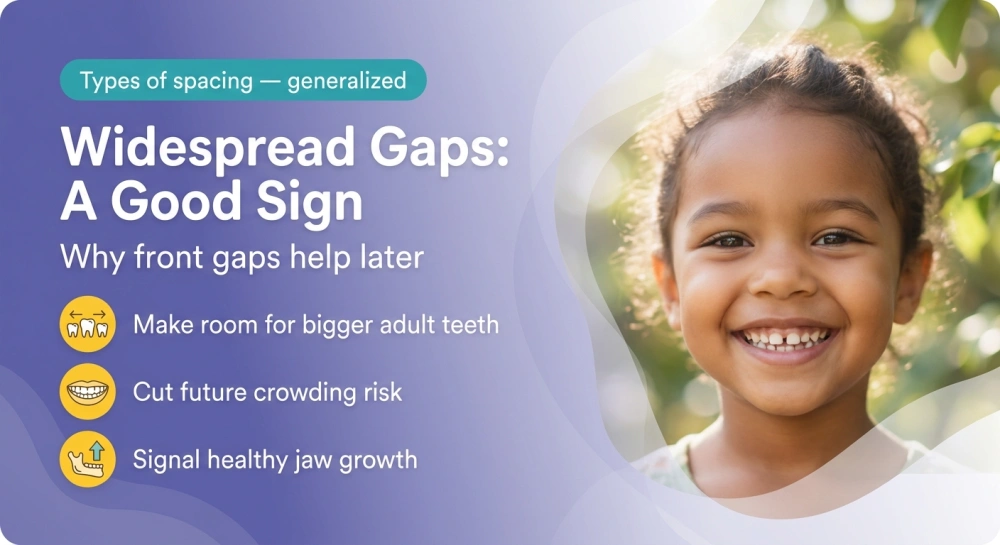
Think of it this way: your child’s jaw is still growing, but the baby teeth emerged when the jaw was smaller. As the jawbone gradually expands, small spaces appear between the primary teeth. This is the mouth preparing itself for the much larger permanent teeth that will arrive beginning around age six.
Children whose baby teeth are tightly packed together with no spaces actually have a higher likelihood of crowding when their permanent teeth come in, because the adult teeth are considerably wider and need room to erupt correctly [4]. So in a meaningful way, seeing space between baby teeth is something parents can feel good about rather than worry over.
“Spacing in the primary dentition is a normal finding and is generally favorable for the eruption of permanent teeth.”
That said, not all spacing looks the same, and context always matters. The amount of space, where it is located, and whether there are other changes happening in your child’s mouth are all factors worth discussing with a professional.
Why Spaced Baby Teeth Actually Matter for Permanent Teeth Eruption
One of the most important functions of baby teeth is to serve as space holders and guides for permanent teeth. Each primary tooth occupies a spot in the jaw and helps preserve the alignment and trajectory for the permanent tooth that will follow. When a baby tooth is lost too early due to decay, injury, or extraction, the neighboring teeth can drift into that space and disrupt the path the incoming permanent tooth needs [5].
This is why child oral health professionals sometimes place devices called space maintainers when a primary tooth is lost prematurely. These small appliances hold the space open so that the permanent tooth has room to come in properly. Pediatric space maintainers are a common and straightforward solution that prevents more complex orthodontic problems down the road.
The spacing you see between your child’s baby teeth is not random. It reflects the jaw’s natural growth trajectory and the anticipated size of the adult teeth preparing to emerge. Research published through the National Institute of Dental and Craniofacial Research (NIDCR) confirms that primary tooth spacing plays a role in favorable permanent tooth positioning [6].
Kids dental checkups allow dental providers to monitor how those spaces are evolving and whether any intervention may be helpful before problems develop.
What Types of Spacing Should Parents Know About?
Not all gaps are created equal. Here is a simple breakdown of the spacing patterns that can occur in a child’s mouth and what they generally mean:
What is generalized spacing?
Generalized spacing describes a mouth where multiple teeth have small spaces between them across both arches. This is the most common and most favorable pattern. It typically reflects healthy jaw growth and gives incoming permanent teeth adequate room to erupt without crowding. Most pediatric dental providers view this pattern positively in children between the ages of two and six [3].
What are primate spaces and why do they appear?
As mentioned above, primate spaces are gaps that appear in specific predictable locations: in the upper arch between the lateral incisor and canine, and in the lower arch between the canine and first molar. These appear in a large proportion of children and are named because they are also observed in non-human primates. Their presence is considered a normal developmental feature [2].
What does it mean if baby teeth have no spacing at all?
When primary teeth are closely spaced or touching with no gaps between them, this is sometimes called a “tight” dentition. It does not necessarily indicate a problem with the baby teeth themselves, but it can be associated with a higher likelihood of crowding when the permanent teeth begin to emerge. Early orthodontic monitoring for kids in this situation can help parents and providers stay ahead of any developing alignment issues [4].
What is a diastema?
A diastema is a specific gap between two teeth, most commonly seen between the two upper front teeth (the upper central incisors). In young children, a diastema in this area is very common and often resolves on its own as the permanent incisors erupt. However, in some cases it persists and may require evaluation to determine whether the frenum (the small band of tissue connecting the upper lip to the gum) is contributing to the gap [7].
When Should You Actually Be Concerned?
While gaps between baby teeth are normal in most cases, certain signs do warrant a conversation with a pediatric dentist. Knowing what to look for helps you make informed decisions about your child’s care without unnecessary anxiety.
What signs suggest a dental evaluation is needed?
- Missing teeth: If a baby tooth appears to be absent rather than simply spaced, early evaluation can help determine whether the tooth failed to develop or is delayed in eruption.
- Unusually large gaps: A gap that seems disproportionately wide or that you can clearly see is growing over time is worth having professionally assessed.
- Pain or sensitivity: If your child complains of discomfort around a gap or a specific tooth, this may signal decay or gum concerns rather than normal spacing.
- Visible discoloration or tissue changes: Redness, swelling, or discoloration near a gap can indicate infection or early decay that should be addressed promptly.
- Early tooth loss: If a baby tooth falls out or is knocked out before the typical age of natural shedding (usually starting around age six for the front teeth), contact a dentist to discuss whether a space maintainer is appropriate.
- Difficulty chewing or speaking: While gaps rarely cause these issues, any noticeable change in your child’s ability to eat or speak clearly is a reason to seek an evaluation.
The CDC notes that poor oral health can lead to pain and affect performance at school and quality of daily life in children [8]. Early identification of any developing dental concerns helps avoid more significant problems later on.
What about late eruption of baby teeth?
Some children experience delayed eruption of primary teeth. If your child has passed 13 to 15 months of age without any teeth appearing, a pediatric dental visit is reasonable. Delayed eruption can sometimes be associated with nutritional factors, genetic conditions, or other medical considerations that a provider should assess [1].
Can Oral Habits Affect Gaps Between Baby Teeth?
Yes, certain oral habits in young children can influence the spacing and alignment of baby teeth over time. The two most commonly discussed are thumb sucking and pacifier use.

How does thumb sucking affect baby teeth spacing?
Thumb sucking is a natural reflex in infants and young children. The American Academy of Pediatrics (AAP) notes that most children naturally stop this habit between the ages of two and four [9]. When the habit continues beyond age four or five, particularly with intensity, it can begin to affect how teeth are positioned. Prolonged thumb sucking may push the upper front teeth outward and create an open bite, where the upper and lower front teeth do not overlap properly. This can change the appearance of spacing in the front of the mouth.
Does pacifier use cause gaps between baby teeth?
Similar to thumb sucking, pacifier use in infancy is generally considered acceptable and even soothing for young children. However, prolonged use past age two to three can begin to affect the shape of the developing dental arch and the positioning of teeth, potentially creating or widening gaps between certain teeth. Gradual weaning from the pacifier before permanent teeth begin to emerge reduces the likelihood of lasting effects [9].
If you have concerns about these habits and how they may be affecting your child’s tooth spacing, pediatric oral habit counseling is available to help guide both parents and children through gentle habit correction strategies.
What Role Do Regular Dental Checkups Play?
Routine dental visits are one of the most important tools available for protecting your child’s oral health. The AAPD recommends that a child’s first dental visit occur by their first birthday or within six months of the first tooth appearing [3]. After that, regular checkups every six months are typically recommended.
These visits give dental providers the opportunity to:
- Monitor tooth spacing and eruption patterns as the primary dentition develops.
- Identify early signs of decay before they progress into larger problems requiring more extensive treatment.
- Assess jaw growth and note whether any orthodontic monitoring may be beneficial.
- Provide fluoride treatments to help strengthen developing tooth enamel.
- Educate parents on proper brushing technique, diet recommendations, and habit guidance appropriate for each age group.
According to the CDC, about 34 million school hours are lost annually due to unplanned dental care in children [8]. Preventive visits help catch developing problems before they become emergencies. Kids dental checkups in Laguna Niguel are available through specialized pediatric dental practices that focus on making the experience comfortable and positive for young patients.
What Happens to Spacing When Permanent Teeth Come In?
The transition from primary to permanent teeth is called the mixed dentition phase, and it typically begins around age six with the eruption of the first permanent molars and lower central incisors. This process continues through early adolescence, with the last primary teeth generally shed by around age twelve [2].
During this phase, it is common for the mouth to look somewhat crowded or uneven as permanent teeth emerge. Because permanent teeth are larger than baby teeth, they need the spacing that the primary teeth preserved. The gaps you saw between baby teeth effectively serve as the “extra room” absorbed by incoming adult teeth.
Will all spacing disappear when permanent teeth erupt?
Most spacing between baby teeth closes naturally once the permanent teeth are fully in place. The upper front diastema, for example, often closes on its own once the upper permanent canines erupt and exert pressure on the adjacent teeth. However, this is not always the case, and some children will have residual spacing or crowding that warrants orthodontic evaluation.
Early orthodontic monitoring for kids during the mixed dentition phase allows providers to identify emerging alignment concerns early, when interventions tend to be simpler and more effective than treatment deferred until all permanent teeth have arrived [10].
What is the significance of the “ugly duckling” stage?
Many parents are surprised by how their child’s teeth look during the ages of roughly seven to nine, when the upper permanent incisors have erupted but the permanent canines have not yet come in. During this period, the upper front teeth may appear to flare outward and have noticeable gaps between them. This is a normal and well-documented developmental phase that dental professionals often refer to as the “ugly duckling stage.” It typically self-corrects once the upper permanent canines erupt and push the incisors together [4].
Understanding this phase can prevent unnecessary concern, but regular monitoring by a pediatric dentist remains important to confirm that development is proceeding as expected.
Frequently Asked Questions
Is it normal for toddlers to have large gaps between their front teeth?
Yes. Large gaps between a toddler’s front teeth are generally considered a normal feature of primary dentition. The baby teeth are smaller than the jaw is growing toward, and spacing reflects that developmental reality. As long as the teeth themselves look healthy and your child is not experiencing pain, spacing in a toddler’s front teeth is typically not a concern. A routine pediatric dental visit can confirm this with a quick examination.
My child’s baby teeth have no spaces at all. Is that a problem?
Tightly packed baby teeth do not cause problems for the primary dentition itself, but they can be associated with greater crowding when the larger permanent teeth arrive. This is worth monitoring over time. Periodic checkups allow a dentist to assess the jaw size and track eruption patterns so that any crowding can be anticipated and addressed early if needed.
Can diet affect how baby teeth are spaced?
Diet has a limited direct effect on tooth spacing, but it plays a significant role in overall oral health. Diets high in sugary foods and drinks increase the risk of early tooth decay in primary teeth. Tooth decay that leads to premature loss of a baby tooth can then result in neighboring teeth drifting and reducing the available space for incoming permanent teeth. Maintaining a nutritious diet low in added sugars supports healthy dental development [8].
When do baby teeth typically start falling out?
Most children begin losing their baby teeth around age five to seven, starting with the lower central incisors. The process continues through approximately age twelve, when the last primary molars are typically shed. There is considerable natural variation, and a child who loses teeth a year earlier or later than average is not necessarily experiencing a developmental problem, though it is worth mentioning at a dental visit [1].
Does fluoride affect how baby teeth grow and are spaced?
Fluoride does not directly influence the spacing of baby teeth, but it does play a critical role in strengthening enamel and reducing the risk of tooth decay. The CDC notes that drinking fluoridated water has been associated with approximately a 25 percent reduction in cavities in children and adults [8]. Strong, intact baby teeth are better able to serve their function as space holders for permanent teeth.
How can I tell if a gap is caused by a missing tooth versus normal spacing?
This can be difficult to determine visually, especially for parents without dental training. Signs that a tooth may be absent rather than simply spaced include a gap that appears disproportionately wide, a gap that has been present since very early infancy without any tooth ever erupting there, or other asymmetries in the dental arch. A dental X-ray, which pediatric dentists use routinely and in child-appropriate low-radiation formats, can confirm whether a tooth is developing beneath the gum or was never formed [5].
About Kidz Modern Dentistry
At Kidz Modern Dentistry, we understand that questions about your child’s dental development can feel overwhelming, especially when you are not sure what is normal and what warrants attention. Our team is here to give you clear, honest answers and to make every visit as comfortable and reassuring as possible for both you and your child.
We provide comprehensive pediatric dental care to families throughout Laguna Niguel, Aliso Viejo, Laguna Hills, Laguna Beach, Mission Viejo, and San Juan Capistrano. Whether your child is coming in for their first visit, a routine checkup, or an evaluation of something you have noticed at home, we bring the same patient-centered approach to every appointment.
What sets Kidz Modern Dentistry apart?
- Same-day emergency appointments: We know dental concerns in children do not always wait, and we work to accommodate urgent needs quickly so your child gets timely care.
- Kid-friendly sedation options: For children who experience dental anxiety or who need more involved care, we offer thoughtfully administered sedation options designed with your child’s comfort and safety as the priority.
- Comprehensive care under one roof: From preventive cleanings and fluoride treatments to restorative care, space maintainers, orthodontic monitoring, and more, families across South Orange County can access a wide range of services without needing multiple referrals.
- Low-radiation digital X-rays: We use modern digital imaging that reduces radiation exposure significantly compared to traditional film X-rays, making it appropriate for the growing children we see every day.
- Oral habit counseling: If your child is experiencing spacing changes related to thumb sucking or pacifier habits, our team provides gentle, supportive guidance to help your child transition away from habits that could affect their dental development.
- Positive experience focused: We have built our entire practice around making dental visits something children feel good about rather than fear. A child who has positive dental experiences early is more likely to carry good oral health habits throughout their lifetime.
If you have noticed gaps between your child’s baby teeth and want an expert evaluation, or if you simply want to establish care with a trusted pediatric dental provider in the area, we welcome you to reach out. Pediatric preventive dental care delivered in a warm, welcoming setting is what we do every single day.
Ready to schedule your child’s visit?
Call Kidz Modern Dentistry at +1 (949) 273-0110 to book an appointment. We serve families in Laguna Niguel, Aliso Viejo, Laguna Hills, Laguna Beach, Mission Viejo, San Juan Capistrano, and the surrounding South Orange County area.
References
- Tooth Eruption – American Academy of Pediatric Dentistry (AAPD)
- Dental Development and Eruption – StatPearls / National Library of Medicine (NIH)
- Policy on Tooth Eruption: The Primary Dentition – American Academy of Pediatric Dentistry (AAPD)
- Mixed Dentition Analysis and Space Assessment – National Center for Biotechnology Information (NCBI/NIH)
- Guideline on Management of the Developing Dentition and Occlusion in Pediatric Dentistry – AAPD
- Children’s Oral Health – National Institute of Dental and Craniofacial Research (NIDCR/NIH)
- Diastema: Causes and Treatment in Children – NCBI/NIH
- About Oral Health – Centers for Disease Control and Prevention (CDC)
- Thumb Sticks and Pacifiers: The Lowdown – American Academy of Pediatrics (HealthyChildren.org)
- Guideline on Orthodontic Treatment in the Developing Dentition – American Academy of Pediatric Dentistry (AAPD)
Common Questions About This Topic
Find answers to frequently asked questions related to this article.
Yes. Large gaps between a toddler's front teeth are generally considered a normal feature of primary dentition. The baby teeth are smaller than the jaw is growing toward, and spacing reflects that developmental reality. As long as the teeth themselves look healthy and your child is not experiencing pain, spacing in a toddler's front teeth is typically not a concern. A routine pediatric dental visit can confirm this with a quick examination.
Tightly packed baby teeth do not cause problems for the primary dentition itself, but they can be associated with greater crowding when the larger permanent teeth arrive. This is worth monitoring over time. Periodic checkups allow a dentist to assess the jaw size and track eruption patterns so that any crowding can be anticipated and addressed early if needed.
Diet has a limited direct effect on tooth spacing, but it plays a significant role in overall oral health. Diets high in sugary foods and drinks increase the risk of early tooth decay in primary teeth. Tooth decay that leads to premature loss of a baby tooth can then result in neighboring teeth drifting and reducing the available space for incoming permanent teeth. Maintaining a nutritious diet low in added sugars supports healthy dental development [8].
Most children begin losing their baby teeth around age five to seven, starting with the lower central incisors. The process continues through approximately age twelve, when the last primary molars are typically shed. There is considerable natural variation, and a child who loses teeth a year earlier or later than average is not necessarily experiencing a developmental problem, though it is worth mentioning at a dental visit [1].
Fluoride does not directly influence the spacing of baby teeth, but it does play a critical role in strengthening enamel and reducing the risk of tooth decay. The CDC notes that drinking fluoridated water has been associated with approximately a 25 percent reduction in cavities in children and adults [8]. Strong, intact baby teeth are better able to serve their function as space holders for permanent teeth.
This can be difficult to determine visually, especially for parents without dental training. Signs that a tooth may be absent rather than simply spaced include a gap that appears disproportionately wide, a gap that has been present since very early infancy without any tooth ever erupting there, or other asymmetries in the dental arch. A dental X-ray, which pediatric dentists use routinely and in child-appropriate low-radiation formats, can confirm whether a tooth is developing beneath the gum or was never formed [5].
