How to Help a Teething Baby Sleep at Night
What are the real signs of teething and what is a myth? When does teething usually start and how long...
Read More: How to Help a Teething Baby Sleep at NightGet gentle, kid-friendly Infant Oral Health for children by friendly professionals in Laguna Niguel at Kidz Modern Dentistry. We make every visit fun, comfortable, and focused on healthy smiles.
AAPD Member
5-Star Rated
Hospital Privileges
90% less radiation than traditional X-rays for your child's safety
Safe nitrous oxide and sedation options for anxious children.
Specialized care for children with autism, ADHD, and other needs
Reserved emergency slots available every day for urgent care. We speak Spanish and Farsi.
Most parents assume dental care starts when a child has enough teeth to brush. That assumption is understandable, and it is also one of the most common reasons early tooth decay goes unnoticed until it has become a bigger problem. Infant oral health exams are designed specifically for babies and toddlers from birth through age 3, when the mouth is changing fast, the first teeth are erupting, and small issues are easiest to catch and address.
At Kidz Modern Dentistry in Laguna Niguel, Dr. Lida Pishbin and Dr. Solmaz Shir see infants and toddlers from across South Orange County for these early visits. Both are board-certified pediatric dentists whose training focused on exactly this age group, which is one of the most developmentally important and most frequently overlooked in dentistry.
Real families sharing their experiences with our pediatric dental care.
The American Academy of Pediatric Dentistry recommends that a child’s first dental visit happen by age 1, or within six months of the first tooth appearing, whichever comes first. The American Academy of Pediatrics echoes that guidance. These recommendations are not arbitrary. Baby teeth begin erupting as early as four to six months, and the conditions that lead to early childhood tooth decay can develop quickly in the months that follow.
Early childhood caries, the clinical term for tooth decay in young children, is the most common chronic childhood disease in the United States. It is also largely preventable. A visit in the first year gives the dentist a chance to identify anything that needs attention before it progresses, and it gives parents specific, accurate information about how to care for their child’s teeth at home based on what the dentist actually sees, not general advice.
For families coming from communities like Aliso Viejo, Mission Viejo, or Laguna Hills, all appointments take place at the Laguna Niguel office on La Paz Road.
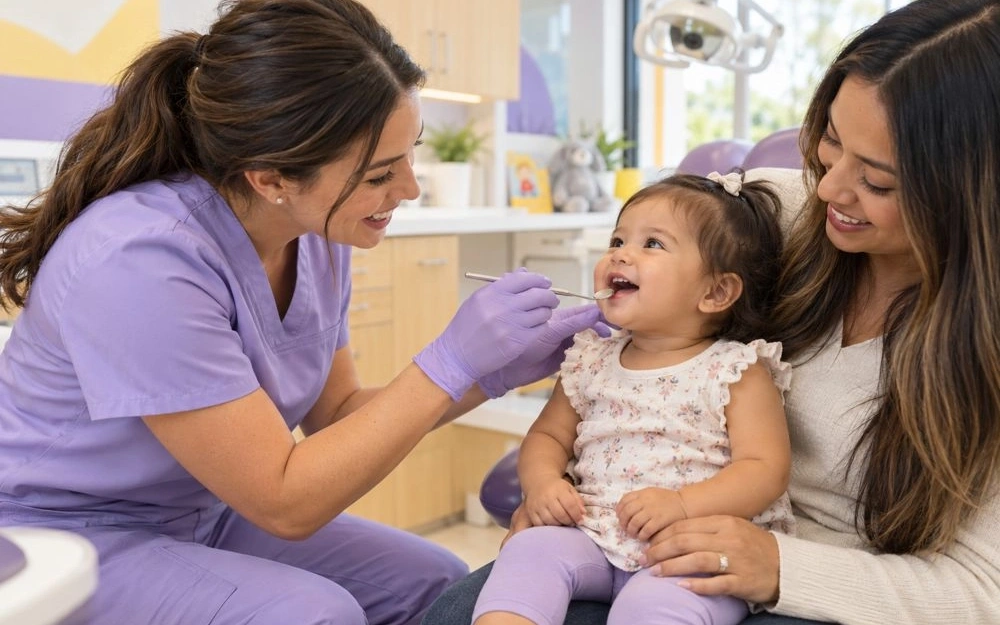
The visit looks different from what most parents picture when they think of a dental appointment. There is no dental chair reclined with a child sitting alone in it. For the youngest patients, the exam often happens with the baby cradled in the parent’s lap, or in what is sometimes called a “knee-to-knee” position: the parent and the dentist sit facing each other, and the baby rests across both sets of knees. This keeps the baby close to the parent and gives the dentist a clear view of the mouth without causing distress.
During the exam, the dentist checks for several things specific to this age group:
If the baby has teeth that are close enough together to touch, the dentist will also check those contact areas, since that is where early decay between teeth can hide. Digital x-rays are only taken when there is a specific clinical reason to do so at this age; a routine infant exam does not automatically include x-rays.
After the clinical check, the appointment focuses on the parent. The dentist goes through home care, which means how to clean the gums and early teeth, what products are appropriate at this age, and what feeding habits increase or reduce decay risk. This part of the visit is worth paying attention to, because the advice is based on what the dentist just saw in your child’s mouth, not generic handouts.
Baby teeth can develop cavities as soon as they erupt, and the earliest signs are subtle. Most parents are looking for a dark hole, the way cavities appear in adult teeth on television. In infants and toddlers, decay often shows up first as white spots or a chalky line along the gum edge of the front teeth. Those white areas are early demineralization, meaning the enamel is softening. At that stage, there are options other than drilling. If it goes unnoticed, that white line becomes brown, then the structure of the tooth starts to break down.
Nursing bottle caries is a pattern of decay that develops when a baby or toddler falls asleep regularly with a bottle of milk or juice, or nurses frequently through the night as teeth are coming in. The upper front teeth are typically the most affected. It can progress surprisingly fast in very young children because their enamel is thinner than adult enamel.
Other things worth bringing up at the visit include:
Visible spots, discoloration, or pitting on any teeth
Swelling or redness in the gums that does not seem related to normal teething
Difficulty latching during breastfeeding, which can sometimes point to a tongue-tie or lip-tie
Teeth that seem to be coming in at unusual angles
A child who seems bothered by eating or drinking on one side
None of these necessarily mean something is wrong. The exam gives you an answer either way, which is usually more reassuring than wondering. Our blog post on signs of early tooth decay in babies covers what to look for between visits.
Slots for emergency dental visits available today. Don't let your child's dental pain wait. Call or text us now!
There is not much your baby needs to do to prepare, but there are a few things that help the visit go smoothly. Try to schedule when your baby is typically alert and in a reasonable mood, which for many families means mid-morning. If the baby is hungry or overtired, even a gentle exam can feel harder than it needs to be.
What you say to a toddler before the visit matters more than parents often realize. Telling a two-year-old “this won’t hurt” or “don’t be scared” can introduce the idea of pain or fear before anything has happened. Straightforward and calm works better: “We’re going to see the dentist so they can check your teeth.” Keep it short and matter-of-fact. Children take cues from how their parents talk about it.
If this is your child’s first visit to a dental office, the new patient information on our website explains what to bring and what to expect so there are no surprises at check-in.
Cleaning your baby’s mouth should start before any teeth appear. A soft, damp cloth wiped along the gums after feedings helps establish a routine and keeps the gum tissue healthy. Once the first tooth erupts, a small, soft-bristled infant toothbrush is appropriate. The amount of fluoride toothpaste recommended for children under age 3 is a smear, roughly the size of a grain of rice, according to AAPD guidelines.
Feeding habits have a direct effect on early cavity risk. Frequent exposure to milk, formula, or juice throughout the day or night gives bacteria in the mouth more opportunity to produce acid. That does not mean every feeding is a problem, but it is something the dentist can talk through with you based on your child’s specific situation. The recommendations vary by age and by what the dentist sees in the mouth.
Oral habits like pacifier use and thumb sucking are common topics at these visits. Most habits in very young children do not need intervention right away, but there are situations where early guidance helps. If that becomes a relevant conversation, oral habit counseling is something the team at KMD can address as part of ongoing care.
After the first exam, the dentist determines the follow-up schedule based on what was found. Most children in this age group are seen every six months, consistent with AAPD recommendations. A child with higher decay risk may be seen more frequently. A child whose exam shows healthy teeth, low risk factors, and good home care practices may follow a standard schedule without additional visits.
These early exams also do something that is harder to quantify: they introduce the dental office as a familiar, calm place before any treatment is ever needed. Children who grow up coming in for routine visits tend to have an easier time with dental care as they get older. That is not a guarantee, but it is a consistent pattern.
For ongoing preventive care as your child grows beyond age 3, the practice’s preventive dentistry services continue the same approach through the teen years.
Pediatric Dentist & Practice Owner
Board Certified Pediatric Dentist
Diplomate by American Board of
Pediatric Dentistry
Pediatric Dentist & Practice Owner
Board Certified Pediatric Dentist
Diplomate by American Board of
Pediatric Dentistry
Kidz Modern Dentistry works with most major dental insurance plans, and the team verifies your benefits before the appointment so you know what to expect. For families without dental insurance, the KMD Total Care membership plans are available as an alternative. The plan details are listed further down this page. To ask questions about coverage or to schedule your child’s first pediatric oral health exam, contact our Laguna Niguel office by phone or through the online booking form.
Experience total freedom in your child’s dental care. Our membership removes the barriers found in traditional insurance — no caps, no delays, and no denials. Review the benefits and exclusions to see how effortless care can be.
Common questions parents ask, answered by our pediatric dental experts.
Longer reads from our pediatric dental team, for parents who want the detail behind the visit.
What are the real signs of teething and what is a myth? When does teething usually start and how long...
Read More: How to Help a Teething Baby Sleep at Night
What Are Gaps Between Baby Teeth? Are Gaps Between Baby Teeth Normal? Why Spaced Baby Teeth Actually Matter for Permanent...
Read More: Should I Worry If My Child Has Gaps Between Their Baby Teeth?
Which toothbrushes do dentists recommend for infants? When should you start brushing your baby’s gums and first teeth? What are...
Read More: Which Toothbrushes Do Dentists Recommend for Infants?Slots for emergency dental visits available today. Don't let your child's dental pain wait. Call or text us now!
We serve families from Southern Orange County, Laguna Niguel, Laguna Beach, Aliso Viejo, Laguna Hills, Mission Viejo, San Juan Capistrano and surrounding communities with comprehensive pediatric dental care.
Monday - Thursday: 8:30 AM - 5:00 PM
Friday: 8:30 AM - 4:00 PM
Saturday: Closed
Thank you for booking — we’ll confirm your reservation soon!