- What should parents know about cavities and how common are they?
- How does mouth rinse work to help prevent cavities in children?
- When is it safe for kids to start using mouthwash?
- Which type of kids mouth rinse is effective and what do the labels mean?
- Does fluoride mouthwash for kids actually reduce tooth decay?
- How does mouth rinse compare with brushing, flossing, sealants, and water fluoridation?
- What do pediatric dentists in Laguna Niguel and Orange County recommend?
- When might a child benefit most from mouth rinse?
- How can parents use mouth rinse safely with children at home?
- What do California and federal regulations say about fluoride and product safety?
- How can you build a cavity prevention routine that fits your child and family?
- Why choose professional guidance and what happens at a preventive visit?
- About Kidz Modern Dentistry
- References
What should parents know about cavities and how common are they?
Tooth decay is one of the most common chronic conditions in childhood. More than half of children ages six to eight have had a cavity in at least one primary tooth, and dental caries can also affect teens and young adults [3]. Decay happens when bacteria in dental plaque use sugars from foods and drinks to produce acids that weaken enamel. Over time, this can cause soft spots and holes in teeth [4]. The good news is that cavities are largely preventable with consistent home care, smart nutrition, professional guidance, and the right use of fluoride.
As a parent, it is natural to wonder whether adding a kids mouth rinse to your child’s routine might help. You might also ask when it is safe, which type to choose, and how it fits with brushing, flossing, sealants, and water fluoridation. In this guide, we will walk through what the research shows, how to decide if a rinse makes sense for your child, and the steps to use it safely.
How does mouth rinse work to help prevent cavities in children?
Fluoride is the active ingredient in most cavity prevention rinses. It supports teeth in two key ways. First, fluoride helps remineralize early weak spots in enamel by encouraging minerals to redeposit and harden the tooth surface. Second, it makes enamel more resistant to future acid attacks by forming a stronger mineral called fluorapatite [4]. A fluoride mouthwash for kids is not a replacement for brushing with fluoride toothpaste. Instead, it can be an add on tool for some children who need extra help with decay prevention [1].
The amount of fluoride in a rinse matters. Over the counter daily rinses commonly contain 0.05 percent sodium fluoride, which is 225 parts per million of fluoride ion. There are also stronger weekly rinse programs, often used in schools, that contain 0.2 percent sodium fluoride. Your pediatric dentist can help you choose a concentration and schedule that fits your child’s needs and age [1].
When is it safe for kids to start using mouthwash?
A key point is swallowing control. Many young children cannot reliably swish and spit. Professional guidelines advise that children who are younger than six years generally should not use fluoride mouth rinse unless a dentist recommends and supervises it, because of the risk of swallowing the rinse [1]. Even after age six, a parent should supervise to make sure the child spits the liquid out and does not eat or drink the product.
Readiness varies by child. If your child can swish water and spit on command without swallowing, that is a good sign they may be ready to try a rinse with your dentist’s guidance. If there is any doubt, hold off and focus on brushing with a pea sized amount of fluoride toothpaste and daily flossing. The United States Preventive Services Task Force also highlights the value of fluoride varnish applications for younger children in primary care settings, which do not rely on a child’s ability to spit [5].
Which type of kids mouth rinse is effective and what do the labels mean?
When you shop for a rinse, the label language can be confusing. Here is what to look for and what to avoid.
- Look for fluoride as the active ingredient. Daily over the counter products most often list 0.05 percent sodium fluoride. This concentration has been studied and is widely used to help prevent cavities when combined with brushing and flossing [1].
- Choose alcohol free for children. An alcohol free mouthwash for children avoids stinging and reduces accidental exposure to alcohol, which is not appropriate for kids. Many child friendly rinses are formulated without alcohol and with milder flavors.
- Check for an accepted seal from professional bodies. Products that have been reviewed by professional programs indicate they meet specific safety and efficacy criteria. Your dental team can recommend options that have been independently evaluated.
- Avoid medicated antiseptic rinses unless prescribed. Some rinses are made to address gum conditions and are available by prescription. These are not routine cavity prevention products for children and should only be used if your dentist recommends them.
- Confirm directions match your child’s age. Labels specify age ranges, dosing, and instructions such as swish time and whether to avoid eating or drinking immediately after use. Follow the label and your dentist’s guidance carefully.
The Food and Drug Administration regulates over the counter anticaries products through a federal monograph, which sets standards for active ingredients and labeling. This framework helps ensure that fluoride rinses sold in stores meet quality and safety requirements when used as directed [9].
Does fluoride mouthwash for kids actually reduce tooth decay?
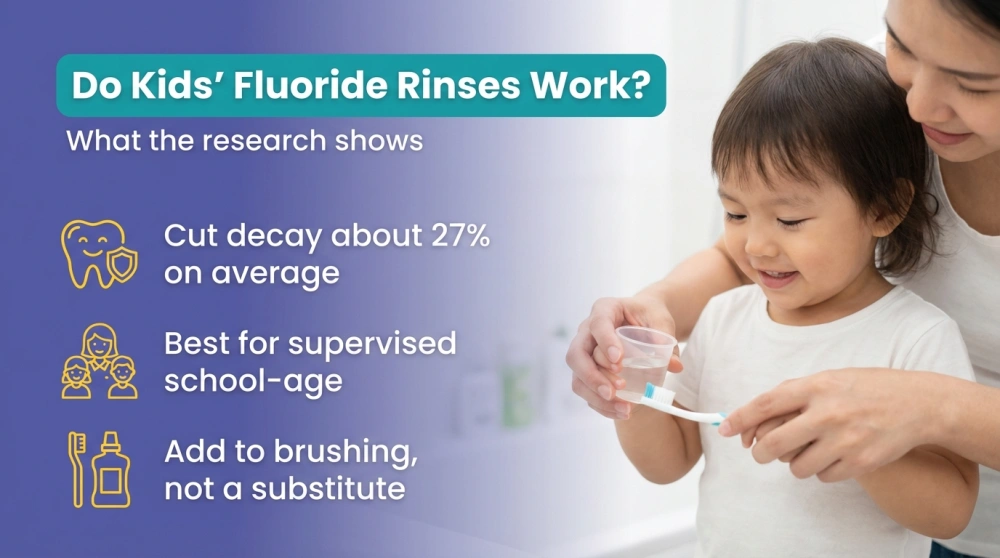
High quality research shows that fluoride rinses can reduce cavities in school aged children and adolescents when used regularly as part of a complete oral hygiene plan. A comprehensive review of randomized controlled trials found that supervised fluoride mouth rinsing programs reduced tooth decay in permanent teeth by about 27 percent on average compared with no rinse. The evidence base included many trials with thousands of participants [2].
What does this mean for your family in practical terms
- Age and supervision matter. The evidence is strongest for children old enough to swish and spit, typically school age and up. Supervised use improves consistency and safety [2].
- Rinse is an add on, not a substitute. Rinsing does not replace twice daily brushing with fluoride toothpaste, daily flossing, healthy eating, and professional care. It is one more layer of protection for children at moderate or high risk of decay [1].
- Consistency produces the benefit. Most study programs used regular schedules, either daily low strength or weekly higher strength rinses. Your dentist can help select a plan based on your child’s caries risk and routine [1].
How does mouth rinse compare with brushing, flossing, sealants, and water fluoridation?
Think of cavity prevention as a toolkit. Fluoride mouthwash is a helpful tool for many school aged children, but it is not the only one and it is not the first one to reach for. Here is how it fits with the rest.
- Brushing with fluoride toothpaste is foundational. Twice daily brushing with a fluoride toothpaste remains the most important habit for fighting cavities. Fluoride toothpaste delivers a concentrated form of fluoride directly to tooth surfaces and is supported by strong evidence for caries prevention [1].
- Flossing protects where brushes cannot reach. Cleaning between teeth removes plaque and food that a brush may miss. This reduces the chance of cavities forming between teeth. Start flossing as soon as any two teeth touch.
- Dental sealants protect the deep grooves of molars. Sealants act like a shield over chewing surfaces that are hard to clean. Research shows sealants can prevent most cavities in the pits and fissures of molars during the first years after placement and continue to offer protection beyond that period [6].
- Community water fluoridation benefits everyone. Fluoride at the recommended level in tap water helps prevent tooth decay in children and adults. Communities with water fluoridation have lower rates of cavities, and the public health recommendation for optimal levels is 0.7 milligrams per liter [7] [8].
Bottom line, a kids mouth rinse can be a valuable addition for many older children, especially those with a history of cavities or challenges with plaque control. It works best as part of a layered plan that includes brushing, flossing, smart snacking, regular cleanings, and sealants when appropriate.
What do pediatric dentists in Laguna Niguel and Orange County recommend?
Families in Laguna Niguel and surrounding Orange County often have questions about timing, product choice, and daily routines. Here are common, dentist aligned recommendations that reflect current best practices.
- Check your child’s caries risk. A pediatric dentist will consider cavity history, diet, saliva flow, medical conditions, fluoride exposure, and home care habits to decide whether a rinse adds value for your child [10].
- Start with strong basics. Aim for twice daily brushing with a fluoride toothpaste, daily flossing, and a balanced diet that limits sticky and sugary snacks. These habits are the first line of defense [4].
- Introduce rinse when your child can spit reliably. For many children, this happens around age six or later. If your child is younger or struggles to spit, talk with your dentist about fluoride varnish or other options [1] [5].
- Choose alcohol free fluoride rinse. Look for a labeled fluoride rinse that is alcohol free and age appropriate. Your dentist can recommend brands with a track record of safety and effectiveness.
- Supervise use and keep it out of reach. An adult should dispense and watch the rinse step to prevent swallowing and overuse.
Parents looking for a pediatric dentist in Laguna Niguel or nearby cities like Laguna Beach, Mission Viejo, Aliso Viejo, Laguna Hills, and San Juan Capistrano often ask for clear steps they can follow at home. If you searched kids dentist near me and landed here, you are not alone. Local families often prefer simple routines that fit a busy schedule and offer steady protection.
Pediatric preventive dentistry in Laguna Niguel is all about partnering with families to match the right tools with each child’s needs, from fluoride toothpaste and sealants to selective use of a fluoride mouthwash for kids when appropriate. Your dentist will help you time each step safely and effectively based on your child’s readiness and risk profile [1] [10].
When might a child benefit most from mouth rinse?
Not every child needs a rinse, but some situations make it a smart addition. Consider these common scenarios and discuss them with your dentist.
- History of cavities. If your child has had cavities in the past, especially in permanent teeth, a fluoride rinse may help strengthen enamel and reduce new decay alongside other preventive steps [2].
- Orthodontic treatment. Braces create more surfaces where plaque can hide. A carefully supervised rinse can help reach around brackets and wires for older children who can spit reliably.
- Limited fluoride exposure. If your household uses mainly bottled or non fluoridated water, your child may not be getting the community level of fluoride that many families benefit from. A rinse might help offset this with your dentist’s guidance [7] [8].
- Dry mouth or medical conditions. Some conditions or medicines reduce saliva, which normally helps protect teeth. Extra topical fluoride can be helpful in these cases under professional supervision.
- High sugar snacking patterns. Frequent sugary snacks and drinks feed cavity causing bacteria. While improving diet is most important, a rinse might offer added protection while you work on nutrition changes.
If any of these apply, your dental team can tailor a plan. They may also discuss timing, such as using a rinse at night after brushing or at a consistent time in the evening routine so it becomes a habit.
How can parents use mouth rinse safely with children at home?
Safety is the first priority. Here are step by step tips parents in Laguna Niguel and throughout Orange County can use.
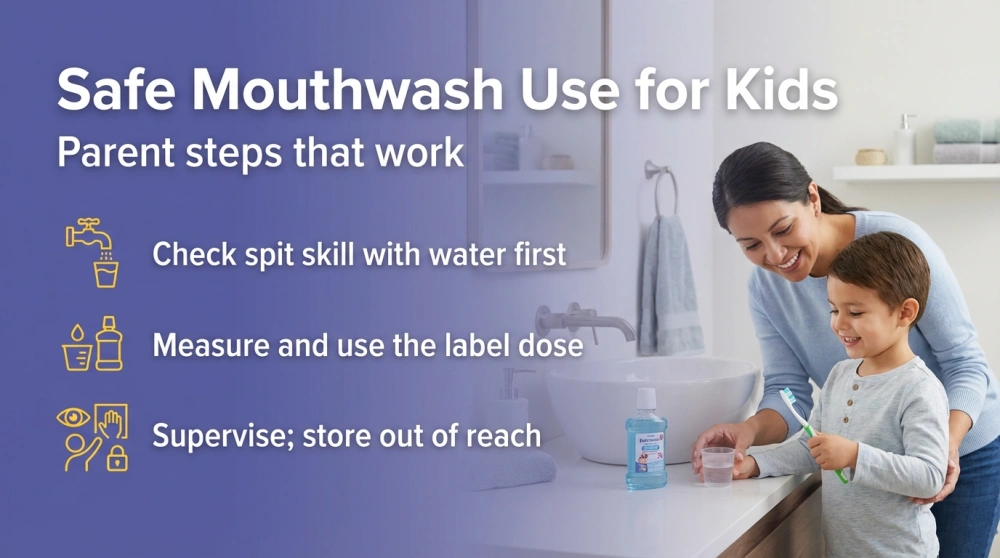
- Confirm readiness to spit. Practice with water first to be sure your child can swish and spit without swallowing.
- Use the exact dose on the label. Dispense the amount specified for your child’s age. More is not better.
- Supervise every time. Watch your child during the rinse step and remind them to spit. Keep the bottle out of reach when not in use.
- Follow label timing and instructions. Many products advise a specific swish time. Follow your dentist’s advice on whether to rinse before or after brushing and how to coordinate with nighttime routines.
- Store safely. Keep all oral care products away from younger siblings to prevent accidental swallowing.
- Stop and call if there is irritation. If your child experiences mouth soreness or upset stomach after use, stop the product and contact your dental provider.
As your child grows, revisit whether a rinse is still needed. Some children maintain excellent cavity control with brushing, flossing, and sealants alone, while others benefit from continued use of a fluoride rinse during the school years. Your dentist will review this at routine checkups and adjust the plan as needed [10].
What do California and federal regulations say about fluoride and product safety?
Several agencies guide the safe use of fluoride for children in the United States and California.
- Federal product standards. The Food and Drug Administration regulates over the counter anticaries products such as fluoride mouth rinses through a monograph that specifies permitted active ingredients, concentrations, and labeling. Products that follow the monograph can be marketed for cavity prevention when used as directed [9].
- National water recommendations. The United States Public Health Service sets the recommended level of fluoride in community drinking water at 0.7 milligrams per liter to balance benefits and risk. This recommendation reflects extensive review of research evidence [8].
- California water fluoridation programs. State agencies support and oversee community fluoridation projects, and local water systems follow state and federal regulations to deliver safe drinking water. Families can check local water quality reports to learn about fluoride levels in their area [7].
These frameworks help make sure the fluoride your family encounters in products and in tap water is consistent with evidence based guidelines for cavity prevention. If you have questions about a product’s labeling or your community’s water, your pediatric dentist can help you interpret that information for your child.
How can you build a cavity prevention routine that fits your child and family?
Every child and family schedule looks different. Here is a simple plan you can tailor to your home, whether you live in Laguna Niguel, Laguna Beach, Mission Viejo, Aliso Viejo, Laguna Hills, or San Juan Capistrano.
- Morning brush with fluoride toothpaste. Use a pea sized amount for children six and older and focus on reaching the back molars and gumline. For younger children, use a smear as directed by your dentist [1].
- Daily flossing. Help your child clean between teeth every day. Floss picks can make this step easier for small hands.
- Smart snacking. Offer water, crunchy fruits and veggies, cheese, and nuts. Save sweets for mealtime to reduce the number of acid attacks during the day [4].
- Consider a nighttime rinse for older kids. If your dentist recommends a fluoride mouthwash for kids, place it near the sink and pair it with a predictable cue like story time or lights out so it becomes routine.
- Sealants and checkups. Ask about sealants soon after first and second permanent molars come in. Keep regular cleanings and exams to catch early problems and refresh coaching on brushing and flossing techniques [6].
- Know your water. If your tap water is fluoridated at the recommended level, encourage your child to drink water throughout the day. This supports hydration and oral health at the same time [7] [8].
Small, consistent steps add up. If you ever feel stuck, reach out to your pediatric dental team. They can help you troubleshoot tricky brushing spots, suggest age appropriate tools, and decide whether a rinse makes sense this season.
Why choose professional guidance and what happens at a preventive visit?
Regular pediatric visits are not just for fixing problems. They are for preventing them. At a typical preventive visit, your dental team will review your child’s health history, assess plaque and gum health, evaluate cavity risk, and recommend age appropriate prevention steps. When a rinse is considered, they will discuss the specific product, concentration, timing, and supervision plan best suited to your child’s skills and needs [10].
Pediatric preventive dentistry supports families with education, coaching, and treatments like sealants and fluoride varnish. If your child has higher risk for cavities or orthodontic appliances, your team will help you layer tools so they work together. They can also coordinate with your physician if medical conditions or medicines influence your child’s oral health.
Pediatric preventive dentistry offers families a roadmap to protect growing smiles. If a fluoride rinse is part of that plan, your dentist will show your child how to swish safely and will check in at follow up visits to confirm it is helping and still appropriate.
About Kidz Modern Dentistry
At Kidz Modern Dentistry, we help families understand when and how to use tools like a children’s fluoride mouthwash so parents feel confident about cavity prevention at home. Our focus is education first, so you can make informed choices about what fits your child’s age, skills, and needs. We serve children and teens across Laguna Niguel and surrounding Orange County communities including Laguna Beach, Mission Viejo, Aliso Viejo, Laguna Hills, and San Juan Capistrano.
Our clinical approach is designed for comfort and clarity. Visits are paced for kids, with step by step explanations, visual coaching, and positive reinforcement. We provide comprehensive preventive care, from cleanings and risk assessments to sealants and fluoride varnish. For anxious patients, we offer kid friendly sedation options when appropriate and always with careful screening and monitoring. Same day emergencies are available because we know families sometimes need immediate support.
We use technology and systems that help parents follow through at home. That includes take home guides for brushing, flossing, and rinsing, plus reminders timed to your child’s growth and eruption patterns. We prioritize alcohol free options for rinses when a rinse is recommended and we coach families on safe supervision so children learn to swish and spit without swallowing.
Our dentists and team bring years of combined experience in pediatric care and are committed to continuing education in prevention science, behavior guidance, and communication with children. Families have shared many success stories where small routine changes produced fewer new cavities and more confident brushing. While every child is different, we are proud of a long track record helping kids move from higher risk to healthier habits through practical steps that fit real life.
We provide care across the region and welcome your questions whether you are in Laguna Niguel or nearby communities. If you would like help building a plan that may include a fluoride mouthwash for kids, sealants, or fluoride varnish, our team is ready to support you with a friendly, personalized visit. Call us at +1 949 273 0110 to schedule.
How do our services connect to the topic and help with next steps?
- Risk based planning. We use structured caries risk assessments to decide whether a rinse is likely to help and when a child is ready to try it [10].
- Age appropriate coaching. We teach swish and spit skills through simple demonstrations, so children build confidence safely.
- Layered prevention. We combine brushing and flossing guidance with sealants and fluoride varnish, then add a rinse only when it adds value [1] [6].
- Clear product guidance. We recommend alcohol free, fluoride containing rinses that match your child’s age and needs within federal monograph standards [9].
- Access and support. Same day help is available for urgent concerns, and we share practical tools parents can use right away at home.
Pediatric preventive dentistry is a shared effort between our team and your family. We focus on clear explanations, steady follow up, and small steps that help children succeed. If you have questions about rinse timing, strength, or safety, we will walk you through every detail at your child’s visit.
Pediatric preventive dentistry in Laguna Niguel reflects our commitment to partnership and prevention. Whether you are just introducing fluoride toothpaste to a younger child or deciding on a rinse for an older one with braces, we will help you map out safe next steps that fit your routine and goals.
References
- Fluoride Therapy Best Practices – American Academy of Pediatric Dentistry
- Fluoride mouthrinses for preventing dental caries in children and adolescents – Cochrane Review on PubMed
- Oral Health Fast Facts – Centers for Disease Control and Prevention
- Tooth Decay Overview – National Institute of Dental and Craniofacial Research
- Prevention of Dental Caries in Children Younger Than 5 Years – USPSTF Recommendation
- Dental Sealants – National Institute of Dental and Craniofacial Research
- Community Water Fluoridation – Centers for Disease Control and Prevention
- U.S. Public Health Service Recommendation for Fluoride Concentration in Drinking Water – Public Health Reports
- Anticaries Drug Products for Over the Counter Human Use – eCFR Title 21 Part 355
- Caries Risk Assessment Best Practices – American Academy of Pediatric Dentistry
Common Questions About This Topic
Find answers to frequently asked questions related to this article.