
- What is tongue tie and how can it affect speech?
- What signs might suggest a tongue tie in a child?
- Does tongue tie always cause child speech problems?
- How is a tongue tie evaluated by dental and speech professionals?
- How is lip tie different from tongue tie?
- When should we consider treatment and what are the options?
- What happens during a pediatric frenectomy and how is laser used?
- Can pediatric speech therapy and myofunctional therapy help?
- What does recovery and aftercare look like after treatment?
- What are the risks, limitations, and realistic expectations?
- What safety standards and regulations apply in California?
- What common questions do parents ask about tongue tie and speech?
- Who is Kidz Modern Dentistry and how can we help families in Laguna Niguel?
- References
What is tongue tie and how can it affect speech?
Tongue tie is the common term for ankyloglossia, a condition where the thin band of tissue under the tongue, called the lingual frenulum, restricts how the tongue moves. Some children with ankyloglossia have a frenulum that is short, thick, or attached close to the tip of the tongue. The result can be limited elevation, protrusion, or side to side movement of the tongue, which may influence feeding, oral habits, and in certain cases speech sound production. Prevalence estimates vary by the criteria used to diagnose it, with reports commonly ranging from about four to ten percent of newborns, and a smaller subset experiencing functional challenges that persist into childhood [1].
Speech involves precise coordination of the lips, tongue, palate, jaw, and airflow. Limited tongue mobility may contribute to difficulty producing certain sounds that require tip elevation or posterior movement, such as t, d, n, l, r, s, z, and in some cases sh and ch. That said, tongue tie alone does not determine whether a child will develop speech difficulties. The relationship is multifactorial and individual. Professional bodies emphasize that a careful functional assessment is needed before attributing speech issues to ankyloglossia [2] [3].
Parents in Laguna Niguel often ask whether a child who struggles to say l or r might have a structural issue. It is a reasonable question. The key is to look beyond appearance and measure function. A pediatric dentist and a speech language pathologist can collaborate to evaluate how the tongue moves during speech and swallowing and whether restriction is the primary factor or one of several factors [2] [4].
What signs might suggest a tongue tie in a child?
Not every tight frenulum causes problems, and not every speech delay points to ankyloglossia. Still, certain signs may suggest that a closer look could help. Consider noting:
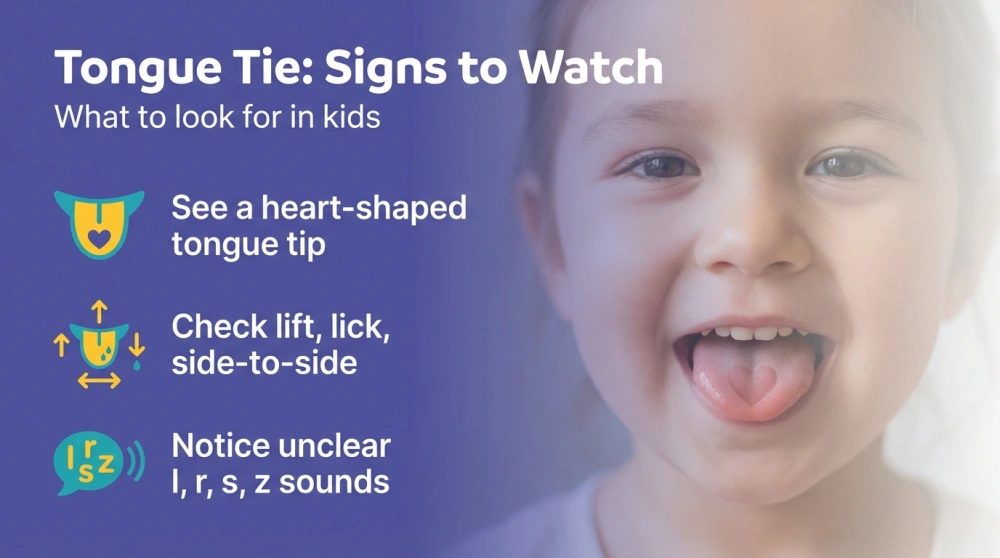
- Visible restriction Does the tip of the tongue look heart shaped when extended, or does the tongue have trouble lifting to the palate [1]?
- Limited mobility Does your child struggle to lick the upper lip, move the tongue side to side, or hold the tongue tip to the ridge behind the front teeth [1]?
- Speech clarity concerns Are certain sounds unclear or substituted in ways that suggest the tongue cannot reach the right position, even with practice and cues [2]?
- Oral function challenges Does your child show signs of trouble with chewing efficiency, swallowing patterns, or oral fatigue during meals [3]?
- Compensations Do you notice mouth breathing at rest, an open mouth posture, or lip tension that seems to compensate for limited tongue lift [4]?
These observations do not diagnose ankyloglossia. They simply indicate that a structured evaluation could be helpful. If you search for a pediatric dentist near me to check tongue mobility, look for teams that coordinate closely with licensed speech language pathologists and follow evidence based guidelines from pediatric dentistry and medical organizations [2] [5].
Does tongue tie always cause child speech problems?
No. Many children with a visible tongue restriction have typical speech. Research and professional guidance indicate that the presence of a frenulum attachment alone does not predict articulation problems. What matters is whether the tie limits movement enough to affect the child’s ability to achieve the precise contact and airflow patterns needed for target sounds. The American Academy of Pediatric Dentistry advises that treatment decisions should be based on functional impairment rather than appearance alone [2].
Evidence on speech outcomes after releasing a tongue tie is evolving. Systematic reviews note that some children with functionally significant restriction show improvements in specific speech sounds after release, often when combined with targeted speech therapy, while others may not demonstrate measurable change. The quality of evidence varies and randomized controlled trials are limited, so individualized assessment and shared decision making remain essential [5].
Because speech development follows a broad range of normal, it is also vital to compare a child’s skills with developmental milestones. For instance, certain sounds emerge later than others, and some error patterns are considered age appropriate. A speech language pathologist can evaluate whether a pattern fits normal development or suggests a disorder requiring therapy [6] [3].
How is a tongue tie evaluated by dental and speech professionals?
A thorough evaluation looks at structure and function. The goal is to understand how the tongue moves during real tasks and whether restriction is the main cause of the child’s challenges. A pediatric dentist in Laguna Niguel, California may collaborate with a speech language pathologist as part of a team approach [2] [3].
What happens during a pediatric dental examination for tongue mobility?
The dentist examines the frenulum attachment, tongue range of motion, elevation toward the palate, and the child’s ability to protrude and lateralize the tongue. The dentist also looks at the bite, palate shape, oral hygiene, and any signs of compensatory muscle use. If ankyloglossia is suspected, the clinician documents function with photos or video and may use validated range of motion measures. Decisions are based on function and symptoms, consistent with guidance from pediatric dentistry [2] [1].
How does a speech language pathologist assess speech and oral function?
The speech evaluation typically includes a case history, a speech sound inventory, stimulability testing, oral mechanism exam, and observation of swallowing and breathing patterns. The clinician determines whether errors are developmental, phonological, or motor based and whether restricted tongue movement contributes. This helps determine if therapy alone is likely to help or if therapy plus a surgical release may be appropriate [3] [4].
Which children are good candidates for a release procedure?
Children who have documented functional limitations that affect feeding, oral rest posture, or speech, and who have not made expected progress with therapy alone, may be considered. A shared decision process reviews potential benefits, risks, and aftercare. Professional organizations encourage conservative management and collaboration across disciplines to ensure that a release targets a true restriction, not simply a variation in anatomy [2] [5].
How is lip tie different from tongue tie?
Lip tie refers to a restrictive upper lip frenulum that may limit the ability of the upper lip to move freely. While lip tie can play a role in infant feeding, its impact on speech in older children is less clear from current evidence. Tongue mobility is more directly involved in shaping many speech sounds. For this reason, the evaluation focuses first on tongue function when speech is the main concern, while also noting the upper lip and other oral structures as part of a complete exam [7] [2].
When should we consider treatment and what are the options?
When a child has a functional restriction that contributes to feeding or speech challenges, and the team agrees that conservative measures alone are unlikely to meet goals, a release procedure called a frenectomy may be considered. Parents often ask whether to act early or wait. The decision is individualized and considers age, severity of restriction, goals of therapy, and the child’s ability to participate in exercises after treatment. For many children with speech concerns, a plan that combines targeted therapy with release, when indicated, is considered. AAPD policy supports individualized decisions based on function and patient specific goals [2].
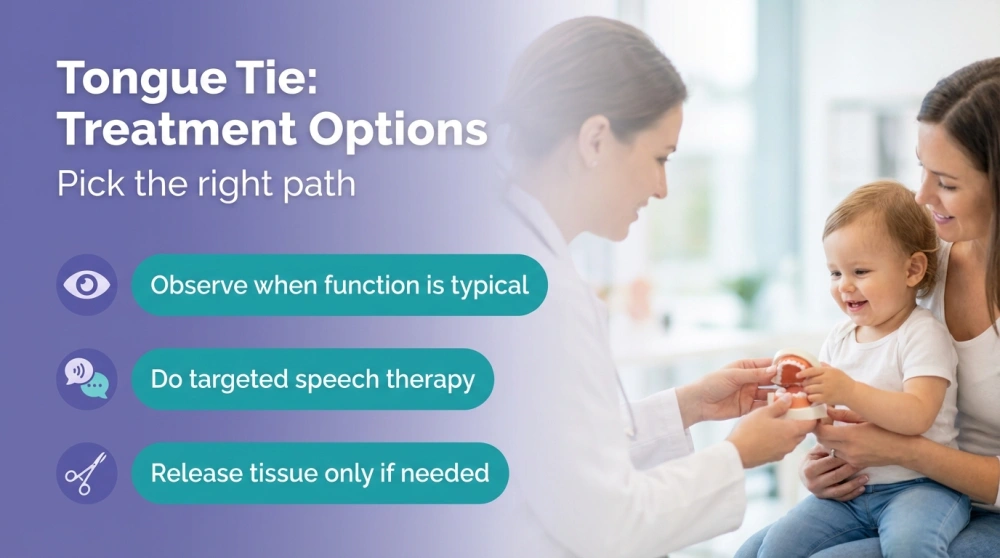
What is the difference between observation, therapy, and surgical release?
- Observation If the child shows typical function or makes steady progress with therapy, the team may monitor without surgical intervention [2].
- Therapy Speech therapy and myofunctional therapy focus on placement, oral rest posture, nasal breathing, and coordinated tongue movement. Therapy can be effective alone or as part of care before and after a release [3] [4].
- Release A frenectomy removes or modifies the restrictive tissue using sterile scissors or a dental laser to improve mobility. The choice of technique depends on age, anatomy, and clinician training. Goals are to improve function and comfort, not cosmetic appearance [2].
How do we decide between scissors and laser techniques?
Both techniques are used in pediatric dental care. Dental lasers can precisely remove soft tissue with careful control of bleeding. Scissors are also effective and remain common. What matters most is proper diagnosis, clinician experience, safety protocols, and an integrated plan with therapy. Parents should feel comfortable asking about training, technology, and how aftercare will be supported [2].
What happens during a pediatric frenectomy and how is laser used?
A pediatric frenectomy is a brief outpatient procedure. The pediatric dentist explains the steps, obtains consent, and reviews aftercare. Local anesthesia is used to keep the area comfortable. For some children, options for minimal or moderate sedation may be considered based on age, medical history, and procedural needs, following strict professional guidelines for safety and monitoring [8].
Parents often ask what the actual release feels like. During a laser procedure, the beam focuses on the targeted tissue while surrounding structures are protected. Children may feel pressure and vibration but typically little to no pain because of anesthesia. The team maintains eye protection and suction for comfort and safety. The immediate goal is improved tongue elevation and protrusion when assessed gently after the release [2].
Some families explore Laser frenectomy for kids after consultation, especially when the evaluation shows a functional restriction that has not responded fully to therapy. When appropriate, a child focused approach includes coaching on tongue placement and movement right after the procedure and in the days that follow so gains in mobility translate into improved function [2] [3].
What should parents expect on the day of the procedure?
- Pre visit review The team discusses medical history, medications, allergies, and comfort options and answers questions about recovery and exercises [8].
- Comfort plan Local anesthesia is standard, and for select cases sedation is considered and monitored according to pediatric guidelines [8].
- Brief procedure The release typically takes minutes, and the team reassesses mobility and provides written aftercare instructions [2].
Can pediatric speech therapy and myofunctional therapy help?
Yes. Therapy is central to success because mobility alone does not guarantee correct sound production or efficient swallowing. Speech language pathologists use evidence based methods to teach tongue placement, airflow, and timing for specific sounds and to reduce error patterns. Myofunctional therapy complements this by addressing oral rest posture, nasal breathing, and coordinated muscle patterns of the face, tongue, and jaw [3] [4].
Therapy can be especially valuable before and after a release. Before, it helps your child learn the target positions and movements. After, it helps integrate new mobility into everyday speech and swallowing. Collaboration among your pediatric dentist, speech therapist, and family supports consistent practice and clear goals [3].
How do we set goals and track progress with therapy?
- Functional goals Agree on practical outcomes like clearer production of specific sounds or more efficient chewing and swallowing [3].
- Home practice Short, frequent practice sessions with simple cues help build new motor patterns.
- Milestone checks Compare progress against age based speech milestones to keep expectations realistic and celebrate gains [6].
What does recovery and aftercare look like after treatment?
Aftercare focuses on comfort, healing, and retraining movement. Post procedure soreness is expected for a few days. Your team will discuss age appropriate comfort strategies. Gentle mobility exercises are often introduced to support range of motion and reduce the risk of tissue reattaching in a restrictive pattern. Your speech therapist may add targeted sound practice to take advantage of improved mobility [2] [3].
What should we watch for during healing?
- Normal changes Mild swelling, a white or yellow fibrin layer at the site, and temporary soreness are typical during the first week.
- Red flags Call your care team for heavy bleeding, fever, increasing pain after day two, or any concern about healing or function.
- Follow up Plan check ins with both dental and speech providers to adjust exercises and ensure function is improving as expected [2].
What are the risks, limitations, and realistic expectations?
Every procedure has risks and limitations. With frenectomy, potential risks include bleeding, infection, discomfort, scar tissue formation, or persistent restriction if tissue heals too tightly. There is also a possibility that speech sounds may still require therapy even after mobility improves. Professional organizations emphasize that appearance alone is not a reason to treat and that expected benefits should be tied to functional goals discussed during evaluation [2] [5].
Setting realistic expectations helps families feel confident. Many children do well with a comprehensive plan that includes therapy and, when indicated, release. Others may achieve their goals with therapy alone. Progress is usually measured over weeks and months, not days, as new motor patterns are learned and practiced with support from your team [3].
What safety standards and regulations apply in California?
Parents deserve clear information about safety. In California, dentists must follow state regulations and professional guidelines when providing care to children, including training and permitting requirements for sedation and adherence to infection control and equipment safety standards. The Dental Board of California publishes laws and regulations that govern dental practice in the state, including requirements for anesthesia and sedation permits, documentation, and monitoring protocols [9].
In addition to state rules, pediatric providers follow national guidance for monitoring and managing children during and after sedation. The joint guidance from pediatric medical and dental organizations outlines team roles, pre sedation evaluation, fasting recommendations, equipment and staffing standards, continuous monitoring, and discharge criteria designed to support safety for every child who receives sedative medications [8].
For soft tissue procedures using lasers, dentists are expected to receive specific training for the devices they use and to follow manufacturer instructions and standard safety measures such as protective eyewear and controlled settings. These expectations align with state regulatory oversight and professional standards that prioritize patient safety and quality of care [9] [2].
What common questions do parents ask about tongue tie and speech?
Could a mild tongue tie still impact speech clarity?
It can, but not always. A child with a mild tie might compensate well and develop typical speech. Another child with a similar appearance could have measurable difficulty with elevation or precision that affects sounds like l and r. That is why function driven evaluation is essential before deciding on treatment [2] [3].
Is a release procedure ever recommended for speech without therapy?
Occasionally, but therapy is frequently part of the plan. Many children benefit most when therapy prepares them for new movement patterns and then helps integrate those patterns after the procedure. Therapy also helps determine whether structural restriction is the true barrier to progress [3].
How soon might we hear changes in speech after a release?
Some families notice immediate improvements in certain movements, such as tongue elevation. Clearer speech often takes longer because the brain and muscles learn new patterns with practice. Your speech therapist will guide targeted home exercises to help translate mobility into clarity over time [3].
Are there age windows when a release is more effective?
There is no single age that guarantees better outcomes. Readiness depends on the child’s developmental stage, cooperation for exercises, severity of restriction, and specific goals. Younger children may need more support for home exercises. Older children may benefit from structured practice to replace long standing compensations [2].
Can a tie cause a speech delay in a toddler?
It can contribute to articulation or oral motor challenges in some toddlers, but many factors influence early speech. A timely evaluation that includes developmental milestones helps determine whether a child’s pattern is within the wide range of normal or whether early therapy is indicated [6] [3].
How does myofunctional therapy relate to speech therapy for tongue tie?
Myofunctional therapy focuses on oral rest posture, nasal breathing, and coordinated muscle function. These foundations support speech therapy, which targets sound specific placement and timing. Together, they can help a child build efficient, sustainable patterns for clear speech and comfortable swallowing [4].
What if my child’s tongue looks tight but speech seems clear?
If your child functions well and meets speech milestones, observation with periodic rechecks may be appropriate. The AAPD emphasizes that appearance alone does not justify treatment when function is normal [2].
Could a lip tie affect speech in school age children?
Current evidence does not show a consistent link between an upper lip tie and speech sound disorders in older children. Tongue mobility is more directly related to many speech sounds. A comprehensive evaluation still considers the lip frenulum as part of the overall picture [7].
What role does the pediatric dentist play alongside the speech therapist?
The pediatric dentist evaluates oral structures, guides procedural decisions, and monitors healing and oral health. The speech therapist evaluates communication, plans exercises, and tracks functional gains. Together, they coordinate care to align structural changes with meaningful functional goals for your child [2] [3].
Where can I find professional guidance to inform our decision?
Authoritative guidance is available from pediatric dental, pediatric medical, and speech language organizations. Reviewing these resources with your care team helps you make informed choices that fit your child’s needs and your family’s goals [1] [2] [3] [8].
Who is Kidz Modern Dentistry and how can we help families in Laguna Niguel?
At Kidz Modern Dentistry, we support families in Laguna Niguel, California with thoughtful, child centered care for concerns related to tongue mobility, oral function, and speech readiness. Our team approach connects pediatric dentistry with local speech language pathologists so families receive coordinated evaluation, treatment planning, and follow up tailored to each child.
Parents who are exploring options after an evaluation may hear about Laser frenectomy for kids as one of several tools. In our practice, we focus first on a complete functional assessment and clear goals. When a release is indicated, we discuss technique, comfort options, and aftercare, and we coordinate closely with your child’s therapist to help new mobility become useful, everyday movement.
Families seeking care with a pediatric dentist Laguna Niguel can expect a supportive, step by step experience. We welcome second opinions and value open conversations about benefits, risks, and alternatives. Our practice offers same day attention for urgent concerns, kid friendly sedation options when appropriate, and a calm environment designed to help children feel safe and understood.
- How we guide next steps We start with a functional evaluation for tongue mobility and oral habits, review findings with you in plain language, and collaborate with your speech therapist to outline a plan you can follow at home and in session.
- Where we operate We serve families across Laguna Niguel and nearby South Orange County communities, providing accessible pediatric dental care close to home.
- Our approach We emphasize conservative, function focused care. When procedures are indicated, we use contemporary technology and follow established pediatric safety guidelines at every visit [8] [9].
- Tools and processes Our clinical workflows include structured assessments, age appropriate comfort plans, and coordinated aftercare with therapy teams so improvements are supported from day one.
- Leadership and experience Our pediatric dental team maintains ongoing education in oral function, child development, behavior guidance, and soft tissue procedures, aligning with best practice recommendations from professional organizations [2] [8].
- Personalized service You will have direct access to qualified pediatric dental professionals who communicate with your child’s speech therapist so the plan is clear and consistent for everyone involved.
- Care stories We regularly see children make steady gains when therapy and procedure timing are aligned. While every child is different, families often share that coordinated care made home practice easier and progress more noticeable over time.
- Service areas and experience Our team brings many years of combined pediatric experience serving Laguna Niguel and neighboring cities, offering preventive visits, oral health coaching, and care plans that fit busy family schedules.
- Your benefits Families appreciate our communication, same day attention for urgent needs, and a thoughtful path from evaluation to aftercare that respects each child’s unique strengths.
When you are ready to talk about tongue mobility, therapy, or procedural options, we are here to help you take the next right step. To reach our team directly, call +1 949 273 0110. For families seeking a local option, Laser frenectomy for kids in Laguna Niguel is available when indicated after a complete evaluation and shared planning with your therapy team.
References
- Ankyloglossia – StatPearls – NCBI Bookshelf
- Policy on Management of the Frenulum in Pediatric Patients – American Academy of Pediatric Dentistry
- Speech Sound Disorders Articulation and Phonology – ASHA
- Orofacial Myofunctional Disorders – ASHA
- Treatment of ankyloglossia for reasons other than breastfeeding A systematic review – PubMed
- Speech and Language Developmental Milestones – NIDCD
- Position Statement Ankyloglossia and Upper Lip Tie – American Academy of Otolaryngology Head and Neck Surgery
- Guideline for Monitoring and Management of Pediatric Patients During and After Sedation – American Academy of Pediatrics and American Academy of Pediatric Dentistry
- Laws and Regulations – Dental Board of California
- Oral Health Policies and Recommendations – American Academy of Pediatric Dentistry
Common Questions About This Topic
Find answers to frequently asked questions related to this article.
