
- What will you learn about enlarged tonsils, mouth breathing, and your child’s growth?
- How do enlarged tonsils and adenoids affect breathing during sleep?
- How can mouth breathing influence facial growth and dental development?
- How does poor sleep impact behavior, attention, and growth?
- When should you seek evaluation and which specialists can help?
- Which pediatric dental treatments can support better breathing and growth?
- How can you support healthy nasal breathing at home?
- Why choose Kidz Modern Dentistry in South Orange County for airway focused pediatric care?
- Which references and resources support this article?
What will you learn about enlarged tonsils, mouth breathing, and your child’s growth?
Parents in Laguna Niguel, Laguna Hills, Aliso Viejo, Mission Viejo, San Juan Capistrano, and Laguna Beach often ask why their child snores, keeps an open mouth during the day, or seems tired despite a full night of sleep. In this guide, we explore how enlarged tonsils and adenoids, mouth breathing in children, and pediatric sleep disordered breathing can influence child growth and facial development. We will also cover practical next steps, from evaluation to treatments like myofunctional therapy for children and rapid palatal expansion, along with when to see a pediatric dentist or an ear nose and throat specialist.
We will keep the focus on education so you can recognize signs early and feel confident about where to start. Along the way, you will see research summaries and quick references to the studies that inform current care recommendations, including guidance from the American Academy of Pediatrics and the American Academy of Pediatric Dentistry [1] [3]. Throughout, we use clear language and real world examples to help you understand how breathing and sleep can affect jaw growth, bite development, behavior, and daily wellbeing.
If you take only one idea from this article, let it be this. Breathing, sleep, and facial growth are connected, and small changes made early can support healthier development over time. We will unpack how that connection works, why enlarged tonsils and adenoids matter, and what you can do next if you are noticing snoring in kids, restless sleep, or difficulties with attention and behavior.
How do enlarged tonsils and adenoids affect breathing during sleep?
What are tonsils and adenoids and why can they block the airway at night?
Tonsils and adenoids are lymphoid tissues in the back of the throat and nasal passage. In some children they grow relatively large compared to the size of the airway. When a child lies down and falls asleep, muscle tone decreases and the airway can narrow further. Enlarged tissues may vibrate and cause snoring, or partially block airflow, contributing to pediatric obstructive sleep apnea known as OSA. Pediatric OSA is estimated to affect roughly 1 to 5 percent of children and is most commonly linked to enlargement of tonsils and adenoids [1] [14].
What is pediatric sleep disordered breathing and how is it diagnosed?
Pediatric sleep disordered breathing describes a range of conditions from primary snoring to OSA. The gold standard test for diagnosing OSA is overnight polysomnography in a sleep laboratory, which records breathing, oxygen levels, and sleep stages [1]. While questionnaires and home devices may screen for risk, formal testing and medical diagnosis rely on sleep study data. Your pediatrician and sleep specialist interpret results in light of symptoms, growth, and daytime function.
What symptoms should parents watch for at night and during the day?
Common night symptoms include loud snoring three or more nights per week, mouth breathing, pauses in breathing, gasping, restless sleep, and bedwetting beyond the typical age range. Daytime signs can include morning headaches, dry mouth, daytime sleepiness and behavior issues such as irritability, hyperactivity, or difficulties with school performance. In some children, bruxism known as teeth grinding in children may occur along with disrupted sleep [1] [8]. If your child snores regularly or shows multiple symptoms, talk with your pediatrician or pediatric dentist about next steps [12].
How are enlarged tonsils and adenoids typically treated when they cause OSA?
When a child has OSA related to enlarged tonsils and adenoids, adenotonsillectomy the surgical removal of both tissues is often considered the first line treatment, as outlined in national guidelines from pediatrics and otolaryngology organizations [1] [2]. Surgery is not the only approach. The care plan may also include watchful waiting, weight management when appropriate, medical therapy for allergic rhinitis and nasal obstruction, and orthodontic or myofunctional therapies depending on age and growth stage [2] [3]. Your team will consider your child’s unique anatomy, sleep study findings, and overall health.
How is this more than just tonsils, and why do breathing, sleep, and jaw development matter together?
Enlarged tonsils and adenoids can be a major contributor to sleep-related breathing issues. However, it is essential to look at the bigger picture. Mouth breathing can cause changes in tongue posture and facial muscle balance, which can affect jaw and dental arch development. These changes may influence airway shape and function over time. This is why pediatric dentists often work closely with pediatricians, sleep physicians, and ENT surgeons to address the entire problem, rather than just focusing on a single structure [3] .
How can mouth breathing influence facial growth and dental development?
What does research show about orofacial development in children who breathe through the mouth?
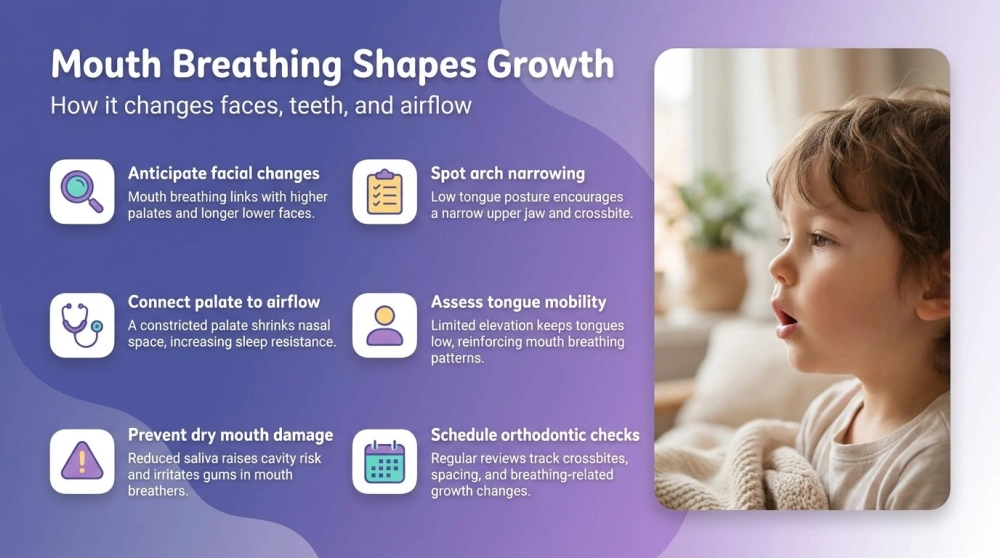
Orofacial development depends on nasal breathing and proper tongue posture against the palate. When a child habitually breathes through the mouth, the tongue tends to sit low and forward, and the lips are often slightly parted. Over months and years, this pattern is associated with a higher palate, a narrow upper arch, an increased lower facial height, and a tendency toward open bite or crossbite. Peer reviewed studies have documented these associations, highlighting differences in dentofacial and soft tissue development in mouth breathers compared with nasal breathers [7].
How can a narrow palate relate to the airway and sleep quality?
The palate forms the roof of the mouth and the floor of the nose. A high narrow palate can reduce the width of the nasal cavity and increase airflow resistance. During sleep, any added resistance can worsen snoring or contribute to OSA in susceptible children. Orthodontic evaluation focuses on the shape of the upper arch, crossbites, and spacing, which may provide clues about breathing habits over time [5].
Where do tongue tie and oral habits fit into the picture?
A restrictive lingual frenulum known as tongue tie can limit tongue elevation and palatal contact, which can contribute to low tongue posture and persistent mouth breathing for some children. The American Academy of Pediatric Dentistry provides guidance on assessing the frenulum in the context of function, speech, feeding, and oral development. Decisions about treatment including frenectomy depend on a thorough evaluation of symptoms, function, and growth stage [13]. Oral habit patterns such as thumb or finger sucking and tongue thrust can compound the effects on bite and arch width if they persist past early childhood.
What are the effects of mouth breathing on teeth alignment and dental health?
Mouth breathing changes saliva flow and lip seal, which can lead to dry mouth. Dry mouth can increase the risk for cavities and gum irritation because saliva helps neutralize acids and wash away food debris. In addition, altered muscle balance around the lips and cheeks can influence tooth position over time. Your pediatric dentist will look at the big picture, including arch form, bite, wear patterns, and soft tissue posture to guide care [3].
Families benefit from coordinated support that can include Orthodontic monitoring to keep track of jaw growth and bite changes as your child matures. This ongoing check in approach helps the team at the right time with conservative steps or interceptive care when indicated.
How does poor sleep impact behavior, attention, and growth?
What do studies show about learning, mood, and daytime functioning?
Sleep is fuel for learning and behavior. Disrupted sleep in children has been linked with attention difficulties, hyperactivity, behavioral challenges, and reduced academic performance. Research shows associations between sleep disordered breathing and neurobehavioral concerns, and randomized clinical trials have demonstrated improvements in behavior and quality of life after addressing OSA in appropriate candidates [8] [10]. If your child seems tired, struggles with focus, or shows mood swings, consider whether sleep quality might be part of the picture.
Can sleep problems affect physical growth?
Growth hormone release peaks during deep sleep, so fragmented sleep can potentially interact with growth patterns. In many children with OSA, treatment can improve sleep continuity and help restore healthy day night rhythms that support growth, activity, and appetite regulation [1]. Pediatricians use growth charts along with sleep and nutrition histories to build a complete picture.
How much sleep do school age children and teens need?
Evidence based consensus recommendations suggest that most school age children benefit from nine to twelve hours per night, and most teens benefit from eight to ten hours per night. Individual needs vary, but consistent bedtimes, regular wake times, and a wind down routine are cornerstones of better sleep for all ages [11].
When should you seek evaluation and which specialists can help?
What signs suggest it is time to schedule an evaluation?
Consider reaching out if your child snores at least three nights per week, breathes through the mouth most of the day, has witnessed pauses in breathing, struggles with morning headaches or daytime sleepiness, or shows academic or behavior changes that you suspect could relate to sleep. Persistent nasal congestion and allergic rhinitis with nasal obstruction can also contribute to mouth breathing and sleep disturbance [12] [9].
What is the role of a South Orange County pediatric dentist and airway focused evaluation?
A pediatric dentist trained in airway focused pediatric dentistry screens for signs of pediatric sleep disordered breathing during routine exams. The evaluation often includes a careful look at tonsils and adenoids through visible signs, palate width, bite relationships, tongue posture, and daytime mouth breathing. The dentist coordinates with your pediatrician for medical evaluation and with ENT specialists when enlarged tissues or nasal obstruction are suspected [3]. If orthodontic risk factors are present, your dentist may discuss timing and options and may recommend Orthodontic monitoring through growth to track changes in a low stress, kid friendly way.
When is an ENT referral appropriate and what can you expect?
Referral to an ENT specialist is often recommended when there is habitual snoring, suspected OSA, enlarged tonsils or adenoids on exam, or persistent nasal obstruction that does not respond to initial medical management. The ENT will evaluate the airway, discuss medical therapies for inflammation or allergy, and consider adenotonsillectomy when indicated according to established clinical practice guidelines [2]. For many children, a team approach that includes medical care, dental growth guidance, and habit coaching provides the best support.
How do allergies and nasal health factor into mouth breathing?
Allergic rhinitis is common in childhood and can cause nasal swelling, congestion, and poor airflow through the nose. This can push a child toward mouth breathing, particularly at night. Managing allergies with your pediatrician or allergist can reduce nasal obstruction and complement dental treatments that support healthy growth and function [9].
What local considerations matter for families in Laguna Niguel, Laguna Hills, Aliso Viejo, Mission Viejo, San Juan Capistrano, and Laguna Beach?
In South Orange County, families have access to collaborative care that connects pediatric dentistry, ENT services, pediatrics, orthodontics, and sleep medicine. Coordinated communication helps ensure that each child receives the right test at the right time, including sleep study referrals when appropriate, and that growth focused dental care aligns with medical findings. When you work with a local team, you gain continuity of care and easier follow up across visits.
Which pediatric dental treatments can support better breathing and growth?
How can myofunctional therapy for children help with breathing and jaw development?
Myofunctional therapy is a set of exercises and habit strategies designed to normalize tongue posture, lip seal, nasal breathing, and swallow patterns. In children with symptoms of sleep disordered breathing, myofunctional therapy may reduce snoring and support healthy arch development when combined with other treatments. A systematic review has reported reductions in OSA severity with myofunctional therapy, and clinicians often use it as an adjunct to surgical or orthodontic care when appropriate [6]. Therapy is personalized and can be fun and engaging for kids with games, cues, and simple daily routines.
What is rapid palatal expansion and when is it considered?
Rapid palatal expansion known as RPE is an orthodontic treatment that gently widens the upper jaw to correct transverse deficiency and crossbites. Because the upper jaw is not yet fused in younger children, expansion can increase nasal cavity volume and may improve airflow in selected cases. Systematic reviews and clinical studies suggest that RPE can reduce OSA indices for children who have both maxillary constriction and sleep disordered breathing, particularly when aligned with medical management for tonsils and adenoids [5]. Decisions about timing are individualized, weighing growth stage, dental development, and airway findings.
How do orthodontic check ins guide timing for intervention?
Growth does not happen all at once, so timing matters. Scheduled check ins let your pediatric dental team assess arch development, bite changes, and breathing patterns as your child matures. With that approach, Laguna Niguel Orthodontic monitoring can be integrated with airway assessments to decide when simple guidance is enough and when focused interceptive steps may help. This helps avoid over treatment while still making the most of natural growth windows.
What about tongue tie evaluation and treatment?
If tongue mobility appears limited and contributes to low tongue posture, difficulty elevating to the palate, or challenges with speech and feeding, your dentist may suggest a functional assessment and possible referral for therapy or a frenectomy. The AAPD policy emphasizes that decisions should be based on function and a thorough team evaluation rather than appearance alone [13]. Any procedure plan, if needed, should include pre and post therapy support to reinforce healthy patterns.
Can dental care alone solve sleep problems?
Dental care is one part of a team approach. Because pediatric OSA is a medical condition, a medical diagnosis and plan are essential. Dental treatments can support airway size and function, reduce negative oral habits, and improve nasal breathing, but they work best alongside pediatric and ENT care guided by established clinical guidelines and, when indicated, sleep study data [1] [2] [3].
How can you support healthy nasal breathing at home?
Which daily routines can help your child breathe and sleep better?
Simple routines can make a meaningful difference when combined with professional guidance. Encourage lips together and tongue up to the roof of the mouth during quiet activities, and remind your child to breathe through the nose during reading, screen time, and homework. Create a consistent bedtime routine with relaxing steps like a bath, dim lights, and quiet reading. Keep the bedroom cool, dark, and quiet, and maintain regular bed and wake times even on weekends. These habits support better sleep quality and daytime energy [11].
Which red flags should prompt a call to your pediatrician or pediatric dentist?
Please reach out if you notice regular snoring, pauses in breathing, gasping, persistent mouth breathing, bedwetting after it had resolved, teeth grinding sounds at night, daytime sleepiness, or behavior changes that do not improve with routines. If your child has a narrow palate and open bite, struggles to keep lips together, or has a suspected tongue tie, an evaluation can clarify next steps and the right referrals [12] [3].
How do allergies and environment play a role at home?
Reducing allergens can ease nasal obstruction. Consider dust control, regular washing of bedding in hot water, and using high efficiency particulate air filters when appropriate. Work with your pediatrician or allergist if you suspect allergic rhinitis because targeted medical care can reduce congestion and support nasal breathing as part of a comprehensive plan [9].
Why choose Kidz Modern Dentistry in South Orange County for airway focused pediatric care?
At Kidz Modern Dentistry, we understand the importance of a healthy airway for children’s growth and development. That’s why we help families connect the dots between breathing, sleep, and oral health in order to ensure their kids can thrive. Located in Laguna Niguel, Laguna Hills, Aliso Viejo, Mission Viejo, San Juan Capistrano, and Laguna Beach, our dedicated team offers comprehensive pediatric dental care that includes airway focused screening during every visit. To provide the best possible care, we collaborate closely with local pediatricians, ENT specialists, orthodontists, and sleep centers to make referrals and coordinate care smoothly for families.
We offer child centered visits, same day attention for urgent concerns, and kid friendly sedation when treatment is needed. Our goal is to help parents understand options clearly, choose the least invasive path that fits their child’s stage of development, and time any interceptive steps to align with growth. If you have questions or would like to talk with our team, call us at +1 949 273 0110.
How does our approach guide families from first questions to confident next steps?
- Whole child evaluation We look at breathing, sleep history, bite development, tongue posture, and daily habits so your plan reflects your child’s real world needs.
- Team based coordination We maintain strong relationships with local pediatric and ENT partners, streamlining referrals for sleep testing or medical care when indicated.
- Growth minded planning We use development timelines to time interceptive steps thoughtfully, checking in regularly and adjusting as your child grows.
- Comfort and communication We use simple language, child friendly explanations, and a calm environment so kids and parents know what to expect.
- Evidence informed care We align our recommendations with professional guidelines and current research so you can feel confident in the plan [1] [2] [3].
What services do we offer that support better breathing and growth?
- Airway focused screening We assess tonsil visibility, palate form, bite relationships, and nasal breathing patterns at routine visits, and we share clear findings with you.
- Habit and function guidance We coach simple daily habits that encourage nasal breathing, tongue up posture, and lip seal, and we coordinate myofunctional therapy when helpful [6].
- Interceptive orthodontic options When indicated, we discuss timing for expansion or other steps to improve arch form and function, guided by current evidence and growth stage [5] [15].
- Tongue tie assessment We evaluate function and collaborate on therapy or referral for frenectomy when appropriate, following AAPD policy [13].
- Coordinated referrals We connect families with pediatricians, sleep specialists, and ENT surgeons to ensure medical evaluation and treatment for OSA when needed [1] [2].
Where do we operate and how do we personalize care for South Orange County families?
We serve children across South Orange County, including Laguna Niguel, Laguna Hills, Aliso Viejo, Mission Viejo, San Juan Capistrano, and Laguna Beach. Our scheduling and communication are designed around school and activity calendars, and our team provides written plans and visual aids that make home routines easy to follow. We value collaboration with families and coaches, and we tailor education to each child’s age and learning style.
What experience and outcomes can families expect with our team?
- Dedicated pediatric focus Our providers work exclusively with children and teens, which helps us adapt visits and guidance to each developmental stage.
- Consistency across visits We track sleep and breathing concerns across time and celebrate small wins that build healthier habits.
- Transparent planning We explain options and timing, estimate lengths of each phase, and discuss what evidence supports each step.
- Local partnerships We coordinate care with nearby medical groups so follow up and testing can happen close to home, often within familiar health systems.
Parents often tell us that having one home base for dental and growth guidance reduces stress and keeps everyone on the same page. If you are ready to get started or just want a second perspective, we are here to help at +1 949 273 0110.
Which references and resources support this article?
- Diagnosis and Management of Childhood Obstructive Sleep Apnea Syndrome – American Academy of Pediatrics
- Clinical Practice Guideline Tonsillectomy in Children Update – American Academy of Otolaryngology Head and Neck Surgery Foundation
- Policy on Sleep Related Breathing Disorders in Children – American Academy of Pediatric Dentistry
- Sleep and Children Information – Centers for Disease Control and Prevention
- Rapid Maxillary Expansion for Pediatric Obstructive Sleep Apnea A Systematic Review and Meta Analysis – PubMed
- Myofunctional Therapy to Treat Obstructive Sleep Apnea A Systematic Review and Meta Analysis – PubMed
- The Effect of Mouth Breathing Versus Nasal Breathing on Dentofacial and Soft Tissue Development in Children – PubMed
- Neurobehavioral Morbidity Associated with Disordered Breathing During Sleep in Children – PubMed
- Allergic Rhinitis Overview – American Academy of Allergy Asthma and Immunology
- A Randomized Trial of Adenotonsillectomy for Childhood Sleep Apnea – New England Journal of Medicine
- Consensus Statement on Children Sleep Duration – American Academy of Sleep Medicine
- Snoring in Children What Parents Should Know – American Academy of Pediatrics HealthyChildren
- Policy on Management of the Frenulum in Pediatric Dentistry – American Academy of Pediatric Dentistry
- Sleep Apnea Health Topic – National Heart Lung and Blood Institute
- Management of the Developing Dentition and Occlusion in Pediatric Dentistry – American Academy of Pediatric Dentistry
Common Questions About This Topic
Find answers to frequently asked questions related to this article.
