
Why Dental Care Is Uniquely Challenging for Children with Autism
If you have a child on the autism spectrum, you already know that everyday experiences most people take for granted can feel overwhelming. A routine dental visit involves bright overhead lights, unfamiliar sounds from instruments, the taste and texture of gloves and prophy paste, and a near-stranger placing their hands inside your child’s mouth. For a child with autism spectrum disorder (ASD), any one of those elements can trigger significant distress. That distress is real, it is neurological in origin, and it deserves a thoughtful, structured response from every member of the dental team.
According to the Centers for Disease Control and Prevention, about 1 in 31 (approximately 3.2%) of children aged 8 years in the United States has been identified with ASD, and ASD occurs across all racial, ethnic, and socioeconomic groups. [1] These numbers translate into a large and growing community of families actively searching for a pediatric dental office for children with autism that goes beyond standard care models.
The American Academy of Pediatric Dentistry (AAPD) notes that individuals with special health care needs, a group that includes children with ASD, face elevated risks for poor oral health due to medical status, sensory challenges, behavioral difficulties, and substantial access barriers. [2] Understanding what makes a dental practice truly prepared to serve these children is the first step toward finding one that fits your family.
Key Features of an Autism-Friendly Pediatric Dental Office
Not every practice that claims to be autism-friendly has invested equally in the systems, training, and physical environment that children on the spectrum actually need. When you are evaluating options near Laguna Niguel, California, there are specific hallmarks worth looking for.
Does the practice offer pre-visit consultations or “get-to-know-you” appointments?
One of the most practical signs that a pediatric dental team understands autism is whether they invite families for a first appointment that is purely about exploration, no instruments, no pressure. Research published in journals including Special Care in Dentistry highlights that breaking dental treatment into sequential components and allowing children to become familiar with the environment before any procedures begin is a cornerstone of successful behavior guidance for patients with ASD. [3] This kind of introductory visit lets your child meet the dentist, sit in the chair, hear the sounds of the office, and build a baseline of trust before anything clinical happens.
Is comprehensive dental care for children with special needs explicitly part of their scope?
Comprehensive dental care for children with special needs requires more than general goodwill. It demands structured protocols, modified communication strategies, flexible scheduling, and staff who have received training specifically in behavior support. Practices that integrate these protocols as a formal part of their service model are meaningfully different from those that accommodate children with ASD on an ad hoc basis.
What communication tools and visual supports do they use?
Research consistently identifies communication barriers as a central obstacle to dental care for children with autism. [4] Effective practices use visual schedules, social story booklets, picture-based instructions, and plain verbal language adapted to the child’s developmental level. Some offices coordinate in advance with parents to learn a child’s specific communication style, favorite characters, or calming phrases. This preparation is a measurable commitment, not just a courtesy.
Are appointment times flexible and low-stimulation options available?
Early morning appointments often mean a quieter waiting room, lower foot traffic, and a clinical team that is not yet fatigued. Practices that offer these scheduling options, and that keep waiting room time minimal for children with ASD, signal genuine operational awareness of how sensory and anxiety thresholds work.
What Does a Sensory-Friendly Environment Actually Look Like?
The concept of a sensory-adapted dental environment has been studied specifically for its impact on children with ASD. A landmark randomized controlled pilot study published in the Journal of Autism and Developmental Disorders found that modifications to the dental environment, including adjusted lighting, music, and weighted blankets, produced measurable reductions in physiological stress indicators and child distress behaviors during dental cleanings. [5] A subsequent study published in the journal Children confirmed that sensory-adapted dental environments reduced discomfort and agitation in children with ASD compared to standard settings. [6]
So what does this look like in practice? A well-designed autism-friendly pediatric dental office may include:
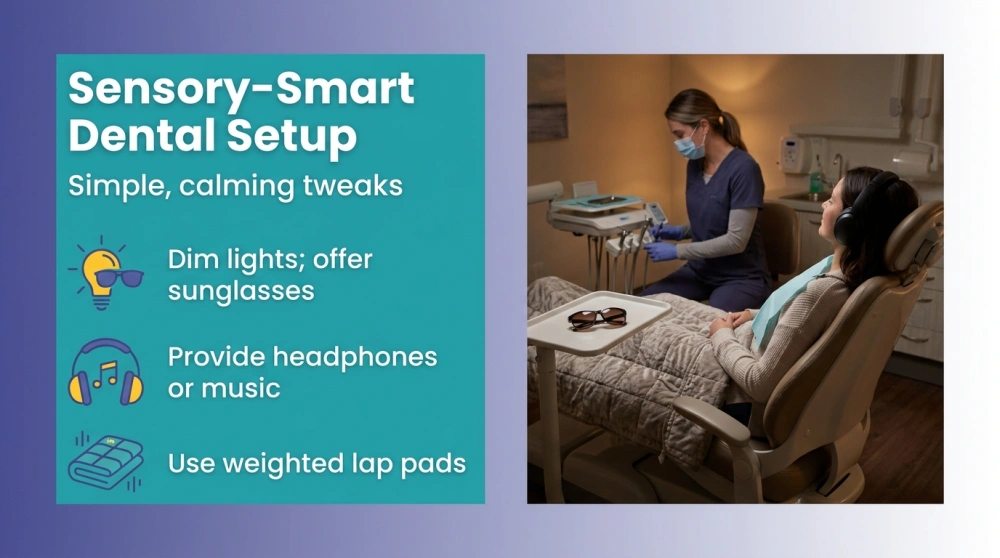
- Dimmed or adjustable lighting: Overhead fluorescent lights can be overwhelming; warm, adjustable lighting or the option to wear sunglasses during treatment can reduce visual overstimulation.
- Noise management: Offering headphones or earbuds so a child can listen to familiar music during a procedure, or using quieter instruments where clinically appropriate.
- Weighted blankets or lap pads: Deep pressure input has a calming effect for many children with sensory processing differences.
- Minimal scent exposure: Strong cleaning agents or flavored products can be intensely aversive; sensory-aware practices seek low-odor alternatives.
- Reduced visual clutter: Calm, uncluttered treatment rooms with predictable layouts are less likely to provoke overstimulation.
- A separate calm-down or waiting area: Having a quieter space away from the main waiting room gives children (and parents) a chance to regulate before the appointment begins.
Research in The American Journal of Occupational Therapy and in Pediatric Dentistry journals has documented that oral care difficulties in children with ASD are strongly correlated with sensory over-responsivity, particularly to touch and taste stimuli. [7] [8] This means environmental modifications are not a luxury. They are a direct clinical response to a documented physiological pattern.
How Desensitization Supports Successful Dental Visits
Desensitization is a structured, gradual process through which a child is introduced to dental-related stimuli at an intensity and pace that remains within their tolerance range, slowly expanding that tolerance over time. In pediatric dentistry, desensitization typically follows what practitioners call the “tell-show-do” approach: explain what will happen verbally, demonstrate it on a model or the child’s hand, and then proceed with the actual step only after the child shows readiness.
For children with autism, this process often spans multiple visits. The sequence might begin with simply entering the dental office and sitting in the reception area, then progressing to sitting in the dental chair without any examination, then tolerating a mirror placed in the mouth, and so on. Each successful step is reinforced through praise, preferred items, or a reward system coordinated with the family. This kind of systematic, incremental exposure reduces the unpredictability that is often at the root of distress for children with ASD.
A systematic review and meta-analysis published in Special Care in Dentistry confirmed that behavioral and sensory adaptation techniques, including gradual desensitization protocols, significantly reduce stress and anxiety indicators in children with ASD during dental treatment. [9] Families seeking an autism-friendly pediatric dentist near Laguna Niguel should directly ask prospective practices whether a structured desensitization protocol is available and how many visits it typically spans before clinical treatment begins.
It is worth noting that desensitization works best when parents are active partners. Pediatric dental teams that take time to understand a child’s triggers, preferences, and reinforcement strategies from the family are in a much stronger position to design an approach that actually works for that specific child.
When Is Sedation Dentistry Considered for Children with Autism?
Despite thoughtful environmental modifications and well-executed desensitization programs, some children with ASD may still have significant difficulty tolerating dental procedures. When anxiety, sensory aversion, or behavioral factors make it impossible to deliver necessary care safely, pediatric sedation dentistry becomes a clinically appropriate option to discuss.
Pediatric sedation dentistry refers to the use of sedative medications to reduce anxiety and allow a child to remain calm and cooperative during treatment. Options typically range from nitrous oxide (sometimes called laughing gas), which is mild, reversible, and delivered through a small nasal mask, to oral sedation, to deeper levels of conscious sedation administered under close medical supervision. General anesthesia, performed in a hospital or surgical center, may be considered for children who require extensive treatment and cannot cooperate under lighter sedation.
The AAPD’s guidelines on the management of dental patients with special health care needs acknowledge that sedation is sometimes necessary to deliver safe, effective care and to prevent the accumulation of untreated oral disease that can affect systemic health and quality of life. [2] It is important for parents to have an open conversation with the dental team about which sedation option is most appropriate for their child’s age, health history, and the scope of treatment needed. Laguna Niguel pediatric sedation dentistry practices that specialize in children with ASD will be familiar with selecting sedation methods that account for the full picture of a child’s medical and behavioral profile.
Parents should ask any prospective practice what monitoring protocols are in place during sedation, what the team’s training credentials are, and how recovery is managed before discharge. These are reasonable, important questions and any experienced pediatric practice will welcome them.
Why Team Training and Communication Matter So Much
An autism-friendly dental environment is only as effective as the people working in it. A beautifully designed sensory room accomplishes nothing if the front desk team does not know how to greet a child who avoids eye contact, or if the dental assistant does not understand that abrupt physical touch without warning can cause an immediate crisis for a child with tactile sensitivity.
What specific training should the dental team have?
Practices that invest in autism-specific training for the entire team, not just the dentist, demonstrate a systemic commitment to accessible care. Relevant training areas include applied behavior analysis (ABA) principles, understanding of sensory processing differences, crisis de-escalation techniques, person-first and identity-first language awareness, and coordination with parents as the primary experts on their own children. Some practices also consult with occupational therapists or behavioral specialists to build individualized care plans.
A mixed-methods systematic review published in Health Expectations found that factors influencing access to dental care for autistic children included the ability of dental teams to communicate effectively with the child and family, the physical environment of the practice, and whether parents felt that staff genuinely understood autism rather than simply tolerating it. [10] These findings underscore that good intentions are not sufficient; structured knowledge and practiced skills are what make a real difference.
How does parent communication factor in?
Before a first appointment, families benefit from sending a brief profile of their child to the dental team: preferred name, communication style, known triggers, calming strategies, and any relevant medical information. Practices that actively request this information and incorporate it into a written care plan are demonstrating the kind of individualized, parent-centered approach that children with autism genuinely need. During the appointment, a good autism-friendly team will narrate each step before performing it, maintain a calm and predictable pace, and check in with both the child and the parent throughout.
How Parents Can Prepare Their Child Before the Appointment
What happens at home in the days and weeks before a dental visit can significantly influence how that visit unfolds. You know your child better than anyone, and your preparation is a meaningful part of the clinical picture.
- Use social stories: A brief, illustrated story that walks through exactly what will happen at the dental office, who they will meet, what sounds they may hear, and how the visit ends, can help reduce the anxiety that comes from not knowing what to expect. Your dental office may provide one, or you can create a simple version using photos of the actual office.
- Practice at home: Briefly opening the mouth wide, tolerating a toothbrush on all teeth including the back molars, and sitting in a reclined position can all be practiced at home in a low-pressure context before the actual appointment.
- Bring comfort items: A favorite toy, a weighted lap pad, noise-canceling headphones, or a familiar snack for afterward can provide anchors of safety in an unfamiliar environment.
- Discuss the schedule: Using a visual schedule or a countdown to the appointment gives children with ASD the predictability they often need to manage transitions.
- Coordinate with the practice in advance: Call or email ahead to share any changes in your child’s routine, current stressors, or strategies that have worked recently. A prepared team is a more effective team.
You should also feel empowered to advocate throughout the appointment. If your child needs a break, ask for one. If a step is causing distress, communicate that. A practice that views you as a partner rather than an observer will respond to your input and adjust accordingly.
Are Children with Autism at Higher Risk for Oral Health Problems?
Research suggests that children with ASD are at elevated risk for certain oral health challenges, though the reasons are multifactorial. Selective eating patterns that favor soft, carbohydrate-rich foods can increase exposure to fermentable sugars, contributing to cavity risk. Difficulty tolerating at-home tooth brushing means that oral hygiene routines may be incomplete or inconsistently maintained. Some medications used in the management of ASD-related symptoms can cause dry mouth, which reduces the natural protective effects of saliva and increases vulnerability to tooth decay. [4]
A 2023 commentary published in JAMA Network Open highlighted that preventive dental care is particularly important for children with autism because poor oral health is more common in this population and because sensory hyperreactivity can make even routine care feel disproportionately stressful. [11] This creates a cycle where aversion to dental visits leads to delayed care, which leads to more complex dental needs that are harder to manage, which deepens aversion further.
Interrupting that cycle early, through regular, positive dental experiences in a supportive environment, is one of the most valuable things a family and a thoughtful dental team can do together. The pediatric dental care for infants and young children recommended by professional associations is particularly meaningful for children with ASD, because early exposure to dental care before significant anxiety develops can shape a child’s relationship with oral health for life. [12]
What to Look for When Finding the Right Pediatric Dental Office
Families in Laguna Niguel, Aliso Viejo, Laguna Beach, Laguna Hills, San Juan Capistrano, and Mission Viejo all have access to Orange County’s network of pediatric dental providers. When evaluating practices, consider asking the following questions directly:
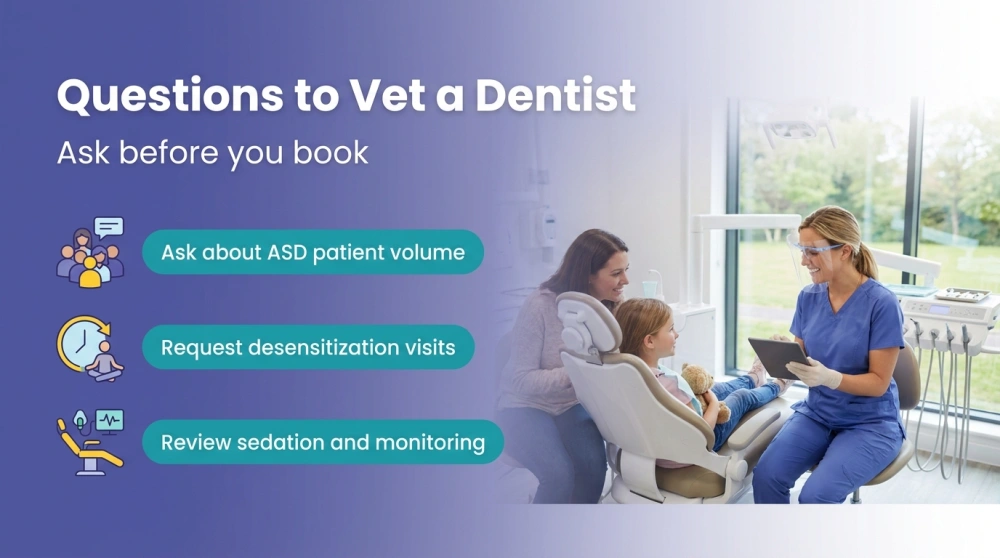
- What percentage of your patients have ASD or other special health care needs, and how does that experience inform your protocols?
- Do you offer desensitization visits, and how many visits does the process typically involve before clinical treatment begins?
- What does your team do when a child becomes distressed during an appointment? What is your de-escalation approach?
- What sedation options do you offer, and how do you determine which is appropriate for a given child?
- Can I bring a comfort item, a family member who knows my child well, or request a specific appointment time?
- Do you coordinate with other providers such as occupational therapists, behavioral therapists, or pediatricians?
A practice that answers these questions with specificity and without hesitation is communicating a level of experience and preparedness that matters. Vague or dismissive answers are informative too. Trust your instincts as a parent, and do not feel you need to settle for a setting where your child does not feel seen or accommodated.
Frequently Asked Questions
At what age should children with autism first visit a pediatric dentist?
The American Academy of Pediatric Dentistry recommends that all children, including those with ASD, have their first dental visit by age one or within six months after the first tooth appears. Early visits for children with autism focus primarily on familiarization rather than extensive examination, making the transition to clinical care more gradual and comfortable over time. [12]
Is nitrous oxide safe for children with autism?
Nitrous oxide is generally considered a safe and well-tolerated option for many children, including those with ASD. Its effects are mild and fully reversible within minutes after the mask is removed. However, every child is different. A child who is highly averse to wearing a nasal mask may not tolerate this method well. The dental team should discuss your child’s specific sensory profile and medical history before recommending any sedation approach.
How do I know if a dental office truly understands autism or is simply claiming to be autism-friendly?
Ask specific, practical questions. Inquire about their desensitization protocol, how they handle sensory meltdowns, what modifications they make to the physical environment, and whether any team members have formal training in ABA principles or developmental disabilities. A practice with genuine experience will answer these questions with concrete details, not generalities.
What if my child refuses to open their mouth at the dental office?
Mouth opening refusal is common in children with ASD and is a recognized challenge in pediatric dentistry. An experienced team will use gradual exposure techniques over multiple visits rather than forcing compliance. They may use a mirror to demonstrate, allow the child to explore instruments by touch, or use a visual schedule that breaks down the mouth-opening step into smaller, achievable parts. If a child consistently cannot tolerate examination after multiple attempts, sedation options can be explored.
Can children with autism have dental X-rays taken?
Pediatric digital X-rays use low-radiation technology and can often be completed during a calm, cooperative visit. For children who are averse to the sensation of the sensor in the mouth, a gradual approach over time is often effective. In some cases, X-rays may be taken under sedation if they are clinically necessary but cannot otherwise be tolerated. [13]
How can I help my child maintain good oral hygiene at home if they resist tooth brushing?
Start with the toothbrush outside the mouth, allowing your child to hold it and explore it. Gradually introduce it to the lips, then the front teeth, then the back teeth over days or weeks. Experiment with different toothbrush textures, sizes, and flavors of toothpaste or fluoride-free alternatives. An occupational therapist with experience in sensory processing can also offer strategies tailored to your child’s specific sensory profile. Your dental team can guide you on fluoride and cavity prevention in the context of limited brushing tolerance.
Do all pediatric dentists accept children with autism?
Many pediatric dentists see children with ASD, but the level of specialized preparation, training, and environmental accommodation varies considerably. Seeking out a practice that actively describes itself as a pediatric dental office for children with autism, and that has verifiable protocols in place, will serve your family better than a general practice that accommodates these children without dedicated systems.
About Kidz Modern Dentistry: Supporting Children with Autism in Laguna Niguel and Surrounding Communities
At Kidz Modern Dentistry, we understand that a dental visit for a child with autism is not a single event. It is a process that starts long before the child walks through the door and continues well after they leave. Our team in Laguna Niguel, California, is dedicated to making that entire process as supportive, predictable, and comfortable as possible for every child we see.
We serve families from Laguna Niguel, Aliso Viejo, Laguna Beach, Laguna Hills, San Juan Capistrano, Mission Viejo, and the broader Orange County area. Our practice was built on the belief that every child deserves dental care that meets them where they are, not where a standard clinical protocol assumes they should be.
Our Approach to Autism-Friendly Pediatric Care
Our comprehensive dental care for children with special needs includes individualized care planning that begins before the first appointment. We invite families to share detailed information about their child’s communication preferences, sensory triggers, calming strategies, and behavioral history so that our team can prepare a visit structure that is genuinely tailored. We do not assume all children with autism respond to the same approach, because they do not.
For children who need a gradual introduction to the dental environment, we offer structured desensitization visits designed to build familiarity and comfort over time. These visits are paced by the child, not by a predetermined clinical agenda. Our team uses visual schedules, tell-show-do techniques, and positive reinforcement strategies throughout, with parent input guiding every step.
We also work closely with children and families to determine whether our pediatric sedation dentistry options are appropriate for their situation. Whether nitrous oxide, oral sedation, or another approach is being considered, we take time to discuss the full picture of each child’s health history, sensory profile, and treatment needs before making any recommendations. Same-day emergency care is available for children of all abilities when dental problems arise unexpectedly.
A Team That Is Prepared, Not Just Willing
Every member of our team, from the person who answers our phones to the clinician who performs the examination, approaches children with ASD with structured knowledge rather than improvised goodwill. We believe that preparation at every level of the practice is what makes visits go well, and that parents should feel genuinely heard as the primary experts on their own children.
If you are looking for a pediatric dental office for children with autism near Laguna Niguel, California, we encourage you to reach out to our team to ask questions and learn whether our approach is a good fit for your child. You can contact Kidz Modern Dentistry directly at +1 (949) 273-0110. We are happy to talk through your child’s needs, describe our protocols, and schedule an initial visit that is paced entirely around your family.
References
- Data and Statistics on Autism Spectrum Disorder – Centers for Disease Control and Prevention (CDC)
- Management of Dental Patients with Special Health Care Needs – American Academy of Pediatric Dentistry (AAPD)
- Educational and Therapeutic Behavioral Approaches to Providing Dental Care for Patients with Autism Spectrum Disorder – Special Care in Dentistry, Nelson et al., 2015
- Challenges and Solutions in Managing Dental Problems in Children with Autism – World Journal of Clinical Pediatrics, Al-Beltagi et al., 2025
- Sensory Adapted Dental Environments to Enhance Oral Care for Children with Autism Spectrum Disorders: A Randomized Controlled Pilot Study – Journal of Autism and Developmental Disorders, Cermak et al., 2015
- Sensory-Adapted Dental Environment for the Treatment of Patients with Autism Spectrum Disorder – Children, Fallea et al., 2022
- Oral Care and Sensory Concerns in Autism – The American Journal of Occupational Therapy, Stein, Polido, and Cermak, 2012
- Oral Care and Sensory Over-Responsivity in Children with Autism Spectrum Disorders – Pediatric Dentistry, Stein, Polido, and Cermak, 2013
- Physiological and Behavioral Parameters Related to Stress and Anxiety in Children with Autism Spectrum Disorder Undergoing Dental Treatment: A Systematic Review and Meta-Analysis – Special Care in Dentistry, Tirupathi and Afnan, 2024
- Factors Influencing Oral Health Behaviours, Access and Delivery of Dental Care for Autistic Children and Adolescents: A Mixed-Methods Systematic Review – Health Expectations, Erwin et al., 2022
- In Support of Addressing Sensory Differences to Improve Preventive Dental Care Among Autistic Children – JAMA Network Open, Wallis, Fichter, and Fiks, 2023
- Oral Health Policies and Recommendations (The Reference Manual of Pediatric Dentistry) – American Academy of Pediatric Dentistry (AAPD)
- Behavioral and Sensory Adaptation Techniques in Pediatric Dental Care for Children with ASD – Special Care in Dentistry, 2024
Common Questions About This Topic
Find answers to frequently asked questions related to this article.
The American Academy of Pediatric Dentistry recommends that all children, including those with ASD, have their first dental visit by age one or within six months after the first tooth appears. Early visits for children with autism focus primarily on familiarization rather than extensive examination, making the transition to clinical care more gradual and comfortable over time. [12]
Nitrous oxide is generally considered a safe and well-tolerated option for many children, including those with ASD. Its effects are mild and fully reversible within minutes after the mask is removed. However, every child is different. A child who is highly averse to wearing a nasal mask may not tolerate this method well. The dental team should discuss your child's specific sensory profile and medical history before recommending any sedation approach.
Ask specific, practical questions. Inquire about their desensitization protocol, how they handle sensory meltdowns, what modifications they make to the physical environment, and whether any team members have formal training in ABA principles or developmental disabilities. A practice with genuine experience will answer these questions with concrete details, not generalities.
Mouth opening refusal is common in children with ASD and is a recognized challenge in pediatric dentistry. An experienced team will use gradual exposure techniques over multiple visits rather than forcing compliance. They may use a mirror to demonstrate, allow the child to explore instruments by touch, or use a visual schedule that breaks down the mouth-opening step into smaller, achievable parts. If a child consistently cannot tolerate examination after multiple attempts, sedation options can be explored.
Pediatric digital X-rays use low-radiation technology and can often be completed during a calm, cooperative visit. For children who are averse to the sensation of the sensor in the mouth, a gradual approach over time is often effective. In some cases, X-rays may be taken under sedation if they are clinically necessary but cannot otherwise be tolerated. [13]
Start with the toothbrush outside the mouth, allowing your child to hold it and explore it. Gradually introduce it to the lips, then the front teeth, then the back teeth over days or weeks. Experiment with different toothbrush textures, sizes, and flavors of toothpaste or fluoride-free alternatives. An occupational therapist with experience in sensory processing can also offer strategies tailored to your child's specific sensory profile. Your dental team can guide you on fluoride and cavity prevention in the context of limited brushing tolerance.
Many pediatric dentists see children with ASD, but the level of specialized preparation, training, and environmental accommodation varies considerably. Seeking out a practice that actively describes itself as a pediatric dental office for children with autism, and that has verifiable protocols in place, will serve your family better than a general practice that accommodates these children without dedicated systems.
