
- What are a baby lip tie and tongue tie
- Will my baby outgrow a lip tie or tongue tie
- What signs suggest a lip or tongue tie is affecting feeding
- How common are ties and how are they diagnosed
- How can you tell if your baby has a tongue tie
- When should a lip or tongue tie be treated
- What are frenotomy and frenectomy, and what is a laser frenectomy
- Does releasing a tongue tie help breastfeeding
- Who should evaluate and treat a tongue or lip tie in infants
- What should you expect during an infant laser frenectomy visit
- How do healing, exercises, and follow up work after release
- Can tongue ties affect speech and will release change speech development
- What safety, consent, and regulatory standards apply in California
- How do insurance, referrals, and local resources in Laguna Niguel and Orange County fit in
- How Kidz Modern Dentistry supports families in Laguna Niguel, CA
- References and resources
What are a baby lip tie and tongue tie
Okay, quick anatomy detour. A baby lip tie and tongue tie are both types of what the pros call tethered oral tissues, or TOTs. That stringy little band under the tongue is the lingual frenulum. The one up top, connecting lip to gum, is the maxillary labial frenulum. If either sits too tight or too short, or just lands in some awkward spot that stops the tongue or lip from moving the way it should, things can get restricted. Tongue tie goes by ankyloglossia in textbooks. Lip tie basically means a restrictive upper lip frenulum, nothing fancier than that. Health pros will sort these by how they look and by how much movement is actually limited. But when it comes down to clinical calls, functional impact tends to carry the most weight [1] [3] .
Here’s where it gets kind of tricky. These things show up differently from baby to baby. Some have that classic thin band you can see right under the tongue tip, easy call. Others have a posterior tongue tie, which sits deeper under the mucosa and honestly, you probably won’t catch it with a casual peek. And just because something looks a certain way doesn’t mean feeding will be a struggle. What really matters clinically is the functional stuff, latch, milk transfer, mom’s comfort, and how baby’s growing [1] [4] .
Will my baby outgrow a lip tie or tongue tie
Here’s the honest truth. Some babies with a mild restriction do great. They feed, they grow, they hit milestones, no procedure needed. Other babies, though, keep running into the same wall. Painful latch, not enough milk coming through, mom’s nipples destroyed, and that’s with real lactation support in the picture. So the better question probably isn’t will they outgrow it. It’s more like, is function okay right now, and are the things you’re already trying actually meeting your goals? The lingual frenulum can stretch and thin out over time, and feeding patterns tend to shift as babies get older. But when a tie is clearly getting in the way and conservative stuff isn’t moving the needle, release becomes something worth thinking about. Professional guidance really leans into individual decisions, weighing risks and benefits together with the family [3] [4] .
Research shows that some breastfeeding challenges related to a restrictive frenulum improve after release, particularly maternal nipple pain and latch quality. That said, not all infants require a procedure. Care teams typically begin with lactation support and positioning strategies, then consider release if significant problems persist [2] [4] [9].
What signs suggest a lip or tongue tie is affecting feeding
Parents often notice patterns that raise questions about tongue or lip tie. Many of these signs can have multiple causes, which is why a skilled assessment is important.
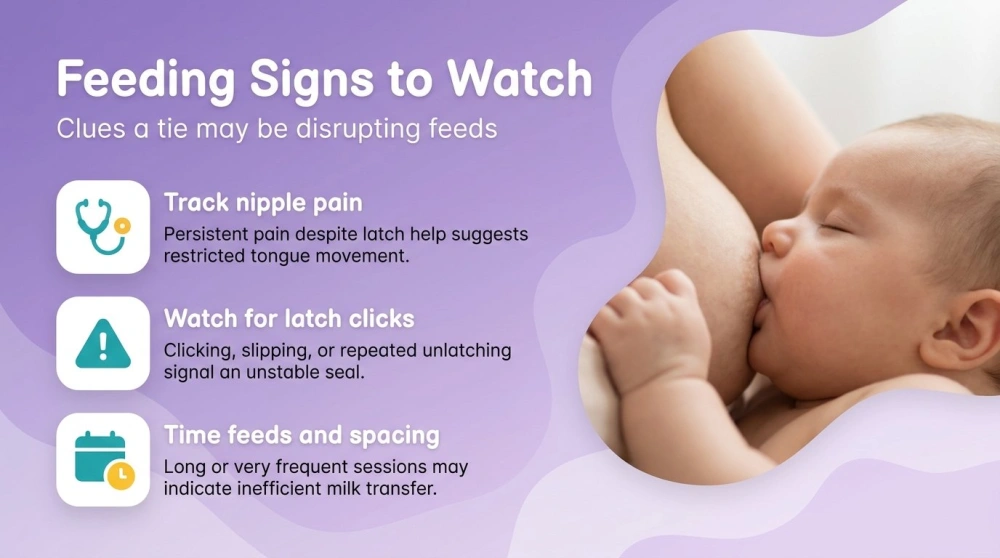
- Maternal nipple pain or damage Persistent pain, cracking, or blanching during or after feeds, even with improved positioning and latch help [4].
- Shallow or painful latch Clicking, loss of suction, slipping off the breast, or repeated unlatching despite attempts at correction [2] [4].
- Prolonged or very frequent feeds Baby takes a long time to feed, seems unsatisfied, or wants to nurse again soon after a feed [4].
- Poor weight gain Growth that falls behind expected patterns based on your pediatrician’s monitoring [5].
- Gassiness or reflux symptoms Excess air intake from an unstable latch may contribute to fussiness and spitting up in some babies [4].
- Difficulty with bottle feeding Milk leaking from the sides of the mouth or prolonged, tiring feeds may occur with bottle as well as breast [1].
- Upper lip rolling inward A tight upper lip frenulum may prevent flanging the lip outward, contributing to a shallow latch [1].
No single sign confirms a tie. A comprehensive functional evaluation by clinicians trained in infant feeding is the most reliable way to determine whether a restriction is present and whether it is clinically important [4].
How common are ties and how are they diagnosed
Published estimates of tongue tie prevalence vary widely, often cited in the range of about 4 to 10 percent of newborns, in part because diagnostic criteria and training differ across settings. In recent years, diagnosis and procedures have increased in several countries, including the United States, reflecting greater awareness and variability in practice patterns [2] [9].
Diagnosis isn’t just a quick peek inside the mouth. It’s three things really. Taking a solid history, doing a hands on exam, and ideally watching a feed happen in real time. During the exam, the clinician’s checking a bunch of specific stuff, can the tongue lift, move side to side, stretch forward, cup around a finger, and is that peristaltic wave happening during the suck. They’re also looking at how the upper lip flanges out. The whole point is figuring out whether something is actually restricting function and causing the feeding problem you came in about. And here’s where the big professional groups land. They’re pretty clear that those appearance based grading systems matter way less than what the tongue and lip can actually do. If clear functional limits stick around even after skilled support, release is worth considering [1] [3] [4] .
How can you tell if your baby has a tongue tie
At home, you may see a thin band under the tongue or notice that your baby struggles to lift the tongue to the roof of the mouth. You might also see the upper lip tethered to the gum. Still, a visible band does not always equal a problem. Some infants with a prominent frenulum feed well with no issues, while others with a subtle posterior restriction may struggle. If there is pain with nursing, poor latch, slow weight gain, or ongoing feeding stress, schedule an in person evaluation. Coordinated assessment by your pediatrician, a board certified lactation consultant, and a pediatric focused oral health professional is the most reliable way to know what is going on and to create a plan that matches your goals [4] [11].
When should a lip or tongue tie be treated
Treatment is considered when a tie clearly contributes to functional problems such as ineffective latch, poor transfer, maternal pain, or inadequate growth, and when conservative measures have not sufficiently helped. Normal anatomic variations that do not limit function usually do not require any procedure. Professional guidance emphasizes the following approach [1] [3] [4]:
- Begin with skilled support Work with an IBCLC for positioning, latch optimization, and feeding strategies. Many difficulties improve with this step alone [4] [11].
- Define the problem Identify specific functional limitations and document maternal and infant outcomes, such as pain scores and weight trends [4].
- Use shared decision making Discuss benefits, risks, and alternatives with your care team and decide together what aligns with your goals [3] [4].
- Time the procedure appropriately When indicated, release can be performed in the newborn period or later infancy. Timing depends on severity, feeding goals, and readiness for aftercare [3].
What are frenotomy and frenectomy, and what is a laser frenectomy
A frenotomy is a simple snip or incision of a restrictive frenulum to free movement. Frenectomy refers to a more complete removal of a portion of the frenulum. In infants, releases are typically conservative and targeted to the restrictive fibers. Clinicians may use sterile scissors or a dental laser to perform the release. Both approaches are used in pediatric settings. Laser technology can allow precise tissue removal with minimal bleeding and clear visualization. The American Academy of Pediatric Dentistry recognizes lasers as an appropriate tool for selected soft tissue procedures when clinicians are trained, follow safety standards, and use proper eye protection and smoke evacuation [1] [12].
Whether scissors or laser is used, the most important factor is an experienced clinician operating within established guidelines, providing adequate pain control, and coordinating care with lactation and feeding specialists. The choice of technique should align with the clinical scenario and the practitioner’s training and equipment [1] [12].
Does releasing a tongue tie help breastfeeding
Multiple studies and reviews have explored whether frenotomy improves breastfeeding outcomes. A Cochrane systematic review reports that release is associated with short term reduction in maternal nipple pain and may improve some aspects of latch. Evidence for long term breastfeeding outcomes is more limited and heterogeneous. Major medical organizations outline that release can be beneficial for a subset of infants when there is a clear functional restriction that does not respond to skilled lactation measures [2] [3] [4] [9].
What this means for families is that a procedure is not a universal solution. It can be helpful when the problem is directly caused by a tight frenulum and when aftercare and continued feeding support are in place. Care teams often track maternal pain, latch quality, infant transfer, and weight to evaluate benefit in the days and weeks after release [2] [4].
Who should evaluate and treat a tongue or lip tie in infants
Comprehensive care is collaborative. Your pediatrician monitors growth and overall health. An International Board Certified Lactation Consultant provides hands on feeding assessment and support. A pediatric dentist or an ear nose and throat specialist with infant feeding expertise evaluates oral anatomy and function and performs releases when indicated. Professional bodies agree that trained clinicians across these disciplines can participate effectively in evaluation and management, and that care is most successful when teams communicate well and center decisions on function and family goals [3] [4] [11].
- When to see an IBCLC Any time there is pain, low supply concerns, slow weight gain, or latch challenges. Early support can change the course of feeding for many families [11].
- ENT versus dentist for tongue tie Both pediatric focused dentists and otolaryngologists manage infant ties. The key is experience with infant feeding, the ability to coordinate care, and adherence to professional guidelines [1] [3].
- Team based plans Parents benefit from clear plans that outline supportive measures, timing, aftercare, and follow up checkpoints [4].
What should you expect during an infant laser frenectomy visit
While details vary by clinic, a typical visit includes several steps designed to maximize safety and comfort and to evaluate function before and after the procedure:
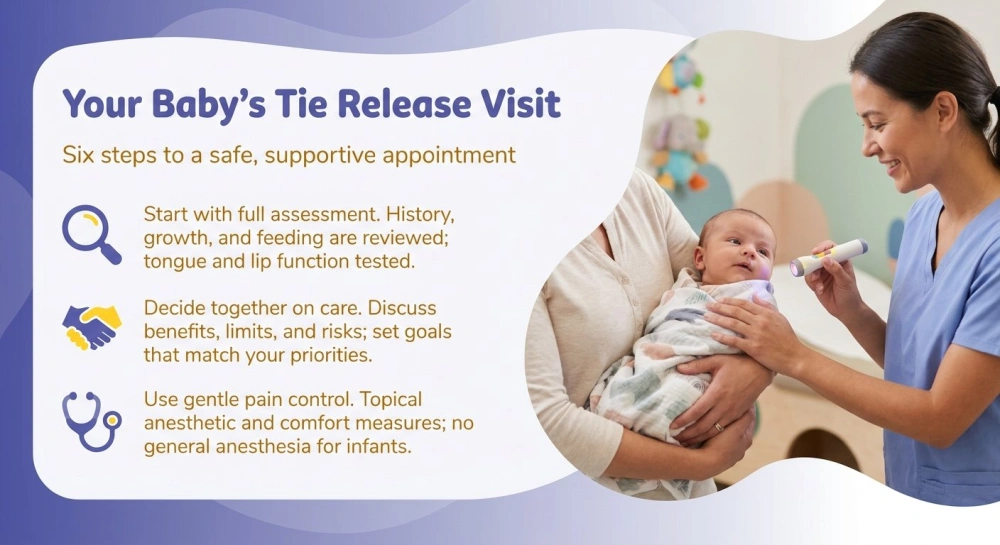
- Comprehensive assessment Review of feeding history, birth history, growth trends, and prior lactation support. Functional exam evaluates tongue mobility, upper lip flange, suck, seal, and stamina [1] [4].
- Shared decision making Discussion of options, expected benefits, limitations of evidence, potential risks, and aftercare. Parents are encouraged to ask questions and to consider a stepwise plan with lactation support [3] [4].
- Pain control Topical anesthetic or other age appropriate comfort measures are used. General anesthesia is not typically needed for infant frenotomy in an office setting and is avoided unless special circumstances exist, consistent with professional guidance [1] [3].
- Release A sterile laser or scissors is used to free restrictive fibers. The procedure itself is brief. Bleeding is usually minimal. Parents may be present according to clinic policy [1] [12].
- Immediate latch support When possible, baby is offered the breast or bottle right after the procedure, with on site guidance to assess early changes in latch and comfort [4].
- Aftercare plan Gentle exercises, wound care instructions, and scheduled follow up ensure that the release translates into functional gains. Coordination with lactation is key [4].
How do healing, exercises, and follow up work after release
Healing is an active process. Soft tissue typically forms a small diamond shaped wound that changes color over several days. Babies may have transient fussiness. The goals of aftercare are to maintain mobility, support an effective latch, and monitor feeding outcomes.
- Gentle mobility exercises Your care team may teach brief, gentle movements to help the tongue lift and extend without strain. These are tailored to your baby and are not painful when performed as directed [4].
- Lactation support Continued IBCLC follow up helps you fine tune positioning, latch, and milk transfer to make the most of new tongue mobility [4] [11].
- Growth and comfort checks Tracking maternal pain, baby’s satiety cues, and weight helps determine whether goals are being met and whether additional support is needed [5].
Many families report early improvements in latch comfort after release. Some infants need time and practice to use new movement patterns. Collaborative follow up supports that transition [2] [4].
Can tongue ties affect speech and will release change speech development
Speech development is multifactorial. Some children with a tight frenulum may have specific articulation challenges, particularly with sounds that require elevation of the tongue. However, many develop normal speech without intervention. For infants, the immediate concern is feeding and growth. Decisions about tongue tie release in the newborn period are generally centered on feeding function rather than predicted speech outcomes. If speech questions arise later, a speech language pathologist can provide targeted assessment and therapy. Professional consensus documents encourage individualized evaluation and caution against assuming that release will prevent or correct every possible speech concern [3] [9].
What safety, consent, and regulatory standards apply in California
In California, dentists are licensed and regulated by the Dental Board of California. Pediatric dentists who provide infant frenotomy or frenectomy must comply with state scope of practice, informed consent requirements, and any permit obligations related to anesthesia or sedation. When lasers are used, clinicians are expected to follow device specific instructions and recognized safety standards, such as protective eyewear for the entire care team and appropriate plume evacuation, consistent with professional policy statements on lasers in pediatric dentistry [7] [12].
For comfort measures during infant procedures, most releases in healthy young infants can be accomplished with topical or local anesthesia and gentle behavioral techniques in an office setting. If deeper sedation is considered for special circumstances, providers must hold the appropriate California permits and follow state regulations as well as professional guidelines for monitoring and emergency preparedness [7] [1] [12].
Breastfeeding support is also an important public health priority in California. State and federal agencies provide resources, data, and initiatives that promote breastfeeding access and education for families and clinicians across Orange County and beyond [5] [6].
How do insurance, referrals, and local resources in Laguna Niguel and Orange County fit in
Families in Laguna Niguel and the surrounding Orange County communities often navigate a combination of resources to support feeding and infant oral function. Your primary care pediatrician is an essential first contact for weight checks and overall health. Many families also work with an IBCLC for hands on feeding strategies. When a release is considered, you may be referred to a pediatric dentist or ENT with infant feeding expertise. Coverage for frenotomy varies by plan and diagnosis. Documentation that includes feeding history, observed functional restriction, prior conservative measures, and growth data can support medical necessity review.
- Local breastfeeding support California and county programs, including Women, Infants, and Children services and hospital based lactation teams, offer education and follow up for early feeding challenges [6].
- Care coordination A clear referral pathway among pediatrician, IBCLC, and treating clinician helps align goals and reduces repeated visits [4] [11].
- Tracking outcomes Keep a simple log of feeds, diapers, weights, and maternal comfort to share at follow up, which can inform decisions and payor review [5].
How Kidz Modern Dentistry supports families in Laguna Niguel, CA
Kidz Modern Dentistry provides infant frenotomy and frenectomy services within a comprehensive pediatric dental setting in Laguna Niguel, California. Our team focuses on function, comfort, and coordinated care. We welcome same day inquiries for urgent feeding concerns and offer kid friendly comfort options designed for infants and young children. Our pediatric focused clinicians work closely with local lactation experts and pediatricians throughout Orange County to align care and prioritize your family’s goals.
- Where we operate We serve families in Laguna Niguel, Aliso Viejo, Mission Viejo, Dana Point, San Juan Capistrano, and neighboring Orange County communities.
- Our approach We use a stepwise model that places skilled lactation support first, then considers release only when functional limitations persist. This model reflects guidance from leading pediatric and breastfeeding organizations and centers shared decision making every step of the way [1] [3] [4].
- Technology and technique For indicated cases, we perform precise infant soft tissue releases with a dental laser in a setting designed to maximize visibility and comfort. Laser use follows pediatric dentistry policy statements on safety, protective eyewear, and plume control [12].
- Integrated aftercare We coordinate same day or next day latch coaching with local IBCLC partners and provide clear, gentle mobility guidance to help babies build new movement patterns.
- Experience and teamwork Our pediatric focused team brings years of combined experience in infant oral assessments, interdisciplinary case reviews, and collaborative follow up with lactation, speech language, and medical colleagues.
- Access and support We offer flexible scheduling for newborns and young infants, transparent communication, and direct contact for questions. Call us at +1 818 260 0016 to connect with our team.
- Track record of care Families share that personalized plans, clear expectations, and coordinated follow up reduce stress and help them reach their feeding goals. While each situation is unique, we are committed to careful assessments, thoughtful planning, and attentive follow up.
If you are wondering whether your baby will outgrow a lip tie or tongue tie, we invite you to schedule a functional assessment. Together we can review feeding history, examine oral mobility, and map a plan that fits your family. Our priority is a calm, efficient visit and supportive, evidence aligned care close to home in Laguna Niguel.
Frequently asked questions for parents in Laguna Niguel, CA
What is the difference between a frenotomy and a frenectomy
Frenotomy is a small release of restrictive fibers to improve mobility. Frenectomy is a more extensive removal of a portion of the frenulum. In infants, the goal is precise, conservative release guided by function. Choice of scissors or laser depends on clinician training and the clinical situation [1] [12].
Is a laser frenectomy better than scissors for babies
Both methods can be effective when performed by trained clinicians. Lasers offer precise soft tissue control and a clear field. Scissors are simple and time tested. Safety, experience, and coordination with feeding support are the most important factors for outcomes [1] [12].
How quickly might breastfeeding feel different after a release
Some parents report less nipple pain at the next feed. Others see gradual change as babies learn new movement patterns and as latch and positioning are refined. Follow up with an IBCLC is very helpful during this period [2] [4] [11].
Is every lip tie significant
No. Upper lip frenula vary widely in appearance and are often normal. Treatment is based on functional impact, not appearance alone [1] [3].
What about speech later on
Speech development depends on many factors. Some children with restrictive frenula have articulation differences, but many do not. Infant decisions are guided by feeding function. Later concerns can be addressed with speech language evaluation. Professional consensus supports individualized assessment rather than blanket predictions [3] [9].
Are tongue ties really more common now
Reports of diagnosis and procedures have increased in recent years in several countries, including the United States. Reasons include growing awareness and variation in diagnostic criteria and practice patterns [9].
What is a posterior tongue tie
Posterior tongue tie refers to a restriction that is deeper under the mucosa and less visible near the tip. It may still limit elevation and function. Functional assessment remains central to decisions about care [3] [4].
What if we choose to wait
Many families pursue continued lactation support and watchful follow up. Your team can track growth, maternal comfort, and feeding efficiency, and you can revisit options if needed. This is a valid path when function is adequate and your goals are being met [4].
What does the local public health context mean for families in Orange County
Breastfeeding is a public health priority. Government and professional organizations note that exclusive breastfeeding provides benefits for infants and parents when it is feasible for the family. California has strong breastfeeding initiatives and local support through hospitals and community programs. Data from national surveys show high breastfeeding initiation rates, with variability in duration and exclusivity. Access to early lactation support and timely evaluation of feeding challenges can make a meaningful difference for families in Laguna Niguel and across Orange County [5] [6] [8].
Parent checklist for deciding about infant tongue tie treatment
- Clarify your goals Are you aiming for exclusive breastfeeding, combination feeding, or bottle feeding expressed milk or formula
- Document the current picture Keep notes on maternal pain, latch, feed duration, and weight checks
- Engage skilled support Work with an IBCLC and your pediatrician to optimize positioning and milk transfer [11].
- Seek a functional exam See a pediatric trained oral health clinician or ENT familiar with infant feeding to assess movement and seal [3] [4].
- Discuss benefits and risks Review what a release can and cannot do, expected healing, and aftercare steps [2] [3].
- Plan follow up Set visits with lactation and your clinician to support new skills and track outcomes [4].
Key takeaways for parents asking if a baby will outgrow a lip or tongue tie
- Function guides decisions Appearance alone is not enough. Evaluate how the tongue and lip move and how your baby feeds [1] [3].
- Skilled help comes first Many feeding issues improve with early lactation support and positioning strategies [4] [11].
- Release can help selected cases Evidence supports short term improvements in maternal pain and latch when restriction is significant and does not respond to conservative care [2] [9].
- Safety and standards matter Choose a clinician trained in infant care who follows pediatric dentistry and medical guidelines, especially when lasers are used [1] [12].
- Local resources are available Families in Laguna Niguel and Orange County can access public health and community lactation services alongside specialty care [6].
How to reach a pediatric dentist in Laguna Niguel for infant frenectomy questions
If your family is in Laguna Niguel or nearby in Orange County and you have questions about infant tongue tie treatment, call Kidz Modern Dentistry at +1 9492730110 We offer same day support when possible, coordinate closely with IBCLC partners, and provide infant focused care in a calm, kid centered environment.
References and resources
- Policy on Management of the Frenulum in Pediatric Dental Patients – American Academy of Pediatric Dentistry
- Frenotomy for tongue tie in newborn infants – Cochrane Database of Systematic Reviews
- Clinical Consensus Statement on Ankyloglossia in Children – AAO HNSF Otolaryngology Head and Neck Surgery
- Clinical Protocols on Breastfeeding and Ankyloglossia – Academy of Breastfeeding Medicine
- Breastfeeding Data, National Immunization Survey – Centers for Disease Control and Prevention
- Breastfeeding Resources and Initiatives – California Department of Public Health
- Licensing and Regulation of Dentists – Dental Board of California
- Breastfeeding and the Use of Human Milk 2022 Policy Statement – American Academy of Pediatrics
- Trends in Ankyloglossia and Frenotomy in the United States – JAMA Otolaryngology Head and Neck Surgery
- Division of Ankyloglossia for Breastfeeding – NICE Interventional Procedures Guidance 149
- About IBCLC Certification – International Board of Lactation Consultant Examiners
- Use of Lasers for Pediatric Dental Patients – American Academy of Pediatric Dentistry
Common Questions About This Topic
Find answers to frequently asked questions related to this article.