- What oral and facial injuries can a mouth guard help prevent for active kids?
- How common are sports related dental injuries for children in Laguna Niguel and South Orange County?
- Which youth sports carry the highest risk for mouth and jaw injuries?
- How does a mouth guard work and what types can families choose from?
- What is the difference between store bought and custom mouth guards for children?
- Which injuries are most reduced with a well fitted guard compared to a loose one?
- Are there rules or standards that require mouth guards in school or league sports?
- How should a child’s mouth guard fit and when does it need to be replaced?
- How do you clean and store a child’s mouth guard safely?
- How can South Orange County parents decide between custom and store options with confidence?
- What if my child has braces, primary teeth, or sensory sensitivities?
- What should parents do if a tooth is chipped or knocked out during a game?
- How can parents work with coaches and leagues to promote mouth guard safety?
- How does Kidz Modern Dentistry help families with sports dental injury prevention?
- Where can you find the sources for this guide?
What oral and facial injuries can a mouth guard help prevent for active kids?
When kids play hard, accidental contact with balls, sticks, ice, turf, or other players can lead to oral injuries. A properly fitted youth sports mouthguard helps cushion impact and spreads force over a wider area, which can lower the risk of several common injuries. Evidence from professional organizations and research reviews indicates that mouth guards reduce the incidence and severity of dental and soft tissue injuries in contact and collision sports [1] [2] [3].
In practical terms, a mouth guard may help reduce the likelihood of the following:
- Chipped or fractured teeth due to direct blows to the mouth [1].
- Knocked out permanent teeth where cushioning can lower force transmitted to tooth sockets [2].
- Lip, cheek, and tongue cuts by creating a smooth barrier between soft tissues and teeth [1].
- Jaw joint stress from clenching or impact that a guard can help absorb [1].
There is active research on whether mouth guards affect concussion risk. Current guidance emphasizes that mouth guards protect the teeth and mouth, while concussion prevention requires a broader approach that includes rules enforcement and safe play education [4] [3]. In short, think of mouth guards as an important part of a layered safety plan, not a stand alone solution.
How common are sports related dental injuries for children in Laguna Niguel and South Orange County?
Across the United States, sports and recreation are a frequent source of dental and facial injuries in school age children and teens [1]. While specific numbers vary by sport and level of play, professional associations consistently report a higher rate of orofacial injuries in contact and collision sports without mouth guard use compared with use [1] [3]. For families in Laguna Niguel, Laguna Hills, Aliso Viejo, Laguna Beach, Mission Viejo, and San Juan Capistrano, the same trends apply wherever kids participate in youth leagues or school teams.
Parents often ask whether a kids sports mouth guards policy is truly necessary for recreational leagues. The evidence indicates that requiring and consistently wearing a properly fitted guard can reduce the frequency of dental trauma and soft tissue injuries in many sports settings [3]. That is why organizations and dental associations recommend mouth guards for a range of activities, not only for varsity level competition [1] [3].
Which youth sports carry the highest risk for mouth and jaw injuries?
Some sports pose a higher risk of oral injuries because of speed, contact, or the use of sticks, pucks, and balls. These activities are commonly flagged by dental and sports bodies for mouth guard use [1] [5]:
- Football and rugby where player contact and tackles are routine.
- Ice hockey and field hockey due to sticks, pucks or balls, and fast play.
- Lacrosse because of stick checks and rapid ball movement.
- Basketball and soccer with frequent accidental elbows, head contact, and falls.
- Martial arts and boxing due to intentional strikes.
- Skateboarding, inline skating, and biking where falls to hard surfaces are common.
Rules vary by league, age group, and sport. Many school and youth organizations require mouth guards in sports such as football, ice hockey, field hockey, and boys lacrosse, while strongly recommending them in others [5]. If you are unsure about a local league in Laguna Niguel or surrounding cities, check the team handbook or ask the coach before the first practice.
How does a mouth guard work and what types can families choose from?
Mouth guards work by absorbing and distributing impact energy. When a blow reaches the jaw or teeth, the guard compresses and spreads force over a broader area, which can help protect teeth, lips, and gums [1]. To do that well, the guard must be made of resilient material, cover key tooth surfaces, and stay in place during rapid movement and heavy breathing [2].
What types of mouth guards are available for kids?
- Stock mouth guards arrive preformed. They are the least adjustable and often feel bulky, which can lead to poor retention and limited protection if they are not snug [2].
- Boil and bite mouth guards soften in hot water and are shaped at home. Fit quality depends on following directions precisely, avoiding thin spots, and achieving even coverage [2].
- Custom mouth guards are made from impressions or digital scans by a dental professional. They generally fit more precisely, which can improve comfort, retention, and coverage of teeth and gums [1] [2].
Parents often notice that children are more likely to wear a comfortable guard consistently. That is where fit and feel make a difference in real world use.
What is the difference between store bought and custom mouth guards for children?
Most families compare store bought options with custom mouth guards for children when deciding what is best for their child. The major differences involve fit, thickness control, retention, ability to speak and breathe, and durability [1] [2] [3].
How does fit and retention differ between these options?
- Fit A custom guard is fabricated to match your child’s teeth and gums, which can offer even thickness and full coverage in key areas. Boil and bite guards can fit well if molded carefully, but uneven pressure or over trimming can thin the material.
- Retention A custom guard often seats with a gentle snap and stays put during play and talking. A loose stock guard may need constant clenching, which can be distracting and less protective.
What about breathing, speaking, and comfort on the field?
- Breathing Children should be able to breathe comfortably through the mouth during sprints and drills. Better fit often allows a slimmer profile without sacrificing protection.
- Speaking Clear communication with coaches and teammates is important. A bulky guard can muffle speech, while a customized fit can improve clarity.
- Comfort Smooth edges and even thickness can reduce rubbing spots and gag reflex triggers.
How do costs and longevity compare for families?
- Durability Quality materials and precise fabrication can increase a guard’s usable life. Store bought guards may compress or tear faster, especially in aggressive play.
- Replacement frequency Young athletes with changing dentition or orthodontic treatment may need more frequent adjustments or refabrication regardless of type.
Injury reduction depends on both the type and the quality of fit. Research and professional guidance suggest that consistent use of a well fitted guard is the key factor in lowering oral injury rates [1] [3].
Which injuries are most reduced with a well fitted guard compared to a loose one?
When a guard fits poorly or shifts, impacts may concentrate on a few teeth or soft tissues. A better fitting guard improves coverage and stability, which supports reduction in several common injuries [1] [3]:
- Tooth fractures and chips where cushioning reduces peak forces on enamel and dentin.
- Avulsion and luxation by stabilizing the upper arch and dispersing impact to the sockets.
- Lip and cheek lacerations by shielding soft tissue from tooth edges.
Parents ask whether the choice between store bought vs custom mouthguards changes injury risk. The main point is that fit, retention, and consistent wear matter most. If a child is not wearing the guard because it is uncomfortable, protection falls to zero. That is one reason many active families choose options that their child will actually keep in for every practice and game [3].
Are there rules or standards that require mouth guards in school or league sports?
Yes, many governing bodies require or strongly recommend mouth guards in specific sports. High school and youth organizations commonly mandate guards in football, ice hockey, field hockey, and boys lacrosse, while recommending them for basketball and other contact activities [5]. Some leagues also specify color or visibility so officials can verify wear during play.
Standards organizations publish guidance on materials and performance, and professional dental associations publish policies on selection and use for children and adolescents [1]. Ask your league about any local rules in Laguna Niguel, Laguna Hills, Aliso Viejo, Laguna Beach, Mission Viejo, or San Juan Capistrano before the season begins to avoid last minute scrambles.
How should a child’s mouth guard fit and when does it need to be replaced?
A well fitted guard should feel snug, stay in place without clenching, and allow easy breathing and clear speech. It should cover the teeth that are most at risk and rest comfortably against the gums without sharp or rough edges [1] [2].
What are the signs a mouth guard does not fit correctly?
- Frequent dropping or shifting during talking or running.
- Gagging or sore spots that do not resolve after minor trimming or adjustment.
- Chewing through thin areas that create holes or tears.
- Difficulty breathing or speaking beyond the first few practices.
When should you replace a child’s guard?
- Growth and tooth changes If adult teeth erupt or primary teeth shed, reevaluate fit.
- Orthodontic changes After archwires or brackets change position, recheck retention.
- Visible wear or damage Replace if there are cracks, thin spots, or tears.
- Odor that persists after cleaning which can indicate deeply embedded bacteria.
Families comparing pediatric mouthguards often notice that kids prefer guards that are easy to wear and easy to speak through. That comfort can translate to more consistent use on the field and better protection over time [3].
How do you clean and store a child’s mouth guard safely?
Good hygiene helps keep the guard fresh and reduces buildup of bacteria.
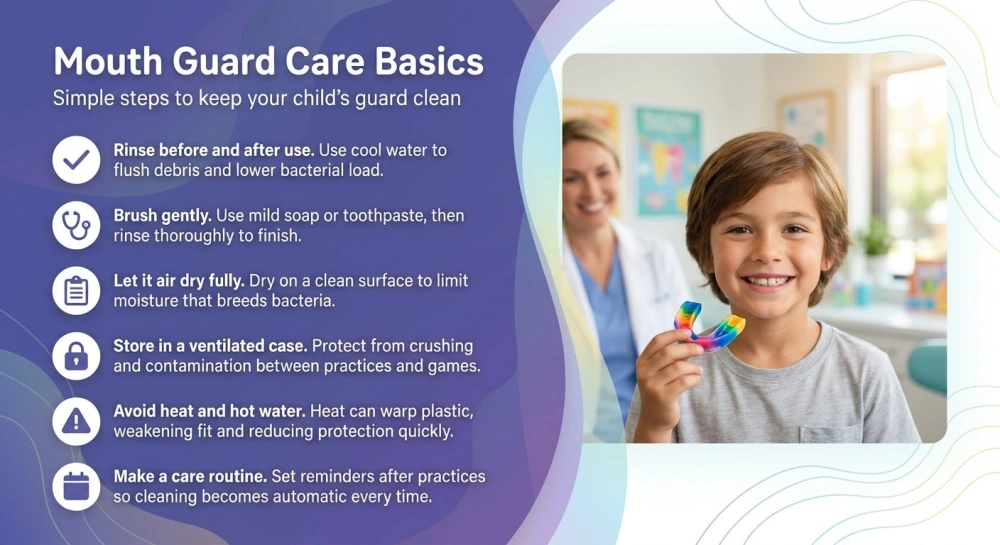
- Rinse before and after use with cool water to remove debris.
- Brush gently with a soft toothbrush and mild soap or toothpaste, then rinse thoroughly [2].
- Air dry fully before storing to limit moisture that supports bacterial growth.
- Use a ventilated case to protect from crushing and contamination.
- Avoid hot water and high heat that can warp the material.
Set a routine after practice and games. Encourage your child to treat the guard like any other piece of essential gear that needs care.
How can South Orange County parents decide between custom and store options with confidence?
Start with your child’s sport, age, and preferences. Some children do well with a carefully molded boil and bite mouth guard. Others need the consistency and comfort of a custom fit approach, especially for higher contact sports or when braces are involved [1] [6]. Consider these points as you compare store bought vs custom mouthguards for your family.
- Sport intensity Higher contact sports often benefit from a more retentive fit.
- Child’s tolerance Sensitive gag reflex or sensory needs can favor a lower profile, custom fit design.
- Consistency Choose the option your child will wear every practice and game.
- Dental situation Braces, active orthodontics, or mixed dentition may require specialized designs [6].
Families searching for a mouth guard Laguna Niguel solution often want a simple, reliable path. A short appointment for assessment and fitting can clarify the best thickness, coverage, and design for your child’s sport and comfort.
Many parents also want a straightforward comparison on total cost and value. A custom option can last longer when growth is slower, while rapid dental changes may favor a lower cost interim solution. Discuss these tradeoffs with a pediatric dental team that works with youth athletes routinely [1] [3].
What if my child has braces, primary teeth, or sensory sensitivities?
Special situations call for tailored solutions.
How should a guard be designed for braces or orthodontic appliances?
- Room for brackets and wires The guard should not bind or dislodge orthodontic components.
- Coverage that protects lips and cheeks from brackets during impacts.
- Periodic checks as orthodontic movement progresses to maintain fit and comfort [6].
What if my child has many primary teeth or mixed dentition?
- Flexible designs can accommodate tooth eruption and exfoliation without constant remakes.
- Monitoring by a pediatric dentist helps decide when to adjust or refabricate.
How can we help kids with sensory or gag reflex challenges?
- Lower profile edges and smooth finishes can increase comfort.
- Gradual wear time practice at home builds tolerance before the first game.
- Personalized adjustments from a pediatric team experienced with sensory needs can make a big difference [7].
What should parents do if a tooth is chipped or knocked out during a game?
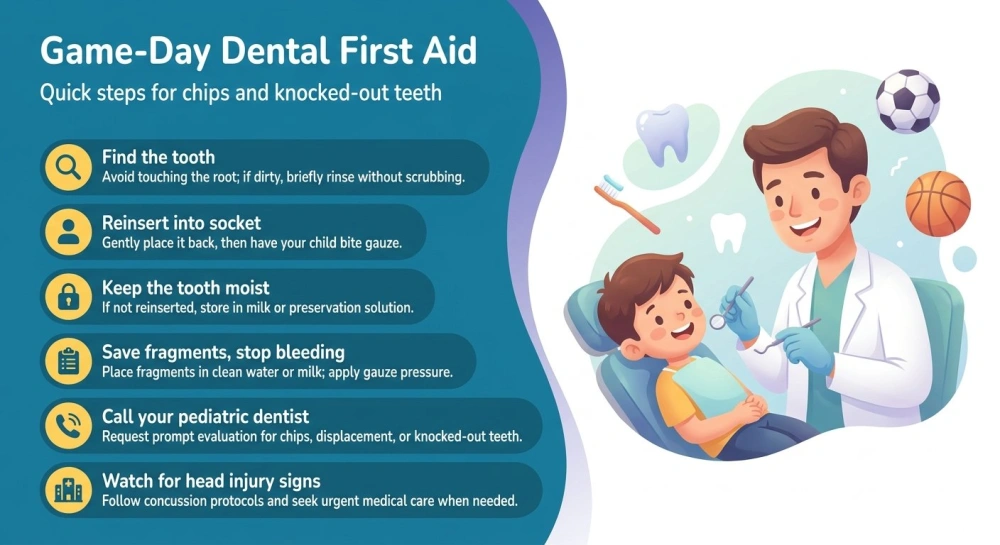
Quick, calm action can improve outcomes. Keep a small dental care kit with your child’s gear that includes clean gauze, a small container with a lid, and saline or clean water. Follow these general steps and seek dental care promptly. For specific medical guidance, consult your dentist and use official emergency resources [8] [9].
What if a permanent tooth is knocked out completely?
- Find the tooth Handle it only by the crown, not the root.
- Rinse briefly with clean water if dirty. Do not scrub.
- Reposition if possible Gently place the tooth back in the socket and have your child bite on clean gauze.
- Keep it moist If you cannot reinsert, place in milk or an emergency tooth preservation product and seek immediate dental care [8].
What if a tooth is chipped or moved out of place?
- Save any fragments in clean water or milk.
- Apply pressure with gauze if there is bleeding.
- Call your pediatric dentist and arrange a same day evaluation.
Some injuries look minor at the field but can involve root or jaw issues. When in doubt, call for guidance. If there are signs of head injury, follow concussion protocols and seek urgent medical care [4].
How can parents work with coaches and leagues to promote mouth guard safety?
Building a culture of safety helps every player on the team. Here are practical ways to partner with your league in Laguna Niguel, Laguna Hills, Aliso Viejo, Laguna Beach, Mission Viejo, and San Juan Capistrano.
- Ask about mouth guard policies before the season so expectations are clear.
- Share resources from professional associations that endorse mouth guard use in contact and collision sports [1] [5].
- Set reminders during equipment checks so kids do not forget guards at home.
- Replace worn guards before tournaments and playoffs.
If your child resists wearing a guard, involve them in choosing color and style, and practice short wear sessions at home while watching a game or doing drills in the yard. Comfort and personal buy in can make safety stick.
How does Kidz Modern Dentistry help families with sports dental injury prevention?
We support families who want straightforward protection for their young athletes. Our team cares for children from preschool to teens across Laguna Niguel and South Orange County. We focus on clear guidance, comfortable fittings, and quick access when you need help fast.
How do our services relate to mouth guards and youth sports safety?
- Personalized assessments We evaluate your child’s sport, bite, growth stage, and comfort needs to recommend the right design and thickness.
- Custom fabrication and fitting We offer scanning or impressions and precise adjustments so guards stay put without clenching.
- Rapid replacements We help with refits as teeth erupt or braces move.
- Emergency readiness Same day visits are available for dental injuries so you can get prompt care.
Where do we operate and whom do we serve?
We serve families in Laguna Niguel, Laguna Hills, Aliso Viejo, Laguna Beach, Mission Viejo, and San Juan Capistrano. If you are looking for a South Orange County dentist who works closely with young athletes, our pediatric team is here to help.
What is our approach to comfort, communication, and follow through?
- Kid friendly environment We make visits positive so children try on and practice with confidence.
- Clear education We teach your child how to wear, clean, and store their guard.
- Coaching collaboration We provide documentation for leagues when a guard is required and help you align with team policies.
What tools or processes do we use for a reliable fit?
- Digital scans or precise impressions for accurate fit and even thickness.
- Chairside adjustments to smooth edges and improve comfort.
- Follow up checks to confirm retention after early practices.
Why do families trust our pediatric team with sports protection?
- Experience with youth athletes We work with a wide range of sports and understand position specific needs.
- Comfort first focus Children are more likely to wear a guard that feels good. We prioritize a design your child accepts.
- Direct access to pediatric specialists You will meet qualified professionals who address questions right away.
Many families start with a quick visit to compare options for custom mouth guards for children and to review the pros and cons of a youth sports mouthguard that fits their child’s sport. We can also coordinate with your orthodontist if your child has active braces.
For parents who value simple next steps, we offer a clear path from evaluation to delivery. If you have questions about mouth guard fitting for kids or want to discuss a plan with a pediatric dentist Laguna Niguel families trust, call us at +1 949 273 0110.
We help families understand choices without pressure. Our goal is to protect smiles through education, comfort focused design, and consistent follow up. Pediatric mouthguards are an important part of that plan.
When you are ready to get started, schedule a visit for Pediatric mouthguards in Laguna Niguel with our team, or ask for guidance about store options for a quick season start. We are happy to assist either way.
Where can you find the sources for this guide?
- Policy on Prevention of Sports Related Orofacial Injuries – American Academy of Pediatric Dentistry
- Mouthguards – American Dental Association
- Mouthguards for preventing orofacial injuries in sport – Cochrane Library
- HEADS UP Concussion Information – Centers for Disease Control and Prevention
- Mouthguard Use in High School Sports – National Federation of State High School Associations
- Mouth Guards and Braces – American Association of Orthodontists
- Sensory Processing Differences Overview – American Academy of Pediatrics HealthyChildren
- Dental Emergencies and Trauma – National Institute of Dental and Craniofacial Research
- Mouth Injuries – MedlinePlus
- Sports Safety and Injury Prevention – Centers for Disease Control and Prevention
- Mouthguards and Their Role in Sports Related Traumatic Dental Injuries Review – National Library of Medicine
- Effectiveness of Mouthguards in Prevention of Orofacial Injuries Review – National Library of Medicine
Common Questions About This Topic
Find answers to frequently asked questions related to this article.