
- What are the real signs of teething and what is a myth?
- When does teething usually start and how long can sleep disruptions last?
- How can you set a bedtime routine for a teething baby that actually works?
- What safe teething pain relief options can help at night?
- Which baby teething remedies are backed by evidence and which should you avoid?
- How do you soothe teething pain during the night without disrupting sleep?
- What are the best teething toys and how do you use them safely?
- How do gum massage techniques help and how do you do them correctly?
- How can feeding and hydration choices affect teething and sleep?
- What sleep environment changes help a teething baby settle?
- How do you handle teething sleep regression without starting new habits?
- When should you see a pediatric dentist for teething concerns?
- What local and professional guidance matters for families in California?
- How can Kidz Modern Dentistry support you during teething nights?
- What sources and references support this guide?
What are the real signs of teething and what is a myth?
Teething is a normal part of development, but it can feel anything but easy when sleep gets choppy. Knowing what to expect can help you respond with confidence. Research shows that common signs include drooling, gum rubbing or chewing, mild irritability, decreased appetite for solid foods, and a slight rise in body temperature that stays below fever range. A high fever, persistent diarrhea, or severe rash are not typical teething symptoms and usually point to something else, so they deserve a call to your pediatrician[5][6].
Myths often cause unnecessary worry. For example, many families wonder whether new teeth cause high fevers. The best evidence suggests that while a small temperature bump can occur, fevers at or above 100.4 F are not caused by teething[5][6]. Another myth is that babies must suffer through teething without help. In reality, several gentle strategies can ease discomfort and support teething baby sleep with less disruption to your nights[2][12].
As your child approaches the first tooth, it is also a good time to think about Infant oral health. Establishing early habits and timely preventive visits will give you trusted guidance as new teeth arrive[1].
When does teething usually start and how long can sleep disruptions last?
For many babies, the first primary teeth appear around six months, although a normal range can be a few months earlier or later. The two lower central incisors often come first, followed by the upper central incisors. Teeth typically erupt in pairs and continue to appear through toddler years until all 20 primary teeth are present around age two to three[10][12].
Sleep disruptions are most noticeable in the days before and after a tooth breaks through the gum. Some babies have only a night or two of restlessness, while others have several days of shorter stretches. The intensity can vary from tooth to tooth. If your baby seems uncomfortable for longer than a week at a time, or if nights remain very unsettled with other concerning symptoms, it is reasonable to consult your pediatrician and schedule an early dental visit with a kids dentist Laguna Niguel for a closer look[1].
How can you set a bedtime routine for a teething baby that actually works?
Consistency and comfort matter. A familiar flow helps your baby relax and cues the brain for sleep. When teething is active, keep the routine predictable but allow for a few extra minutes of soothing. Here is a simple bedtime routine for teething baby comfort that many families find helpful.
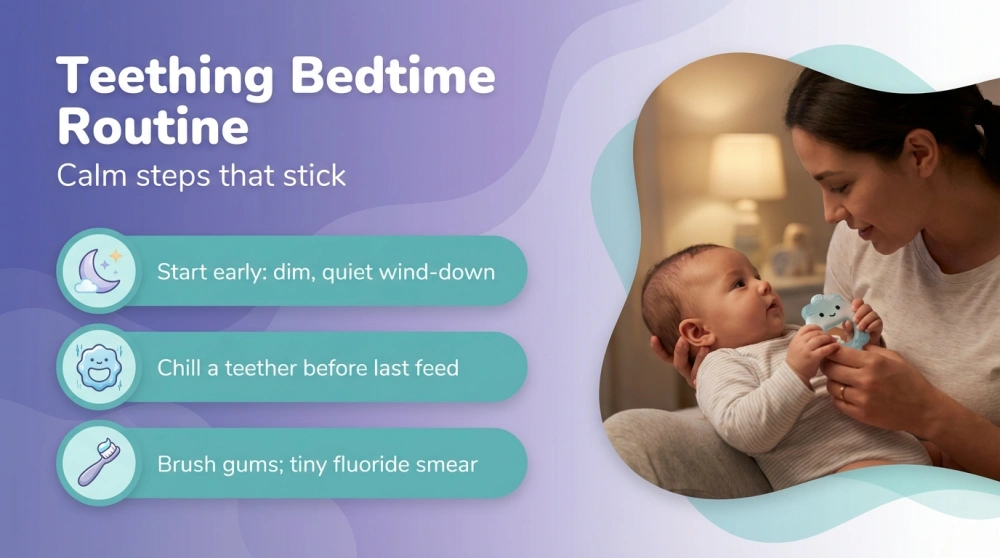
- Start calm early Begin wind down 30 to 45 minutes before bedtime with lights low and voices soft to reduce stimulation.
- Offer a safe chew Provide a chilled teether for five to ten minutes before the last feed so your baby can gnaw and release gum pressure[6][12].
- Brush the new tooth or gums Once the first tooth appears, use a tiny smear of fluoride toothpaste on a soft brush to clean before bed, which supports teething baby sleep by removing plaque and soothing gums[1][10].
- Feed mindfully Offer the last feed in a calm, dim space. If your baby is older and drowsy, give a gentle burp and place in the crib while sleepy but still awake to maintain healthy sleep cues[7].
- Use a brief comfort step Try a short gum massage or a cool washcloth for teething right before lights out to lower discomfort peaks[2][12].
- Keep the goodbye the same A few loving words and a light touch signal safety and predictability, even on tough nights.
What safe teething pain relief options can help at night?
Safe teething pain relief focuses first on nonmedication options, with medications used thoughtfully, only as needed, and under pediatric guidance.
What nonmedication strategies work best at bedtime and overnight?
- Cold pressure Chilled, not frozen, silicone teethers or a clean damp washcloth from the refrigerator can relieve gum soreness through cooling and gentle counter pressure[6][12].
- Gum massage A clean finger with gentle circular pressure for one to two minutes can ease discomfort before bed and during brief night wakings[2].
- Comfort holding Brief cuddles and a calm voice reset your baby without fully waking them, which supports help teething baby sleep at night.
When are medications considered and what should you avoid?
- Acetaminophen Can be considered for nighttime discomfort under your pediatrician’s guidance and the product label directions[9].
- Ibuprofen May be considered for babies over six months if your pediatrician recommends it and you follow dosing directions on the label[8].
- Avoid topical numbing gels Products with benzocaine are not recommended for infants due to serious safety concerns highlighted by the FDA[3].
- Avoid homeopathic teething tablets and gels The FDA has warned against these products due to variability and safety risks[4].
Always confirm with your pediatrician before giving any medicine to your baby. Do not use aspirin for children.
Which baby teething remedies are backed by evidence and which should you avoid?
Parents hear many suggestions about baby teething remedies. A practical way to decide is to ask if the option is supported by research and professional guidance.
- Supported by professional guidance Chilled teethers, a cold washcloth for teething, clean finger gum massage, and a stable bedtime routine are recommended by pediatric and dental groups as first line options[2][6][12].
- Use with medical guidance Acetaminophen or ibuprofen when appropriate, only as directed and with input from your pediatrician[8][9].
- Avoid due to safety risks Benzocaine gels, lidocaine preparations, homeopathic teething tablets, and gels with unknown ingredients are not recommended for infants[3][4].
- Avoid teething necklaces and beads These can pose choking and strangulation hazards. Professional pediatric guidance advises against their use[13].
- Be cautious with natural oils Clove or herbal oils can irritate delicate gums and are not supported by pediatric dental guidance for infants[2].
Professional groups emphasize that teething discomfort is temporary, and gentle measures usually provide enough relief to protect teething baby sleep while teeth erupt[2].
How do you soothe teething pain during the night without disrupting sleep?
Night wakings often increase when a tooth is about to cut through. The goal is to reduce pain signals while keeping your baby drowsy so they can settle again.
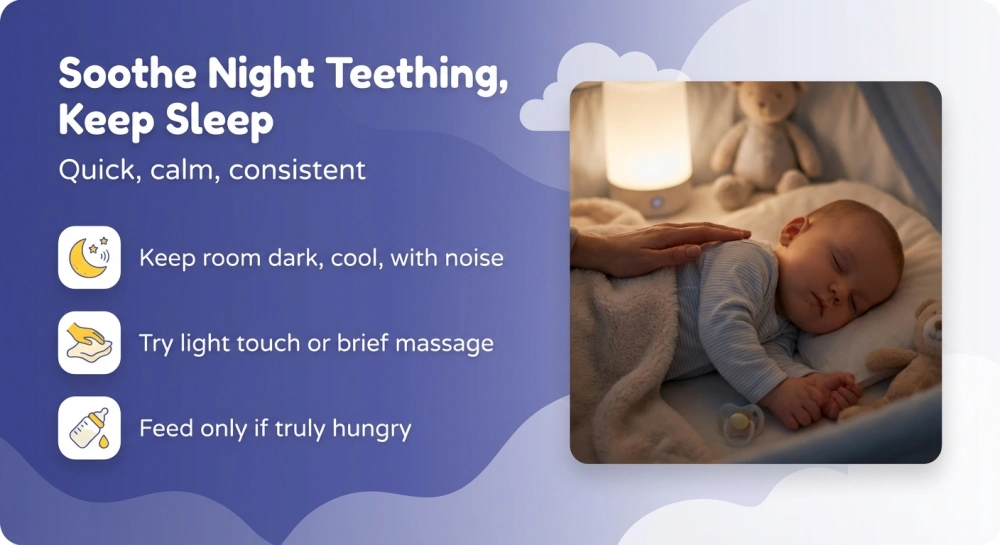
- Keep the room sleep ready Use a dim red or amber night light only if needed, maintain cool temperature, and keep white noise steady so the environment feels unchanged during brief check ins[7].
- Use the lightest touch first Try a gentle pat, a few soft words, or a short gum massage. Pull back if your baby becomes more alert and try again after a minute[2].
- Offer a chilled teether If your baby is fully awake and fussy, a chilled teether for a few minutes can settle sore gums before a quick return to the crib[6][12].
- Feed only if truly hungry If night feeds are developmentally needed, keep them calm and brief. Avoid feeding to sleep for older babies if you are working on independent sleep skills[7].
Parents often ask whether adding a new nightly habit will help teething baby sleep. Short term changes can backfire if they become the only way your baby knows how to fall asleep. Instead, rely on a consistent routine and brief comfort to help your child back to sleep as pain eases[7].
What are the best teething toys and how do you use them safely?
The best teething toys combine safe materials, easy cleaning, and the right size for your baby’s mouth. Here is what to look for and how to use them to soothe teething pain.
- Choose safe materials and size Look for one piece silicone or rubber without small detachable parts. Size should be large enough that your baby cannot fit the whole toy in the mouth[12].
- Chill but do not freeze Cold reduces inflammation signals. Hard frozen items can hurt gums and may crack or leak. Chilling in the refrigerator is the safer approach[6][12].
- Rotate textures Soft bumps and ridges can massage gums. Offer a variety and see what your baby prefers[12].
- Keep them clean Wash daily with warm soapy water and air dry to reduce germs, especially before bedtime use[12].
If you are not sure which option to try first, start with a simple ring style teether. It is durable, easy to chill, and comfortable for little hands to grip[12].
How do gum massage techniques help and how do you do them correctly?
Gum massage can interrupt pain signals and provide counter pressure that many babies find soothing. It is a quick addition to your teething sleep tips toolkit.
- Wash hands Clean hands prevent germs from reaching sore gums[2].
- Use gentle circles Place a clean finger on the swollen gum area and make slow circular motions with light pressure for one to two minutes[2].
- Try a cool option You can wrap your finger in a clean, damp, chilled washcloth for added comfort[12].
- Stop if upset If your baby resists, pause and try again later when your child is calmer.
Done before bedtime, gum massage can lower discomfort peaks and help teething baby sleep settle more smoothly before lights out[2].
How can feeding and hydration choices affect teething and sleep?
Teething can change feeding patterns for a few days. Many babies prefer cooler purees or softer textures when gums are sore. Hydration also matters because drooling increases moisture loss. Small sips of water for babies over six months or normal breastmilk or formula feeds help maintain comfort. To protect teeth and sleep, consider the following.
- Avoid bottles in the crib Putting a baby to bed with milk or juice raises the risk of early tooth decay and disrupts sleep when the bottle becomes a sleep cue[1][10].
- Brush before bed Clean the gums or teeth with a soft brush and a tiny smear of fluoride toothpaste as soon as the first tooth appears[1][10].
- Protect the cheeks and chin Drool can irritate skin. Apply a thin coat of a pediatrician approved barrier cream to reduce irritation and support sleep comfort[6].
Many parents find it reassuring to hear that these steps support long term habits that promote Infant oral health and easier sleep routines as more teeth appear[1].
What sleep environment changes help a teething baby settle?
Your baby’s sleep space can ease transitions during teething nights. A few small changes can make a real difference.
- Keep it cool and dark Cooler rooms and darkness support melatonin release and calmer sleep. Blackout curtains and a comfortable room temperature help many babies settle more easily[7].
- Use white noise Consistent sound masks household noise and creates a cue that nighttime has arrived[7].
- Follow safe sleep Place your baby on the back in a separate sleep space with a firm, flat mattress and a fitted sheet, without pillows or loose blankets[7].
Keeping the room environment consistent gives your baby a reliable framework that reduces full awakenings when teething discomfort bubbles up[7].
How do you handle teething sleep regression without starting new habits?
Teething sleep regression describes a short period when previously solid sleep gets rocky due to gum inflammation and discomfort. The best approach blends empathy with consistency.
- Expect brief setbacks A few restless nights are common around the time a tooth erupts. Most babies return to baseline within days[5].
- Stick to your routine Maintain your bedtime flow and nap times. Predictability keeps your baby feeling secure and reduces new habit loops[7].
- Comfort in the crib Offer a hand on the chest, a gentle pat, or soft words to soothe without taking your baby out of the sleep space when possible.
- Use safe relief Bring in chilled teethers, gum massage, or pediatrician guided medication if needed and then return to the crib[6][8][9].
Parents often worry that any extra help will undo progress. Short, consistent, and safe soothing usually supports a faster return to steady sleep than starting new long routines in the middle of the night[7].
When should you see a pediatric dentist for teething concerns?
You do not need to wait for a problem to meet a pediatric dentist Laguna Niguel. Professional groups recommend the first dental visit by your child’s first birthday or within six months of the first tooth. This early visit gives you personalized teething sleep tips, feeding guidance, and a clear prevention plan[1].
Schedule sooner if you notice any of the following.
- Persistent sleep disruption Several nights of intense discomfort with swollen gums and no improvement.
- Feeding refusal Ongoing refusal to drink or feed that risks dehydration.
- Unusual gum changes Large bluish swelling likely an eruption cyst or bleeding that needs evaluation[2].
- Suspected tooth decay White or brown spots, pits, or changes in tooth color, especially if bottles go to bed[1][10].
If you live in Laguna Niguel, CA and want guidance about Infant oral health in Laguna Niguel, our local pediatric team can help you decide on next steps that fit your child and your routine.
What local and professional guidance matters for families in California?
Families in Laguna Niguel, California benefit from both national pediatric guidance and state level resources. Professional standards from the American Academy of Pediatric Dentistry and the American Dental Association shape clinical recommendations on teething care, first visits, fluoride use, and safe pain relief[1][12]. In California, licensed providers operate under the oversight of the Dental Board of California, which offers consumer resources to help you verify licensure and understand complaint processes if concerns ever arise[11].
For sleep safety, the American Academy of Pediatrics safe sleep recommendations apply to all states, including California. These guidelines emphasize placing babies on their backs for every sleep, using a firm and flat surface without soft bedding, and room sharing without bed sharing for at least the first six months, which supports safer nights during teething phases[7]. California families can also explore statewide public health resources on infant safe sleep from the California Department of Public Health for community programs and education[14].
When choosing pain relief or teething products, check FDA advisories. The FDA advises against benzocaine teething gels and homeopathic teething tablets for infants due to safety concerns, which helps families make informed choices in California and nationwide[3][4].
How can Kidz Modern Dentistry support you during teething nights?
We meet parents where they are with practical, science informed care that makes a stressful season feel manageable. Our pediatric dentist in Laguna Niguel partners with you on prevention, comfort strategies, and early visits that build confidence for the months ahead.
What services do we offer that relate to teething and sleep?
- Early checkups and guidance First visit by age one sets a foundation for healthy habits, gentle exams, and personalized teething sleep tips tailored to your child’s routine[1].
- Comfort forward care Teething can make mouths tender. We use a light touch, kid friendly language, and tell show do to reduce anxiety.
- Preventive care focus We help you choose brushes, toothpaste amounts, and feeding patterns that support strong sleep and cavity prevention from the start[1][10].
- Emergency availability If you are worried about unusual gum swelling, a chipped baby tooth, or sudden pain, our same day emergency access helps you get answers quickly.
- Safe relief planning We coordinate with your pediatrician on safe teething pain relief when needed and offer clear guidance on what to avoid based on FDA advice[3][4].
Where do we operate and how do you reach us?
Our home base is in Laguna Niguel, CA where we care for families across the surrounding communities. Call us at +1 949 273 0110 to schedule a first visit or to ask a quick question about your baby’s teething and sleep.
What is our approach to helping families through teething?
- Personalized plans We listen first then build a simple plan that fits your bedtime routine for teething baby comfort.
- Evidence guided choices Our team follows current pediatric dental and medical guidance on safe remedies, sleep friendly routines, and the timing of care[1][7][12].
- Gentle technology When imaging is needed, we use modern techniques designed for children, always with a focus on comfort and safety.
- Clear next steps We help you know exactly when to try home strategies, when to call your pediatrician, and when to book a dental visit.
How do we demonstrate leadership, experience, and care?
- Experienced pediatric team Our clinicians have dedicated training in the unique needs of infants and young children.
- Family education first We focus on practical coaching that helps your baby sleep better while teething without making nights more complicated.
- Trusted community partner Families in our area rely on us for timely responses and understandable guidance during the trickiest weeks of teething.
Whether you are seeking quick help teething baby sleep at night or a full preventive plan for Infant oral health, we are here to support you with calm, consistent care that fits your family. If you are comparing options for a kids dentist Laguna Niguel or ready to meet a pediatric dentist Laguna Niguel, our team is happy to welcome you and answer every question.
What sources and references support this guide?
- Perinatal and Infant Oral Health Care – American Academy of Pediatric Dentistry
- Teething FAQ – American Academy of Pediatric Dentistry
- FDA takes action against use of over the counter benzocaine teething products in infants and children – U.S. Food and Drug Administration
- FDA warns against use of homeopathic teething tablets and gels – U.S. Food and Drug Administration
- Signs and symptoms of primary tooth eruption: a meta analysis – Pediatrics
- Teething advice for parents – NHS
- Sleep Related Infant Deaths Updated 2022 Recommendations – American Academy of Pediatrics
- Ibuprofen for children information – HealthyChildren.org
- Acetaminophen for children information – HealthyChildren.org
- Children’s Oral Health – National Institute of Dental and Craniofacial Research
- Consumer resources and license verification – Dental Board of California
- Teething guidance and tips – American Dental Association
- Teething necklaces and beads safety – HealthyChildren.org
- Infant safe sleep resources – California Department of Public Health
Common Questions About This Topic
Find answers to frequently asked questions related to this article.
