- What will you learn about thumb sucking and pacifiers today?
- How do thumb sucking and pacifiers affect teeth and jaws?
- When do most children stop naturally and when should you intervene?
- What dental problems can happen if the habit continues past age 3 to 4?
- Are pacifiers safer than thumb sucking for teeth?
- How do frequency, intensity, and duration change the risk?
- When should you stop the pacifier and how can you do it with less stress?
- How can you help your child stop thumb sucking kindly and effectively?
- Will teeth self correct after the habit stops and when might orthodontics be needed?
- What about speech, ear infections, and breathing considerations?
- How do dental checkups and fluoride protect kids during and after habits?
- Which product and safety rules should parents in California know?
- What questions should you ask a pediatric dentist in Laguna Niguel and South Orange County CA?
- How does Kidz Modern Dentistry support families in Laguna Niguel and South Orange County CA?
- What sources and references were used?
What will you learn about thumb sucking and pacifiers today?
Parents across Laguna Niguel, Laguna Hills, Aliso Viejo, Mission Viejo, Laguna Beach, and San Juan Capistrano often ask if thumb sucking or pacifier use is bad for a child’s teeth. The short answer is that these soothing habits are common and often temporary, yet the timing, frequency, and intensity matter for oral development. In this guide, we will walk through how habits like thumb sucking and pacifier use can affect teeth and jaws, when to consider stopping, and gentle strategies to help your child make the transition. We will also look at product safety, evidence on health effects, and how a pediatric dentist can support your family with practical next steps.
You will find science backed answers from respected organizations and research. We cite guidance from the American Academy of Pediatric Dentistry, the American Dental Association, federal safety standards, and peer reviewed studies to help you confidently decide what is right for your child and your family routine [1] [2] [3] [6] [7] [8] [12].
Throughout, we will speak plainly about real world concerns, from bedtime comfort to preschool peer questions, and we will outline options that respect your child’s pace. If a habit is raising questions or you notice changes in your child’s bite, a visit with a pediatric dentist can clarify what is typical and what needs attention. Kidz Modern Dentistry serves Laguna Niguel and South Orange County, and our team is ready to help if you want a personalized plan.
How do thumb sucking and pacifiers affect teeth and jaws?
Thumbs, fingers, and pacifiers can be soothing. When used over time and with enough pressure, they can also shift teeth and influence how the upper jaw grows. The main dental changes linked with ongoing nonnutritive sucking include an anterior open bite, an increased overjet sometimes called a front teeth overbite, and a posterior crossbite [1] [7] [12].

- Anterior open bite This means the front teeth do not touch when your child bites down, and a gap remains between the upper and lower front teeth. The habit can keep the front teeth from erupting fully or can tip them outward [7] [12].
- Increased overjet This means the upper front teeth are positioned further ahead of the lower front teeth than usual, sometimes described as protrusive front teeth [7].
- Posterior crossbite This is when the upper back teeth bite inside the lower back teeth, often linked to changes in jaw width and tongue posture when a habit persists [7] [12].
Research shows that risk is strongly related to how many hours per day a child sucks, how strong the sucking force is, and how long the habit is maintained. Short lived or light habits in toddlers are much less likely to cause lasting changes. Longer and more intense habits, especially beyond the preschool years, raise the chance of bite changes [1] [7].
When do most children stop naturally and when should you intervene?
Many children stop thumb sucking or pacifier use on their own between ages 2 and 4. Pediatric dental guidance suggests active encouragement to stop as children approach kindergarten, generally around age 3 to 4, to reduce the chance of bite problems [1] [2] [3]. You do not need to rush a very young toddler, but it helps to keep the habit from becoming an all day routine.
Pacifier use has some unique timing considerations. The American Academy of Pediatrics notes pacifier use at sleep times is associated with reduced risk of sleep related infant deaths during the first year of life. After infancy, families can consider gradually limiting and then stopping pacifier use, balancing sleep routines and dental development goals [5] [11]. Your pediatrician and pediatric dentist can help you decide on timing that fits your child’s needs.
If you see tooth changes, speech concerns, or daytime dependence on the habit past age 3 to 4, it is a good moment to check in with a pediatric dentist. Early guidance can make change easier and can sometimes prevent the need for more complex treatment later [1] [12].
What dental problems can happen if the habit continues past age 3 to 4?
Persistent habits can influence dental growth. Not every child will have the same changes, and some changes may be mild. Still, it helps to know what to watch for as a habit continues.
- Open bite risk increases Ongoing thumb or pacifier use can keep the front teeth from contacting, which may affect biting into foods and speech sounds [7] [12].
- Overjet may increase Upper front teeth can tip forward, which may increase the chance of tooth injury during falls or play, and may affect smile alignment [7].
- Crossbite can form Narrowing of the upper arch can lead to a crossbite in the back teeth, which may require orthopedic or orthodontic correction if it persists [12].
- Gum irritation can occur Constant pressure on certain areas can irritate soft tissues or cause calluses on the thumb or finger [2].
- Cavities can increase with sweet coatings Pacifiers dipped in sweeteners or bottles at sleep time increase cavity risk. Avoid adding sugar, honey, or juice to pacifiers or bedtime bottles [3] [10].
These risks grow with longer and more forceful habits, which is why steady, supportive steps to stop around preschool age are recommended [1] [12].
Are pacifiers safer than thumb sucking for teeth?
Parents often ask whether a pacifier is better than a thumb. Each has pros and cons, and the dental effects depend on the specific child and pattern of use.
- Pacifiers are removable You can limit a pacifier to naps and bedtime, then phase it out more easily than thumbs, which can be harder for a child to stop because they are always available [2] [3].
- Both can affect the bite Long duration and strong intensity create similar risks for open bite and crossbite with either thumbs or pacifiers, especially if the habit continues into the preschool years and beyond [1] [7].
- Pacifiers have safety standards United States federal rules set design and safety requirements for pacifiers, which can reduce choking hazards when products meet the standard. Always choose pacifiers that meet safety rules and inspect them regularly [6].
- Medical factors influence timing Pacifier use during sleep in the first year is associated with a reduced risk of sleep related infant deaths. Decisions after infancy should consider sleep, soothing, ear infection risk, and dental growth, guided by your pediatrician and dentist [5] [11].
What matters most is how often and how firmly your child uses the habit, and how long it continues. Your pediatric dentist can help tailor a plan that fits your child’s needs and temperament.
How do frequency, intensity, and duration change the risk?
Think of three levers that influence dental changes from habits.
- Frequency How many times per day does the habit occur, and is it only for sleep or also during the day at school or daycare [1] [7].
- Intensity How hard does your child suck and for how long during each session. Light soothing may be less impactful than vigorous sucking that creates visible pressure on teeth and gums [1].
- Duration How many months or years the habit continues. Habits that fade in toddler years are much less likely to change the bite than habits that continue through preschool into the early school years [7] [12].
Small shifts in these levers can reduce risk. For example, moving from all day use to sleep only, or helping a child relax without sucking during stressful moments, can make a meaningful difference. A pediatric dentist can help you set realistic goals and celebrate small wins.
When should you stop the pacifier and how can you do it with less stress?
Many families aim to start weaning from the pacifier around age 2, then continue toward stopping by age 3 to 4 to support healthy dental development. This timing also allows you to support sleep transitions and address ear infection concerns if they arise [1] [3] [11].
What gradual steps help pacifier weaning feel manageable?
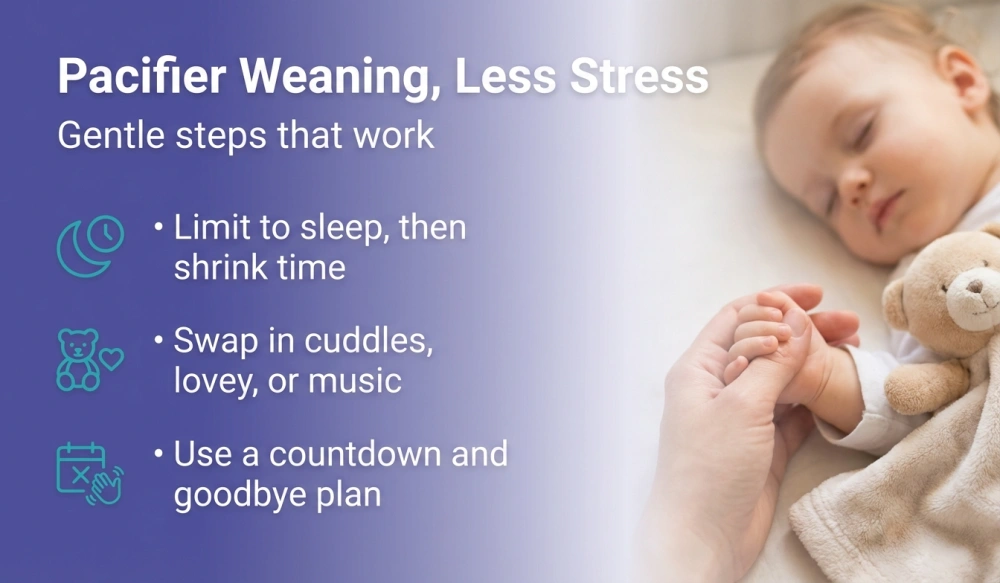
- Limit to sleep times first Move toward naps and bedtime only, then reduce duration within those windows. A sticker chart or bedtime calendar can help your child see progress [3].
- Use substitution comfort Offer a favorite stuffed animal, a soft blanket, gentle music, or more cuddle time during routine transitions. A consistent soothing routine can be as comforting as the pacifier [11].
- Try a countdown plan Mark a special day on the calendar, talk about it with simple positive language, then say goodbye to the pacifier together. Some families use a story about a helper who collects pacifiers for baby animals, which can make the change feel meaningful [3].
- Trim exposure Keep pacifiers in a set place and out of sight during the day so the habit is not triggered by seeing one nearby [3].
- Check product safety Replace worn pacifiers and use only one piece designs that meet safety standards. Never tie a pacifier around the neck or attach with long cords, which can be dangerous [6].
If your child struggles with anxiety or sleep after the change, pause and consult your pediatrician and pediatric dentist. A stepwise plan with gentle reinforcement is more successful than pressure or punishment [1] [8].
How can you help your child stop thumb sucking kindly and effectively?
Stopping thumb or finger sucking can take patience. Because thumbs are always available, you will rely more on routines, positive coaching, and sometimes reminders or habit breaking appliances if needed. The aim is to help your child feel in control and supported.
What positive strategies work for thumb sucking?
- Notice triggers Many kids suck thumbs when they are tired, worried, or bored. Plan calming activities for those times, such as reading together or quiet play [2].
- Use praise and rewards Catch progress and recognize it. Short goals like a few minutes without sucking during a TV show, then longer goals at bedtime, can build momentum [1].
- Involve your child Let your child help choose a reminder, like a bandage or a fabric thumb cover at night. The goal is collaboration rather than pressure [1] [8].
- Coordinate with school Share your plan with caregivers and teachers so reminders are consistent and supportive across settings [1].
- Consider dental reminders For older children who want help, a gentle habit reminder appliance can reduce the ease of thumb placement. Evidence shows that counseling and reminders can reduce habits over time in motivated children [8] [12].
A pediatric dentist can tailor a plan, demonstrating tongue resting position, nasal breathing cues, and swallowing patterns that support a stable bite as the habit fades [12].
Will teeth self correct after the habit stops and when might orthodontics be needed?
When a child stops a habit early, many bite changes can improve as teeth continue to grow and erupt. The chance of self correction is higher when the habit ends before the permanent front teeth come in. Open bite and mild overjet can improve in the months after stopping, especially if the habit ended by around age 3 to 4 [12]. That said, not all changes resolve fully on their own. Some children may need interceptive orthodontics to guide jaw growth or tooth position if the bite remains altered or if the habit continued into the early school years [7] [12].
What signs suggest an orthodontic consultation could help?
- Persistent open bite A visible gap between front teeth when biting down several months after the habit has ended [12].
- Crossbite in back teeth Upper back teeth bite inside lower back teeth, which can affect chewing and jaw growth [12].
- Speech or chewing difficulty Ongoing lisp or trouble biting into foods that does not improve after stopping the habit [12].
Your pediatric dentist can advise on timing for any interceptive steps, such as palatal expansion for crossbite or habit reminder appliances, and can coordinate with an orthodontist when appropriate [12].
What about speech, ear infections, and breathing considerations?
Parents also ask about concerns beyond teeth. Evidence suggests several considerations, though individual experiences vary and your medical team can personalize guidance.
- Speech considerations Habits that alter tongue posture and front tooth contact can influence certain speech sounds. Many children improve as the habit stops and teeth erupt. If speech concerns persist, a speech language pathologist can help, often in partnership with your dental team [12].
- Ear infection risk Research has found an association between pacifier use and increased ear infections in some children, especially after 6 months. Discuss the balance of risks and benefits with your pediatrician when planning pacifier weaning after the first year [11] [13].
- Breathing and sleep If you notice mouth breathing, snoring, or restless sleep, let your pediatrician and dentist know. They can evaluate nasal airways, tonsils, and dental arches to support healthy breathing habits [12].
As always, decisions are child specific. Coordinated care among your pediatrician, pediatric dentist, and where needed a speech language pathologist or ear nose and throat specialist can help your child feel and function their best.
How do dental checkups and fluoride protect kids during and after habits?
Regular checkups set the stage for healthy teeth during and after soothing habits. The American Academy of Pediatric Dentistry recommends a first dental visit by age 1, then regular checkups, preventive services, and coaching tailored to each child. This schedule supports early detection of bite changes and cavities and gives your family a trusted place to ask questions [9].
- Early exams Your dentist can monitor bite development, tongue and lip posture, and habit patterns, then suggest small adjustments that fit your daily life [9].
- Fluoride and sealants Fluoride varnish and toothpaste strengthen enamel, and sealants protect grooves in back teeth. These steps reduce cavity risk, which is helpful if habits affect oral hygiene routines or saliva flow. National data show that tooth decay remains common in children, so prevention matters [4] [10].
- Diet coaching Avoid pacifier dips in sugary liquids and limit frequent snacks or drinks with added sugars. These steps lower cavity risk and support healthy routines [3] [10].
- Injury prevention If front teeth are more forward from a habit, your dentist can discuss mouthguard use for sports and active play to reduce injury risk [12].
Prevention is not just treatments. It is coaching that fits your child’s personality. Pediatric teams use simple visuals, games, and comfort techniques so kids can thrive at the dentist.
Which product and safety rules should parents in California know?
Parents in Laguna Niguel and South Orange County can boost safety with a few key checks.
- Choose pacifiers that meet federal standards United States rules define safety features for pacifiers, including shield size, ventilation holes, and construction, to reduce choking hazards. Look for compliance with federal requirements and inspect pacifiers for wear and tear, cracks, or loose parts. Replace pacifiers regularly and follow manufacturer age and size guidance [6].
- Avoid cords and modifications Never tie a pacifier to a string, ribbon, or necklace and do not attach it with long straps. Use short, safety designed clips only when supervised. Avoid home modifications that could compromise safety [6].
- Understand dental appliance decisions If a habit reminder appliance is considered, your pediatric dentist will review benefits, risks, and care instructions. In California, dental sedation that may be used for anxiety or special needs is regulated with permit requirements and monitoring rules to enhance safety. Care should be provided by licensed dentists who follow state rules and professional guidelines [14] [12].
When in doubt, ask your pediatric dentist to review product options and fit considerations for your child. Safety and comfort go hand in hand during transitions away from soothing habits.
What questions should you ask a pediatric dentist in Laguna Niguel and South Orange County CA?
Bringing a few focused questions to your visit can make your plan more effective and easier to follow at home.
- What changes do you see in my child’s bite today Ask about open bite, overjet, or crossbite, and whether they are likely to improve with simple habit changes [12].
- What is the simplest first step we can try Request one or two actions tailored to your child’s routine, such as limiting to sleep times or using a sticker chart [1].
- How do we reinforce progress without stress Ask for language and reward ideas that match your child’s age and temperament [1].
- When should we check progress again Plan a follow up so your child can celebrate improvements and the dentist can monitor tooth position [9].
- If a habit reminder appliance is needed, what are the options Discuss design, care, expected time frames, and how success will be measured [8] [12].
- How does this plan fit with my child’s sleep and school schedule Coordinate with your pediatrician and teachers as needed to keep the approach consistent and supportive [11].
Local families often ask about care close to home and scheduling around school and activities. Pediatric dentists who serve Laguna Niguel, Laguna Hills, Aliso Viejo, Mission Viejo, Laguna Beach, and San Juan Capistrano can help you plan visits that fit your week and provide written steps to share with caregivers.
How does Kidz Modern Dentistry support families in Laguna Niguel and South Orange County CA?
We know that comfort habits are personal. Our role is to support you with clear information, a friendly environment, and practical tools that fit your child’s routine. Here is how our pediatric team helps families navigate thumb sucking and pacifier transitions.
- Personalized habit evaluation We review your child’s bite, jaw growth, and oral posture, then map a plan for gradual change. We discuss sleep routines, school rhythms, and any medical considerations so the plan works in real life.
- Gentle, coaching forward approach Kids respond to patient coaching and achievable goals. We provide sticker charts, simple scripts for parents, and fun visual cues that help children feel proud of each step forward.
- Interdisciplinary coordination When appropriate, we coordinate with your pediatrician, speech language pathologist, or orthodontist so your child receives consistent guidance and timely next steps.
- Evidence guided options If a habit reminder appliance or interceptive orthodontic step is considered, we review benefits, expected timelines, and care tips with you, grounded in professional guidelines and research.
- Kid friendly sedation available when needed For children who have high anxiety or special health care needs, we offer kid friendly sedation within a safety focused framework and in accordance with California rules. This is used only when necessary and after careful discussion of options.
- Same day emergency support Life happens. If a front tooth is injured or a retainer breaks, prompt care can protect your child’s smile and confidence.
- Local access and flexible scheduling We serve families across Laguna Niguel, Laguna Hills, Aliso Viejo, Mission Viejo, Laguna Beach, and San Juan Capistrano. Appointments are available to fit school calendars and after school needs.
- Warm, welcoming environment Our office is designed for kids, with a calm, positive atmosphere and a team that communicates at kid level while keeping parents fully informed.
Kidz Modern Dentistry provides comprehensive pediatric care for children of all ages, from first visits to habit counseling to interceptive orthodontic referrals when appropriate. We focus on prevention and education first, then tailor treatment if needed. To talk through a plan for your child or to schedule a visit, call us at +19492730110. If you are looking for a pediatric dentist in Laguna Niguel, a kids dentist in Laguna Hills, or a children’s dentist in Aliso Viejo, our team is ready to help you take the next step with confidence.
What sources and references were used?
- Policy on Oral Habits for the Pediatric Dental Patient AAPD
- Thumb Sucking MouthHealthy by ADA
- Pacifiers MouthHealthy by ADA
- Oral Health Fast Facts CDC
- Sleep Related Infant Deaths Updated 2022 Recommendations Pediatrics via PubMed
- Requirements for Pacifiers Part 1511 eCFR
- Effects of Breastfeeding and Sucking Habits on Malocclusion in Primary Dentition PLoS One
- Interventions for Managing Nonnutritive Sucking Habits in Children Cochrane Database
- Periodicity of Examination and Preventive Dental Services AAPD
- Baby Teeth Matter NIDCR
- Pacifiers Soothe Your Baby Safely HealthyChildren by AAP
- Management of the Developing Dentition and Occlusion AAPD
- Pacifier Use and Otitis Media Pediatrics via PubMed
- Sedation Permit Information Dental Board of California
Common Questions About This Topic
Find answers to frequently asked questions related to this article.