- Why can early pediatric dental visits shape jaw and tooth development to reduce braces later?
- What happens at the first early visit and when should it be scheduled?
- How does interceptive orthodontics work for young children?
- What is habit counseling and how can it influence jaw development?
- How do airway and myofunctional habits affect facial growth?
- How do preventive treatments support guided jaw growth?
- What diagnostic tools help us make safe, child specific decisions?
- What timelines should parents know from toddlerhood through early teen years?
- How do California and local standards guide pediatric dental care?
- What questions should you ask at your child’s next visit?
- Frequently asked questions about early orthodontic guidance
- Who is Kidz Modern Dentistry and how do we support your family?
- References
Why can early pediatric dental visits shape jaw and tooth development to reduce braces later?
Early dental visits give pediatric dentists a front row seat to a child’s growth and development. That early window lets us guide tooth eruption, track jaw development, and address emerging problems before they become complex. Strategic steps like monitoring spacing, using space maintainers after early tooth loss, correcting crossbites while the palate is responsive, and coaching healthy oral habits can decrease crowding risk and sometimes reduce the need for full braces later or shorten future orthodontic treatment time. The goal is not perfection or promises but smart prevention and timing. National professional groups recommend the first dental visit by the first birthday and orthodontic screening by about age seven, because that is when growth guidance matters most [1] [2].
For families in Laguna Niguel, Laguna Hills, Laguna Beach, Aliso Viejo, and Mission Viejo, regular early dental visits also support oral health basics that make orthodontic options simpler later. Cavities can trigger premature tooth loss and crowding; avoiding decay through tooth decay prevention keeps natural space for permanent teeth to erupt in better alignment [1] [6] [7]. When we combine prevention with interceptive orthodontics, we work with growth rather than against it.
What happens at the first early visit and when should it be scheduled?
The American Academy of Pediatric Dentistry advises that children establish a dental home by the first birthday or within six months of the first tooth erupting. At this visit, we focus on gentle assessment, habit guidance, and a personalized prevention plan. You can expect a comfortable exam, cavity risk assessment, cleaning as needed, fluoride varnish according to risk and age, and coaching on brushing, diet, and home routines [1] [7].
We document tooth eruption patterns and spacing. Even in toddlers, spacing between baby teeth can be a positive sign that there is room for larger permanent teeth. Limited or tight spacing can flag a higher chance of crowding later, which informs how closely we will watch development and whether we might take preventive steps. If your child lives in or near Laguna Niguel, we will also consider local water fluoride levels and lifestyle patterns that may affect cavity risk. From the start, we plan recall visits at intervals based on individual risk and needs [1].
How does growth and development tracking guide choices over time?
Across routine dental checkups for toddlers and school aged children, we track changes in jaw width, tooth eruption sequence, molar relationship, and bite symmetry. Small shifts can forecast larger changes. For example, an emerging posterior crossbite in a six year old may signal a narrow palate that could benefit from timely expansion. Likewise, premature loss of a baby molar can invite neighboring teeth to tip into the space, crowding out the permanent successor unless we hold the space [5]. By intervening at the right time, we help the bite develop in a direction that may decrease future orthodontic complexity [2] [3].
How does interceptive orthodontics work for young children?
Interceptive orthodontics aims to guide developing bites and jaws during the mixed dentition years when both baby and permanent teeth are present. Rather than waiting for all permanent teeth to erupt, a pediatric dentist coordinates or initiates selective treatments that address specific problems early. The intention is to improve function, preserve space, and support natural eruption paths. This approach can reduce crowding, help correct crossbites, and sometimes reduce the extent of treatment needed in adolescence [2] [3] [4] [5].
Which spacing and eruption issues can benefit from space maintainers?
When a baby molar is lost too early, neighboring teeth tend to drift into the open space. That drift can block the permanent tooth underneath, leading to crowding or impaction. A space maintainer holds the spot for the upcoming tooth. These small appliances may be fixed or removable and are customized for your child. Space maintenance is a cornerstone of eruption guidance and preventive orthodontics, particularly after extractions due to cavities. Decay prevention is therefore integral to crowding prevention because keeping baby molars healthy preserves future space naturally [5] [6].
When is crossbite correction recommended and why does timing matter?
A posterior crossbite occurs when upper teeth bite inside lower teeth on one or both sides. In growing children, the palate responds well to orthopedic widening. Correcting a crossbite early can improve symmetry, help the jaw joints function comfortably, and provide additional arch width for permanent teeth. Evidence suggests that expansion in the mixed dentition can be effective, making timing an important factor. Early treatment also reduces the chance of a functional shift that reinforces asymmetry as a child grows [4] [5].
How does an early orthodontic assessment reduce the need for braces later?
The American Association of Orthodontists recommends that children receive an orthodontic evaluation by age seven. At that point, enough permanent teeth have erupted to detect crowding, crossbites, and bite imbalances. Addressing selected issues early may decrease the need for complex mechanics later or shorten future treatment time. While some children will still benefit from comprehensive braces as teens, early assessments help optimize timing and approach so that treatment is as efficient and conservative as possible [2] [3].
What is habit counseling and how can it influence jaw development?
Habit counseling addresses behaviors that affect the bite and facial growth. Prolonged thumb sucking or heavy pacifier use can push front teeth forward, narrow the upper arch, and contribute to open bite or crossbite. Gentle, age appropriate strategies can help children let go of habits during key windows. Tools range from positive reinforcement and behavioral charts to dental habit appliances in selected cases. The earlier we guide habits, the more the face and bite can grow unhindered [10].
How do myofunctional habits relate to tooth eruption guidance?
Muscles influence how teeth erupt and where jaws grow. For example, a forward tongue posture or low resting tongue position may not support normal arch development. Conversely, nasal breathing with a tongue resting on the palate tends to support a broader upper arch. While research on myofunctional therapy continues to evolve, pediatric dentists screen for dysfunctional swallowing, tongue posture, and lip seal concerns, and coordinate care with allied professionals when appropriate. The aim is to create a balanced environment where eruption takes a healthier path [8] [10].
How do airway and myofunctional habits affect facial growth?
Airway focused pediatric dentistry considers how breathing patterns relate to craniofacial development. Mouth breathing can be associated with narrow arches and altered growth patterns in some children. Pediatric dentists collaborate with pediatricians, otolaryngologists, and sleep physicians when concerns arise. If a child has persistent snoring, witnessed pauses in breathing during sleep, or chronic mouth breathing, evaluation helps address the underlying cause. Managing airway issues may support healthier growth and reduce sleep related risks [8].
What is mouth breathing and how is it evaluated in children?
Mouth breathing means the child primarily breathes through the mouth rather than the nose during rest or sleep. It can be due to nasal obstruction, enlarged tonsils or adenoids, allergies, or habit. Screening may include medical and dental history, observation of lip seal and tongue posture, and referrals for medical evaluation. Our role is to identify patterns and collaborate so the airway is addressed while we guide the bite developmentally [8].
When should a tongue tie evaluation be considered for dental growth concerns?
A restricted lingual frenum can affect breastfeeding in infancy and may contribute to functional limitations in some children. Evaluation focuses on function, not just appearance. Decisions about treatment should be individualized and made with parents after balanced discussion of benefits and risks. Professional guidance emphasizes careful assessment and avoidance of unnecessary procedures. When indicated, collaborative care supports oral function and can complement growth guidance efforts [9].
How do preventive treatments support guided jaw growth?
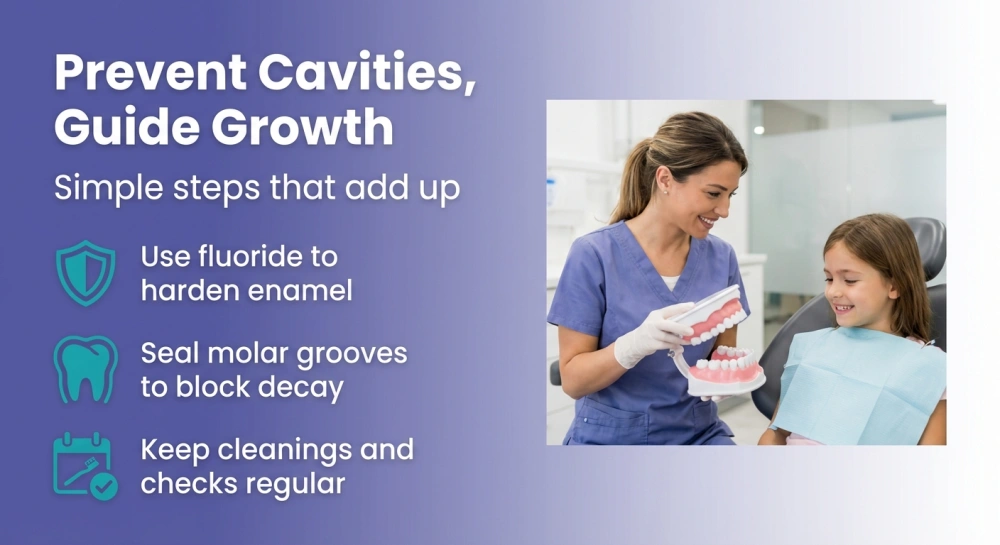
Strong prevention helps keep baby and permanent teeth healthy, which in turn preserves space and supports smoother eruption paths. Fluoride varnish, dental sealants, and regular cleanings are practical tools that lower cavity risk and protect enamel. Lower decay rates mean fewer early tooth losses, fewer infections that disturb eruption, and more predictable alignment outcomes later. Prevention pairs naturally with interceptive orthodontics because both aim to simplify the future [6] [7].
Why are fluoride and sealants important for keeping options open?
Fluoride varnish helps remineralize enamel and prevent new decay. The United States Preventive Services Task Force recommends fluoride varnish for young children, starting with the eruption of the first tooth, in primary care settings, and dental teams routinely apply it based on risk. Dental sealants protect the grooves of molars from trapping bacteria and food. Public health data show that sealants can prevent a large share of cavities in molars among school aged children. Together, these measures support tooth decay prevention so that space and timing for eruption remain favorable [6] [7].
How do regular dental checkups for toddlers support eruption guidance?
At recall visits, we look for emerging asymmetries, monitor the sequence and timing of tooth eruption, reinforce brushing and flossing skills, and update the prevention plan. When needed, we plan radiographs based on individualized criteria to confirm the position of developing teeth or to evaluate areas where clinical visualization is limited. Early detection allows us to recommend space maintainers, crossbite correction, or habit interventions with the right timing [1] [5] [8].
What diagnostic tools help us make safe, child specific decisions?
Modern pediatric dentistry uses targeted diagnostic tools to answer specific questions. Clinical examination remains the foundation. When images are needed, digital systems allow lower exposure settings and quick capture. Growth and development records, including measurements of arch width, photographs, and occasionally models, help us monitor changes over time and decide whether an orthodontic referral is appropriate. The principle is to gather just enough information to guide care without excess testing [1] [8].

How are digital x rays for kids used cautiously and according to guidelines?
Dental radiographs are recommended only when they will provide information that affects diagnosis or treatment. The Food and Drug Administration and American Dental Association provide selection criteria that help clinicians decide when to take images, and pediatric dentists follow age, risk, and symptom based recommendations. We use protective measures, child sized exposure settings, and collimation to limit dose. Digital systems and careful technique help keep radiation as low as reasonably achievable while still answering clinical questions [11].
What growth and development records are useful before orthodontic referral?
Depending on the concern, records may include panoramic imaging to assess developing tooth positions, occlusal photos, bite registrations, and measurements of arch length and width. For crossbite or arch width concerns, clinicians may track midpalatal suture development indirectly through dental age and clinical indicators. Collaboration with an orthodontist ensures that records are collected efficiently and interpreted in the context of your child’s stage of growth [2] [5].
What timelines should parents know from toddlerhood through early teen years?
What should parents watch from ages one to three?
From the first tooth, focus on twice daily brushing with a smear of fluoride toothpaste for toddlers and a pea sized amount for children able to spit. We track eruption and spacing closely. For children in Laguna Niguel, Laguna Hills, Laguna Beach, Aliso Viejo, and Mission Viejo, we tailor recall frequency to cavity risk and work with families to build confident home care routines. Gentle habit coaching often starts in this window to prevent bite changes from prolonged sucking habits [1] [7] [10].
What is important during ages four to seven?
As the first permanent molars and incisors erupt, spacing patterns and bite relationships become clearer. This is the ideal time for an early orthodontic assessment, especially if you notice crossbites, crowding, or jaw shifts when closing. Sealants are usually placed on first permanent molars soon after eruption to protect the deep grooves. If a baby molar is lost early due to decay or injury, space maintenance is often recommended to support orderly eruption [2] [5] [6].
What about ages eight to twelve?
Mixed dentition continues as canines and premolars erupt. We monitor arch width, canine guidance, and residual spacing. This is a common period for interceptive orthodontics when indicated, including expansion for crossbite and selective alignment for functional concerns. Mouth breathing or sleep related symptoms should be discussed and investigated if persistent so that airway and dental development support each other [4] [8].
How do the teen years fit into the overall plan?
By adolescence, most permanent teeth have erupted and comprehensive orthodontics can fine tune alignment and bite as needed. Children who had well timed interceptive care often experience simpler plans. Regardless of prior treatment, excellent hygiene, routine dental visits, and consistent oral health habits continue to be essential to maintain a healthy smile [2] [6].
How do California and local standards guide pediatric dental care?
In California, pediatric dental care follows national clinical guidelines for prevention, imaging, and growth guidance, but also adheres to state specific standards for radiology and sedation. These frameworks support safety while enabling individualized care. Families in Laguna Niguel and neighboring communities benefit from clinicians who apply both national evidence and state regulations in daily practice [1] [11] [12] [13].
Which state and national guidelines apply to imaging and sedation in children?
For imaging, dentists in California follow federal and national guidance on selection criteria and exposure reduction as well as state requirements for radiation safety in dental facilities. For sedation, the California Dental Board regulates permit types, training, and monitoring standards for treating minors. Pediatric practices incorporate these rules into protocols to support safe, child centered care during procedures that may require sedation [11] [12] [13].
How do we collaborate with orthodontists under California practice standards?
Collaboration is built on appropriate referral timing, clear documentation, and informed consent. We coordinate interceptive care with local orthodontists in Laguna Niguel, Laguna Hills, Laguna Beach, Aliso Viejo, and Mission Viejo, ensuring that records and treatment goals are shared. This team approach helps align airway considerations, eruption guidance, and bite correction with the child’s developmental stage and family preferences [2] [5] [8].
What questions should you ask at your child’s next visit?
- Is my child’s eruption pattern on track and do you see any signs of crowding or crossbite that we should monitor?
- What habits should we reinforce or discourage to support jaw development and healthy tooth eruption?
- Would a space maintainer help if we have had any early tooth loss?
- Is this the right time for an early orthodontic assessment or should we wait for more teeth to erupt?
- How often should we schedule radiographs based on my child’s risk and symptoms?
- What can we do at home for tooth decay prevention including fluoride, sealants, and diet choices?
- Are there signs of mouth breathing or sleep concerns that call for a medical referral?
- What local resources or specialists would be helpful for airway focused pediatric dentistry if needed?
Frequently asked questions about early orthodontic guidance
Can early visits really reduce the need for braces later?
Early care can reduce crowding risk and the scope of future orthodontics by preserving space, correcting crossbites during growth, and discouraging habits that push teeth out of alignment. Some children will still benefit from braces, but early guidance often simplifies the plan and may shorten treatment time [2] [4] [5].
What is interceptive orthodontics and when is it used?
Interceptive orthodontics includes targeted treatments during mixed dentition to guide jaw growth and eruption. Examples include expansion for crossbite, selective alignment for functional problems, and space maintenance after early tooth loss. Decisions are based on individual findings and growth timing [3] [5].
Do sealants and fluoride really make a difference for orthodontic outcomes?
Yes. Keeping baby and early permanent teeth free of decay preserves natural space and prevents premature tooth loss that can contribute to crowding. Sealants and fluoride are evidence based measures that lower cavity risk, making future orthodontic planning more predictable [6] [7].
How safe are digital x rays for kids?
When used according to selection criteria and with child sized settings, dental radiographs provide valuable information with minimal exposure. Clinicians follow national guidance to take images only when they will influence care and to keep dose as low as reasonably achievable [11].
When should my child see an orthodontist for the first time?
An orthodontic evaluation by about age seven is recommended so that developing issues like crowding and crossbite can be identified and timed appropriately for intervention if needed [2].
Can thumb sucking or pacifiers change how the jaws grow?
Prolonged non nutritive sucking can influence bite relationships and arch width. Gentle habit counseling and, if needed, dental habit appliances can help children transition away from the habit during important growth windows [10].
Does mouth breathing affect orthodontic needs?
Mouth breathing is associated with altered craniofacial growth in some children. Addressing airway issues with the medical team and guiding dental development together can support better outcomes over time [8].
What is a space maintainer and how long is it worn?
A space maintainer is a small appliance that holds the place of a lost baby tooth until the permanent tooth erupts. Duration depends on the child’s dental age and which tooth is developing underneath. Regular checks ensure it remains clean and secure [5].
How do you decide between waiting and early treatment?
We look at growth stage, severity of the issue, risk of progression, and your child’s comfort and cooperation. Some concerns benefit from early action while others are best timed later. Shared decision making with families guides the plan [2] [5].
Who is Kidz Modern Dentistry and how do we support your family?
Kidz Modern Dentistry provides pediatric dental care for families in Laguna Niguel, Laguna Hills, Laguna Beach, Aliso Viejo, and Mission Viejo. Our focus is simple and family centered. We help guide healthy growth and development with prevention, careful monitoring, and timely interceptive care when needed. If you have questions or need to schedule, reach us at +19492730110.
How do our services connect to early orthodontic guidance?
- Early dental visits establish a dental home by the first birthday and set the stage for ongoing growth assessments, eruption guidance, and tooth decay prevention.
- Interceptive orthodontics is coordinated during mixed dentition to correct crossbites, preserve space, and streamline future orthodontic needs.
- Habit counseling addresses thumb sucking, pacifier use, mouth breathing, and other myofunctional habits that can shift bite development.
- Airway focused pediatric dentistry includes screening for sleep and breathing concerns and collaborative referrals when indicated.
- Preventive care with cleanings, fluoride, and sealants protects enamel and supports predictable eruption.
Where do we operate and how do we personalize care?
We serve families across Laguna Niguel and nearby communities including Laguna Hills, Laguna Beach, Aliso Viejo, and Mission Viejo. We tailor recall intervals, imaging, and prevention to your child’s risk and developmental stage. Visits are designed to be calm and friendly so children build confidence over time.
What is our approach to comfort, safety, and communication?
- Same day emergencies are available for urgent pediatric dental needs so problems are addressed promptly and comfortably.
- Kid friendly sedation is offered when appropriate and follows California Dental Board standards for training and monitoring.
- Clear communication means you understand options, timing, and expected steps for preventive orthodontics and eruption guidance.
How do our tools and workflows support your child’s development?
- Digital imaging uses child sized settings and selection criteria to capture only the views that inform care.
- Growth tracking with photos and measurements helps us compare visits and decide if interceptive steps are timely.
- Collaborative referrals connect families with orthodontists and medical partners who align with airway focused care and evidence based protocols.
What experience and values guide our team?
Our pediatric dental team brings a thoughtful, evidence guided perspective to each visit. We emphasize prevention, comfort, and education so parents feel supported. While every child is unique, we have seen that small, well timed steps can make a big difference in how a smile develops. Case examples include children who avoided early crowding through space maintenance and those whose crossbites were corrected during growth. These stories reflect careful timing and teamwork rather than guarantees.
How can you get started today?
- Schedule an early exam to set up a dental home and a practical prevention plan.
- Ask about eruption and growth checkpoints so you know what to look for between visits.
- Plan for an orthodontic screening by age seven or sooner if concerns arise.
- Lean on us for habit counseling and airway focused evaluations when needed.
We are here to help you take the next right step, one visit at a time. Call +19492730110 to connect with our team.
References
- Periodicity of Examination, Preventive Dental Services, Anticipatory Guidance, and Oral Treatment for Infants, Children, and Adolescents – American Academy of Pediatric Dentistry
- Orthodontic Checkups No Later Than Age 7 – American Association of Orthodontists
- Early orthodontic treatment for Class II malocclusion in children – Cochrane Database of Systematic Reviews
- Interventions for posterior crossbites in children – Cochrane Database of Systematic Reviews
- Management of the Developing Dentition and Occlusion in Pediatric Dentistry – American Academy of Pediatric Dentistry
- Dental Sealants: Proven to Prevent Cavities – Centers for Disease Control and Prevention
- Prevention of Dental Caries in Children Younger Than Five Years – U.S. Preventive Services Task Force
- Policy on Obstructive Sleep Apnea – American Academy of Pediatric Dentistry
- Identification and Management of Ankyloglossia and its Effect on Breastfeeding in Infants – American Academy of Pediatrics
- Nonnutritive Oral Habits in Children – American Academy of Pediatric Dentistry
- Dental Radiographic Examinations: Recommendations for Patient Selection and Limiting Radiation Exposure – U.S. Food and Drug Administration
- Radiologic Health Branch Requirements for Dental X Ray Facilities – California Department of Public Health
- Sedation and Anesthesia Permits and Regulations – Dental Board of California
Common Questions About This Topic
Find answers to frequently asked questions related to this article.