- Are dental sealants really necessary for my child’s teeth in Orange County?
- What are dental sealants for kids and how do they work?
- When do kids get sealants and which teeth are usually sealed?
- How effective are pediatric dental sealants for cavity prevention?
- How long do dental sealants last and how are they maintained?
- Are dental sealants safe for children and what about BPA free options?
- How do sealants compare with fluoride treatments and other prevention?
- What is the step by step process for placing sealants for molars?
- Who is a good candidate for sealants and who might not need them?
- What do professional associations and guidelines recommend?
- How much do sealants for kids cost in California and what about insurance?
- How do local schools and community programs in Orange County approach sealants?
- How should parents in Laguna Niguel and nearby prepare for a sealant visit?
- What questions should you ask a pediatric dentist in Laguna Niguel?
- What common myths about sealants can we clear up?
- When should you call a dentist about a sealant issue?
- How can families support long term cavity prevention at home?
- Why choose Kidz Modern Dentistry for pediatric dental sealants in Orange County?
- Where can you review the references for this article?
Are dental sealants really necessary for my child’s teeth in Orange County?
Parents across Laguna Niguel, Aliso Viejo, Mission Viejo, San Juan Capistrano, Laguna Hills, and Laguna Beach often ask whether dental sealants are worth it for their kids. The short answer is that sealants are a well studied preventive option that can help protect the deep grooves of back teeth from decay. Children rely on their molars for chewing, and those pits and fissures can trap food and bacteria even when brushing is careful. Sealants add a thin protective layer that blocks plaque acids from reaching the enamel surface. Major public health authorities and pediatric dental organizations support sealants for many children, especially those at higher risk of cavities in their molars [1] [2] [3] [4].
If you are weighing the choice, consider your child’s cavity history, their oral hygiene habits, diet, and whether their molars have deep grooves. For many families, sealants complement daily brushing with fluoride toothpaste and regular professional care. If your child is in a higher risk group due to diet, early signs of enamel demineralization, or difficulty keeping back teeth clean, a sealant can be a simple way to lower the chance of a new cavity forming on the chewing surface of a molar [2] [3].
What are dental sealants for kids and how do they work?
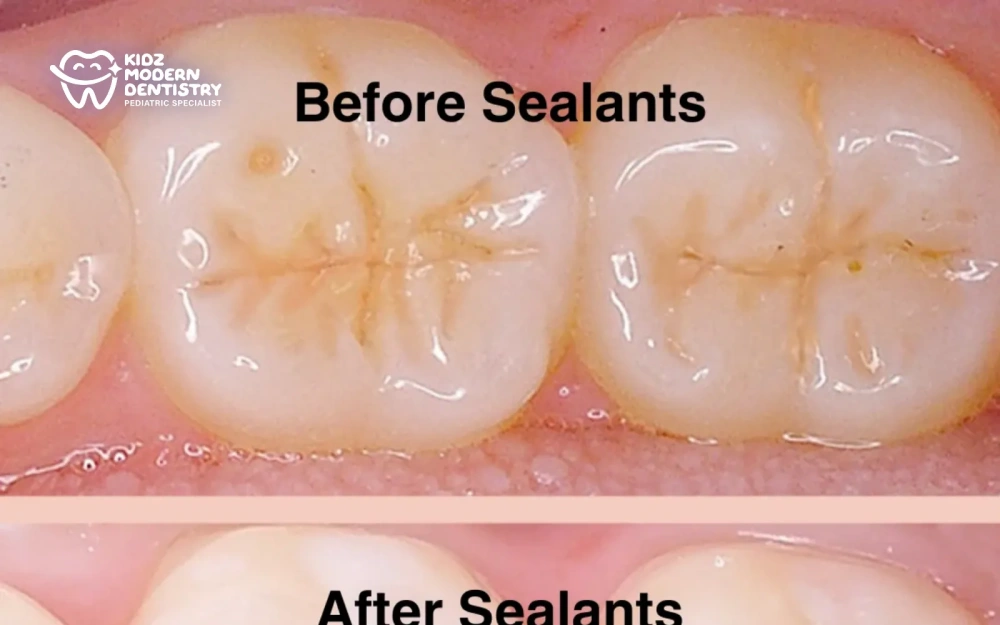
Dental sealants are thin coatings placed on the chewing surfaces of molars and premolars. They flow into the natural pits and fissures, creating a smooth surface that is easier to clean. Most pediatric dental sealants are resin based materials that bond to enamel after a gentle preparation step. Some offices also use glass ionomer materials that can be helpful in certain situations. The goal is the same in both cases, which is to reduce the accumulation of plaque and to protect enamel from acids produced by bacteria [2] [4].
When you hear terms like pediatric dental sealants, molar sealants for children, or sealants for molars, they all refer to this protective coating. The process is quick, does not require shots, and can be completed during a routine visit for many kids. After placement, your child can eat and drink right away, which makes the visit convenient for busy families in Orange County.
When do kids get sealants and which teeth are usually sealed?
Sealants are typically recommended when the first and second permanent molars erupt into the mouth with enough of the chewing surface visible for placement. This often happens around age six for the first permanent molars and around age twelve for the second permanent molars, though timing varies by child. Some children who are at higher risk of cavities may also benefit from sealants on premolars or on primary molars when the grooves are deep and there is a history of decay. A pediatric dentist will evaluate individual risk and tooth anatomy to make a recommendation tailored to your child [1] [2] [4].
How effective are pediatric dental sealants for cavity prevention?
Research shows that sealants can significantly reduce cavities on the chewing surfaces of molars. Public health data indicate that sealants lower the risk of decay in molars for years after placement, with the greatest protection seen in the first two years after application. Children without sealants have been found to be several times more likely to develop cavities in their first molars compared with those who have sealants [1]. Systematic reviews also find strong evidence that resin based sealants prevent cavities compared with no sealant and show favorable results compared with some other single strategies for occlusal surfaces [3] [4].
Here is what that means for families in Laguna Niguel and nearby communities:
- Protection where it matters Most childhood cavities occur on the chewing surfaces of molars due to deep grooves. Sealants target that exact area [2].
- Early application adds value Placing sealants soon after molars fully erupt can block decay before it starts during the years when kids are still perfecting brushing and flossing skills [1].
- Ongoing benefit with checkups Regular dental visits allow the dentist to monitor and maintain sealants so they continue to protect over time [4].
How long do dental sealants last and how are they maintained?
Parents often ask how long do dental sealants last. Sealants are designed to be durable, and many continue to protect for several years. The exact time varies depending on the material used, your child’s chewing habits, and oral hygiene. Even if a sealant partially wears, the remaining material in the deepest grooves can still offer protection. During checkups, your pediatric dentist will inspect sealants and touch them up if needed. The maintenance is simple and does not add significant time to a regular visit [3] [4].
To help sealants last:
- Keep regular visits Periodic exams allow timely repair if a corner chips or if new grooves become exposed.
- Practice gentle habits Avoid chewing very hard objects that can stress teeth, such as ice or pen tips.
- Brush with fluoride toothpaste Daily fluoride exposure strengthens enamel around the sealed area and supports overall oral health.
Are dental sealants safe for children and what about BPA free options?
Safety is a common concern, especially regarding possible exposure to bisphenol compounds. Research and regulatory reviews indicate that dental sealants have a strong safety record. Any potential exposure from modern materials is very low and, according to federal evaluations, remains well below established safety thresholds. Simple steps during placement, such as thoroughly curing and wiping the surface, further minimize potential exposure. Many products are formulated to be BPA free by formulation, and your dentist can discuss material choices available in the office [2] [5] [4].
As a parent, you can ask your pediatric dentist about the specific brands used, the curing technique, and post placement wipe and rinse protocols. These are standard parts of clinical practice and help ensure that sealants are both effective and safe for kids.
How do sealants compare with fluoride treatments and other prevention?
Sealants and fluoride address different surfaces and work in complementary ways. Fluoride toothpaste and professional fluoride varnish help strengthen smooth surfaces and the entire tooth, while sealants physically protect the chewing surfaces of molars where grooves are deep. For many children, the best approach combines daily fluoride toothpaste use, periodic professional fluoride applications, and sealants on at risk molars. Independent reviews find that sealants can be more effective than fluoride varnish alone for preventing cavities on the chewing surfaces of first permanent molars over certain time frames, especially in higher risk groups [3] [4].
If your child already receives fluoride varnish, adding sealants to the chewing surfaces still offers additional protection because each strategy targets a different mechanism. Your pediatric dentist will use your child’s risk profile to suggest a schedule that balances both options.
What is the step by step process for placing sealants for molars?
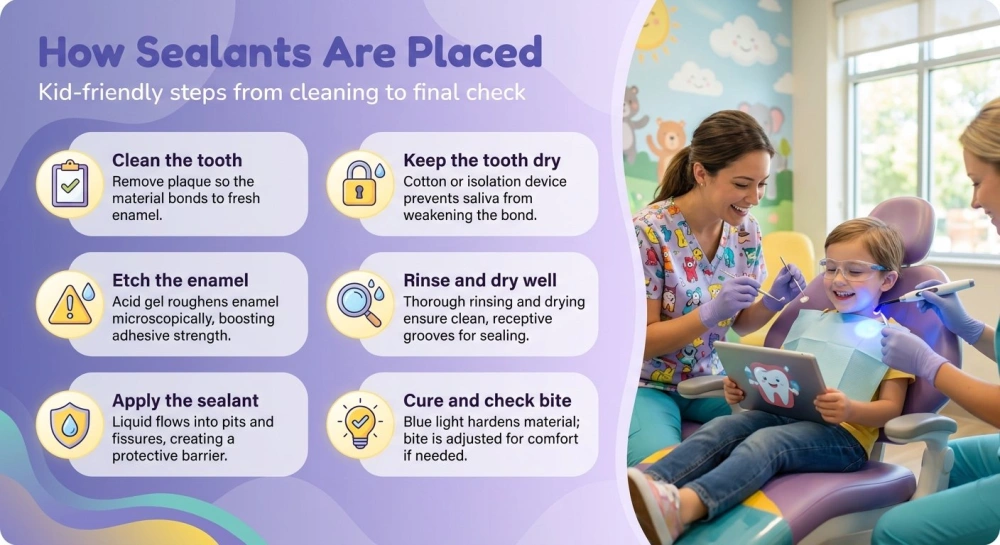
The pediatric sealant procedure is straightforward and comfortable for children. Here is what to expect:
- Cleaning the tooth The chewing surface is cleaned to remove plaque and debris.
- Isolating the area Cotton rolls or a small isolation device keep the tooth dry so the material bonds properly.
- Conditioning the enamel A gentle gel prepares the enamel by creating microscopic texture for bonding.
- Rinsing and drying The gel is rinsed, then the tooth is dried thoroughly.
- Applying the sealant The liquid flows into the pits and fissures.
- Light curing A special light hardens the material within seconds.
- Checking the bite The dentist confirms that the bite feels natural and adjusts if needed.
- Finishing and wipe Any excess is smoothed, and the surface is wiped and rinsed per best practice protocols [2] [4].
Most children do not need local anesthesia for this visit. For very anxious kids or those with special health care needs, a pediatric dentist can discuss behavior guidance and, if appropriate, minimal sedation options that are tailored to the child. The goal is to make the experience positive and stress free while prioritizing safety and consent in line with California standards.
Who is a good candidate for sealants and who might not need them?
Sealants are often recommended for children at higher risk of molar cavities. Your child may be a good candidate if their molars have deep grooves, if there is a history of enamel decalcification, or if keeping back teeth clean is challenging. Children who snack frequently on sugary foods, who have limited access to fluoridated toothpaste, or who have recently had cavities on other tooth surfaces may also benefit. By contrast, children with very shallow grooves and consistently low cavity risk may not need sealants right away. Decisions are made tooth by tooth, based on examination and discussion with your pediatric dentist [2] [4].
What do professional associations and guidelines recommend?
Professional organizations recognize sealants as an important preventive measure. Guidance from pediatric and public health authorities supports placing sealants on permanent molars soon after eruption in children who are at increased risk for tooth decay. Policy statements also note that sealants can be appropriate for primary molars in certain higher risk cases. Systematic reviews and national data inform these recommendations, highlighting both effectiveness and safety when sealants are placed and maintained properly [1] [3] [4].
How much do sealants for kids cost in California and what about insurance?
Parents in Orange County often ask about the cost of sealants for kids and whether insurance covers them. Fees can vary across offices and depend on the number of teeth sealed, the material used, and the time required for placement. Many private dental plans provide benefits for sealants on permanent molars in children up to certain ages. Public programs may also cover sealants for eligible children, and coverage information is available through program websites and benefits guides. If your family participates in state programs, you can review general information and provider directories to see what is covered and how to access care [7] [8].
To plan ahead:
- Call your insurer Ask about age limits, tooth specific coverage, frequency, and any copayments.
- Request a pretreatment estimate Your dental office can submit a benefits check so you understand any out of pocket cost before the visit.
- Ask about flexible scheduling Many offices can coordinate sealants during a cleaning appointment to reduce time away from school and activities.
How do local schools and community programs in Orange County approach sealants?
School and community sealant programs help reach children who might otherwise miss preventive care. Public health resources describe how school programs identify eligible students, provide consent forms, and place sealants in a portable clinic setting. These programs have been shown to be an efficient way to prevent cavities in large groups of children and can complement regular dental care with a private pediatric dentist. Families can check school communications and county health program announcements for opportunities in their area [1] [9] [8].
How should parents in Laguna Niguel and nearby prepare for a sealant visit?
Good preparation makes the visit smooth for everyone. Here are practical steps that help:
- Schedule when your child is rested Morning appointments or times when your child has energy often work best.
- Keep teeth clean before the visit Ask your child to brush as usual so the surface is easy to prepare.
- Share medical information Tell the team about allergies, medications, and any previous dental experiences that might affect cooperation.
- Discuss materials If you prefer BPA free options, ask about the product line your office carries and the steps used during placement [5].
- Plan for comfort Bring a favorite small toy or use simple relaxation techniques if your child is nervous.
What questions should you ask a pediatric dentist in Laguna Niguel?
Clear communication builds confidence. Consider asking:
- Which teeth do you recommend sealing Ask which molars are at risk and why.
- What material will you use Inquire about resin based or glass ionomer choices and whether BPA free options are available [4] [5].
- How do you ensure the tooth stays dry Isolation technique influences success, so understanding the method helps.
- How will you monitor the sealants Learn about follow up at routine exams and any touch up policies.
- What are the costs and coverage Review fees, benefits, and any financing options or program resources [7].
What common myths about sealants can we clear up?
It is easy to run into conflicting information online. Here are facts to keep in mind:
- Myth Sealants are only for kids with many cavities. Fact Sealants are preventive, and many children who have never had a cavity benefit from protecting deep grooves before decay starts [2] [4].
- Myth Sealants are painful. Fact Placement is noninvasive and does not require shots. Children usually return to normal activities right away [2].
- Myth Sealants replace brushing and fluoride. Fact Sealants work together with daily fluoride toothpaste and good hygiene but do not replace them [3].
- Myth Sealants always fall out quickly. Fact With proper placement and follow up, sealants can protect for years, and touch ups are simple when needed [3] [4].
When should you call a dentist about a sealant issue?
Contact your pediatric dentist if your child says a sealant feels rough or high, if you see a chip, or if food seems to catch in a sealed groove. Most adjustments are quick. If your child experiences sensitivity on a sealed tooth, let the office know so that the dentist can check the sealant margin and enamel. Routine exams remain the best way to confirm that sealants are intact and that no new decay is forming at the edges.
How can families support long term cavity prevention at home?
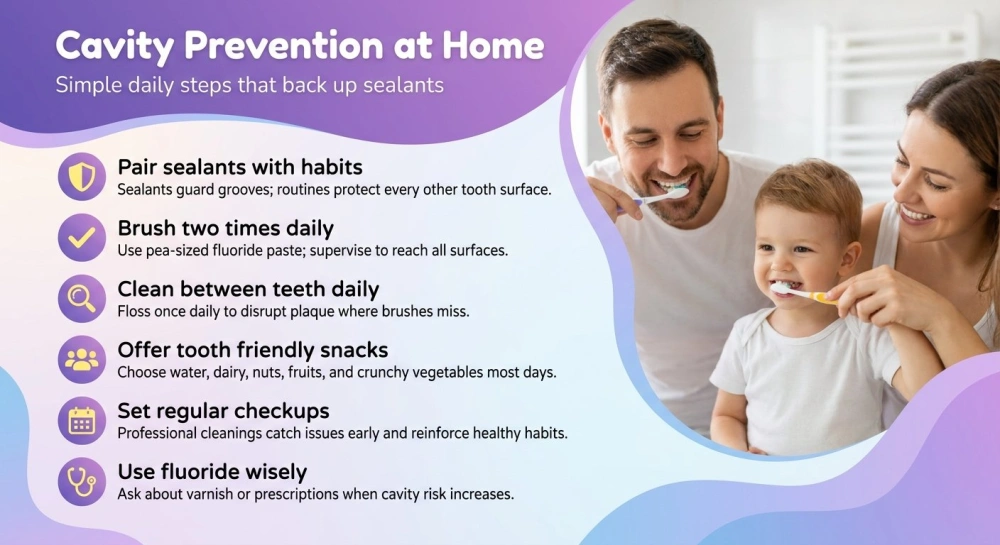
Sealants work best as part of a simple routine at home. Families in Laguna Niguel and throughout Orange County can make a big difference with consistent habits:
- Brush two times daily with fluoride toothpaste Use a pea sized amount for children and supervise brushing to reach all surfaces.
- Clean between teeth daily Floss or use appropriate aids once a day to disrupt plaque where brushes do not reach.
- Offer tooth friendly snacks Choose water, dairy, nuts, and crunchy fruits and vegetables more often than sticky sweets.
- Set regular checkups Professional cleanings and exams allow early detection and support for healthy habits.
- Use fluoride wisely Ask your dentist about fluoride varnish or prescription products when risk is higher [4].
Why choose Kidz Modern Dentistry for pediatric dental sealants in Orange County?
At Kidz Modern Dentistry, we focus on education, prevention, and a positive experience so children feel comfortable and parents feel informed. Our pediatric team serves families in Laguna Niguel, Aliso Viejo, Mission Viejo, San Juan Capistrano, Laguna Hills, and Laguna Beach, and we welcome children of all ages for preventive visits that may include sealants when appropriate.
Here is how our approach helps you decide next steps with confidence:
- Personalized risk assessment We evaluate tooth anatomy, cavity history, diet, and hygiene to determine which teeth would benefit from sealants and when to place them.
- Kid friendly comfort We use gentle isolation tools, clear show and tell explanations, and calm pacing to make the visit easy for children. For those who are especially anxious, we offer kid friendly sedation options that are carefully reviewed and consented in advance.
- Evidence guided materials We select sealant materials supported by current research, and we can discuss BPA free choices. We follow thorough cure and surface wipe steps as part of our routine protocol.
- Comprehensive preventive plans Sealants are paired with cleanings, fluoride therapy, and home care coaching so families have a complete plan for cavity prevention for children.
- Same day flexibility If a child is ready and the tooth is erupted and dry, we can often place sealants during the same visit to save time for parents who juggle school and activities.
- Clear communication We provide written after care tips and schedule follow up checks so you know how we will monitor and maintain each sealant.
- Local experience Our team has years of combined experience caring for children in Orange County, including kids from Laguna Niguel, Aliso Viejo, Mission Viejo, San Juan Capistrano, Laguna Hills, and Laguna Beach.
- Accessible support Have a question after hours about a sealant that feels rough or a tooth that seems sensitive We offer guidance and quick visits for minor adjustments.
We also serve families who need help fast. Same day emergencies are welcome, and we prioritize comfort and clear explanations. If you want to discuss pediatric dental sealants, cavity prevention for children, or a full preventive visit,
call us at +1 9492730110 to speak with our team. Together, we will map out a plan that fits your child’s needs and supports a healthy smile.
Where can you review the references for this article?
- Dental Sealants Vital Signs Report 2016, Centers for Disease Control and Prevention
- Dental Sealants, National Institute of Dental and Craniofacial Research
- Pit and fissure sealants for preventing dental caries in permanent teeth, Cochrane Library
- Sealants, American Dental Association Oral Health Topics
- Bisphenol A information for dental composites and sealants, United States Food and Drug Administration
- Oral health policies and recommendations including sealants, American Academy of Pediatric Dentistry
- Denti Cal information for providers and beneficiaries, California Department of Health Care Services
- Seal America School Sealant Program Manual, National Maternal and Child Oral Health Resource Center
- School based dental sealant programs, Centers for Disease Control and Prevention
- Oral Health Resources, Centers for Disease Control and Prevention
Common Questions About This Topic
Find answers to frequently asked questions related to this article.