
- What is ankyloglossia in infants and why does it matter?
- What are the most common signs of tongue tie in babies during feeding?
- What parent and baby behaviors might point to infant tongue tie?
- What physical signs in your baby’s mouth should you look for?
- How is tongue tie diagnosis performed by pediatric providers?
- What is the difference between lip tie vs tongue tie?
- When should you seek help for breastfeeding difficulties and whom should you see first?
- What conservative steps can support feeding before considering a procedure?
- What is a frenulum and how can a restrictive one affect growth and speech?
- What is an infant frenectomy and what does the procedure involve?
- What risks, benefits, and outcomes are reported in the research?
- How do we approach pain control and comfort for babies during and after care?
- What does aftercare look like and how should follow up be handled?
- How do California and local regulations shape infant oral procedures and referrals?
- How can families in South Orange County CA get coordinated care and IBCLC referral?
- Who are we and how can we help families in South Orange County CA?
- Where can you review the sources for this article?
What is ankyloglossia in infants and why does it matter?
Ankyloglossia in infants, commonly called tongue tie, describes a restrictive lingual frenulum that limits the tongue’s range of motion. The frenulum is the small fold of tissue under the tongue. When it is too short, thick, or positioned in a way that restricts movement, babies may struggle to lift, extend, or cup the tongue effectively during feeding. Estimates of how common this is vary because different studies use different criteria, but research suggests a range of roughly 4 to 10 percent of newborns [2] [3] [11]. Not every baby with a tight frenulum has symptoms, and not every feeding problem is caused by a tongue restriction [1] [2].
Why does this matter for families in Laguna Niguel, Laguna Hills, Aliso Viejo, Mission Viejo, Laguna Beach, and San Juan Capistrano? Early feeding is a time of learning for both baby and parent. If a baby cannot achieve a deep, efficient latch, you may notice discomfort, prolonged feeds, or slow weight gain. Addressing concerns early with a team that includes your pediatrician, an International Board Certified Lactation Consultant, and a pediatric dentist helps you understand what is happening and choose next steps grounded in evidence and your goals [1] [4].
What are the most common signs of tongue tie in babies during feeding?
Feeding clues often appear before you can easily see a restriction. If you or your baby experience the following, a focused feeding assessment can be helpful:
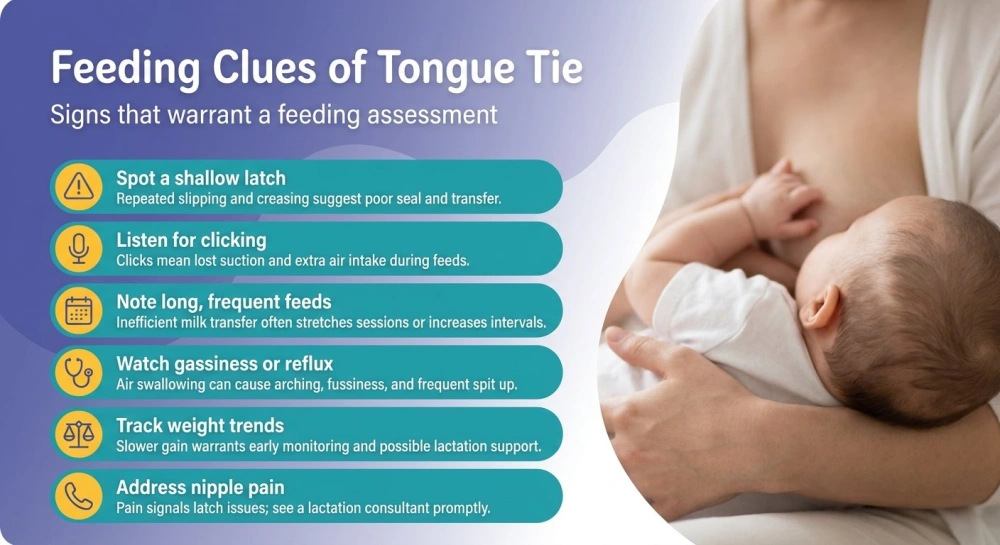
- Poor latch that slips or feels shallow with frequent relatching attempts [4] [11].
- Clicking while feeding, which can indicate loss of suction and air intake [4].
- Prolonged feeds that last longer than expected or very frequent feeds due to inefficient milk transfer [3] [4].
- Gassiness and reflux like symptoms such as arching, fussiness at the breast or bottle, and frequent spit up that may be related to aerophagia [4].
- Slow weight gain or concern about intake that prompts additional monitoring [3] [6].
Parents feeding at the breast may also experience sore nipples, creasing, blistering, or cracking. Pain alone is not a diagnosis, yet it is a meaningful signal that latch mechanics need review. An IBCLC can often improve comfort through positioning and latch adjustments, and if restriction is suspected, can coordinate with other clinicians for a thorough exam [4] [6].
What parent and baby behaviors might point to infant tongue tie?
Beyond direct feeding signs, certain behaviors may hint at an inefficient seal or limited tongue motion:
- Lip dimpling or pursing to compensate for reduced tongue cupping [1].
- High workload during feeding such as visible jaw fatigue or head bobbing [1].
- Frequent breaks to breathe that are not explained by nasal congestion or other conditions [2].
- Audible gulping followed by coughing or sputtering that may suggest difficulty coordinating suck swallow breathe patterns [4].
- Restlessness at the breast or bottle with frustration early or late in the feed [3].
These cues do not prove ankyloglossia in infants, and many resolve with lactation support alone. Still, patterns that persist despite skilled feeding help warrant an evaluation for structural and functional contributors [4] [11].
What physical signs in your baby’s mouth should you look for?
Parents sometimes notice oral features that raise questions. While a clinical exam is essential, you might observe:
- Difficulty lifting the tongue tip to the palate or past the lower gum ridge [1].
- Limited side to side motion or inability to cup the tongue around a finger during non nutritive suck testing [2].
- A heart shaped tongue tip when the baby cries or tries to protrude the tongue [1].
- A thin or thick band under the tongue that seems tight or blanches with gentle elevation [1] [9].
Visual appearance alone is not enough, because some babies with obvious frenula feed well, while others with subtle anatomy have significant functional restriction. Experienced clinicians focus on what the tongue can do, not only what it looks like [1] [11].
How is tongue tie diagnosis performed by pediatric providers?
Tongue tie diagnosis is a clinical judgment that combines history, feeding observation, and an oral functional exam. A typical process includes:
- History of latch comfort, clicking while feeding, nipple condition, feed length, and weight trends [4].
- Feeding assessment at breast or bottle with an IBCLC to evaluate latch depth, suction, and transfer [4].
- Oral motor exam to assess tongue elevation, lateralization, extension, cupping, and compensation strategies [1].
- Consideration of differential causes such as low tone, torticollis, nasal obstruction, or maternal supply factors [2].
Several assessment tools exist, but no single scoring system is universally accepted. This is why multidisciplinary input is valuable and why individualized care plans are recommended [2] [11].
What is the difference between lip tie vs tongue tie?
Lip tie refers to a restrictive attachment of the upper labial frenulum that may affect flange at the breast or bottle. Tongue tie involves the lingual frenulum under the tongue. Some babies can have both. Expert groups caution that upper lip frenulum anatomy varies widely in normal infants and that treatment decisions should be based on function and symptoms rather than appearance alone [1] [2]. A careful exam helps determine whether a lip restriction contributes to feeding issues or whether other factors are more important.
When should you seek help for breastfeeding difficulties and whom should you see first?
Seek help early if you are worried about latch, milk transfer, pain, or weight gain. For families in South Orange County CA, a practical first step is scheduling a visit with your pediatrician and requesting an IBCLC referral for a detailed feeding consult. An experienced IBCLC can often make rapid improvements with latch technique and positioning. If restriction is suspected after this focused support, coordinated evaluation with a pediatric dentist or an ear nose and throat specialist can clarify whether a procedure is appropriate [4] [11].
What conservative steps can support feeding before considering a procedure?
Many babies improve significantly with non procedural care. Helpful strategies often include:
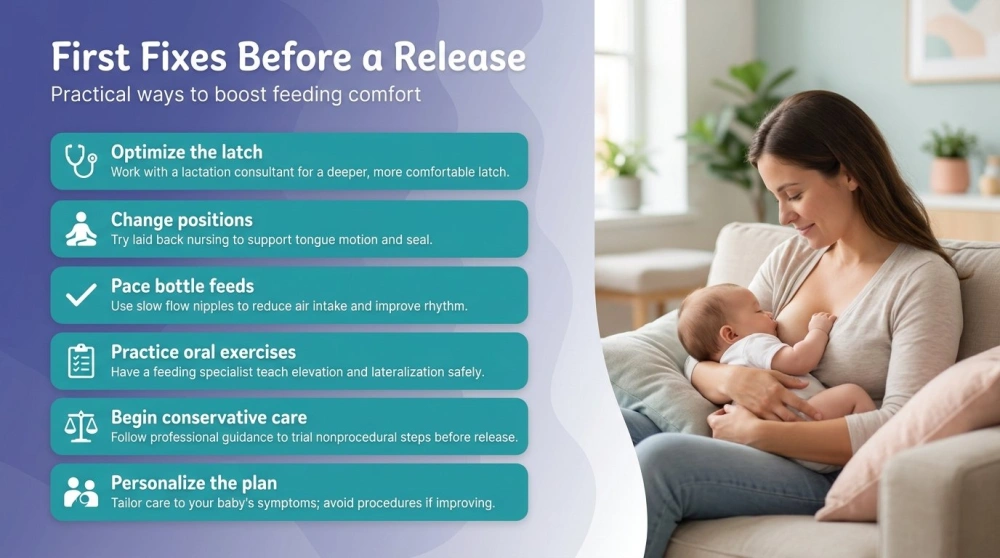
- Skilled latch optimization with hands on guidance from an IBCLC to achieve a deeper, more comfortable latch [4].
- Positioning changes such as laid back nursing to support better tongue movement and seal [4].
- Pacing techniques for bottle feeds to reduce air intake and improve rhythm [4].
- Oral motor exercises taught by qualified feeding specialists to encourage elevation and lateralization when appropriate [2].
A conservative trial is consistent with guidance from multiple professional groups, which emphasize individualized plans and avoidance of intervention when symptoms resolve with feeding support alone [2] [11].
What is a frenulum and how can a restrictive one affect growth and speech?
The lingual frenulum is a normal structure that varies in length, thickness, and insertion point. In early infancy, its most meaningful impact relates to feeding. Some studies and clinical experience suggest that a significantly restrictive frenulum can influence oral development patterns, though long term effects on speech or dentofacial growth are not consistently predicted by appearance alone [1] [2]. Speech development is multifactorial, and evaluation by a speech language pathologist is appropriate when concerns arise beyond feeding.
What is an infant frenectomy and what does the procedure involve?
When a clinically significant restriction persists despite skilled lactation support, an infant frenectomy may be considered. A frenectomy is the minor procedure of releasing restrictive frenulum fibers to improve tongue mobility. The release can be performed with sterile scissors or with a soft tissue laser depending on clinician training and the specific case [1] [2]. Many providers encourage immediate feeding after the release to assess function and comfort and to support soothing and hemostasis [3] [4].
Families often ask about practical details. The appointment usually includes a review of history, an exam, informed consent, a brief procedure, and post visit feeding. Minor bleeding is the most common event and typically resolves quickly with pressure and feeding support. Follow up is arranged to monitor healing and function [1] [3].
Pediatric frenectomy is one option in a comprehensive plan that centers your goals and your baby’s well being. Decisions are best made in partnership with your care team after weighing benefits and risks for your specific situation [1] [11].
What risks, benefits, and outcomes are reported in the research?
Parents deserve balanced information when considering any procedure. Evidence from randomized and observational studies indicates that frenotomy can reduce maternal nipple pain in the short term and may improve latch and some breastfeeding measures for selected dyads. Findings on long term breastfeeding duration are mixed across studies due to variability in definitions, timing, and co interventions [3] [6] [11].
Potential risks include minor bleeding, transient fussiness, oral aversion, and very rarely infection or need for repeat release. Serious complications are uncommon when the procedure is performed by trained clinicians using appropriate technique and follow up [2] [11]. Because not all feeding problems are caused by a frenulum restriction, professional societies recommend careful assessment and a team approach before proceeding [1] [2] [4].
How do we approach pain control and comfort for babies during and after care?
Comfort measures are tailored to the infant and the procedure. Strategies may include feeding immediately after the release, skin to skin contact, oral sucrose when appropriate, and gentle calming techniques. Many infants tolerate the brief procedure well with these supportive measures. Decisions about topical or local anesthetics are individualized based on clinician judgment and current guidance, and many providers collaborate with lactation and pediatric teams to align comfort strategies with feeding goals [1] [2].
What does aftercare look like and how should follow up be handled?
Aftercare focuses on function first. Most teams encourage feeding right away and monitor latch and comfort. Wound care instructions vary by clinician and by the specific release performed. Some emphasize gentle oral mobility exercises and continued lactation support to reinforce new patterns, while others advise a lighter touch to avoid irritation. Because expert guidance differs, your follow up plan should be individualized and coordinated across your team so advice is consistent and practical for your family [1] [4] [11].
How do California and local regulations shape infant oral procedures and referrals?
In California, dentists are licensed by the Dental Board of California, and the scope of practice is defined in the California Business and Professions Code. Within this scope, trained dentists may diagnose and treat oral conditions, which can include frenectomy when clinically indicated and performed within the standard of care [7] [8]. Parents or legal guardians provide informed consent for minors. Collaboration with medical providers and IBCLCs supports comprehensive assessment, documentation, and continuity of care. Families in Laguna Niguel and neighboring communities can request coordinated referrals and ensure that records are shared securely among providers for a smooth experience.
How can families in South Orange County CA get coordinated care and IBCLC referral?
If you live in Laguna Niguel, Laguna Hills, Aliso Viejo, Mission Viejo, Laguna Beach, or San Juan Capistrano, consider a stepwise plan:
- Start with your pediatrician to screen for growth or medical concerns and to discuss feeding challenges.
- Ask for an IBCLC referral so a lactation expert can observe a full feed and make tailored recommendations [5].
- Seek a pediatric dental evaluation if restriction remains a concern after focused feeding support.
- Coordinate follow up among your team so you receive consistent guidance on latch, bottle pacing, and oral function exercises when indicated.
Some families choose to explore Pediatric frenectomy after a careful evaluation confirms a functional restriction that persists despite conservative care. Others find that lactation work alone resolves the problem. Both paths are valid when guided by your goals and by a thorough assessment [1] [4].
Which signs in South Orange County CA most often bring families to us?
We hear similar questions from parents across South Orange County CA. You might notice that your baby falls asleep quickly at the breast yet wakes hungry, or you may hear clicking while feeding and see milk leaking from the sides of the mouth. Some families report gassiness and reflux like symptoms after almost every feed, while others have been told their baby is on the lower end of weight gain percentiles. These are common reasons to request a multidisciplinary feeding assessment. A structured visit that observes a complete feed and examines tongue function helps determine whether the pattern points to infant tongue tie or to other correctable factors [4] [6].
How can you make a confident decision about next steps for your baby?
Clarity comes from understanding the why behind each recommendation. Consider asking your team these questions:
- Which specific functions are limited and how do they affect milk transfer right now [1]?
- Which conservative strategies have been tried at the breast or bottle and what changed [4]?
- What outcomes are likely for your situation based on your baby’s exam and current evidence [3] [6]?
- How will follow up be coordinated to support feeding after any intervention [4]?
This approach keeps the focus on function, comfort, and your goals while aligning with guidance from professional organizations that encourage careful assessment and team based care [1] [2].
What practical tips can make feeding more comfortable today?
While you arrange evaluations, small adjustments may help right away:
- Try a deeper latch by bringing baby to breast chin first with wide mouth and body alignment.
- Experiment with positions such as side lying or laid back to use gravity and improve seal [4].
- Use paced bottle feeding with a slow flow nipple so baby can coordinate suck swallow breathe more easily [4].
- Protect nipple comfort with gentle care and allow time for healing if soreness is present, while seeking professional guidance.
If discomfort or slow weight gain persists, a timely team assessment helps you move forward with confidence [6].
Which common myths about infant tongue tie can create confusion?
Misinformation can make decisions harder. Consider these clarifications grounded in current guidance:
- Myth that all breastfeeding pain means tongue tie. Reality is that latch technique, engorgement, and infant positioning often explain pain and are highly modifiable with IBCLC support [4].
- Myth that appearance alone determines need for release. Reality is that function during feeding is the key factor in decision making [1] [2].
- Myth that posterior restrictions are always pathological. Reality is that posterior variants are debated and require careful functional assessment rather than assumptions from appearance [2].
- Myth that one approach fits all. Reality is that individualized care plans work best and often begin with conservative steps [4] [11].
What real world scenarios might help you picture the process?
Every family is unique, yet certain paths are common. One family notices clicking while feeding and persistent sore nipples despite diligent efforts at home. After an IBCLC visit, latch improves and pain decreases. Because weight gain remains slower than expected, a pediatric dentist evaluation confirms restricted elevation and poor cupping. The team discusses options, and the family chooses to continue conservative care with close follow up. Another family sees similar signs plus significant transfer issues on weighed feeds. After collaborative counseling, they opt for Pediatric frenectomy and ongoing lactation support. In both scenarios, clear goals, shared decision making, and consistent follow up guide the plan [1] [3] [4].
How does location influence access to evaluation and treatment in Laguna Niguel and nearby cities?
Families in Laguna Niguel, Laguna Hills, Aliso Viejo, Mission Viejo, Laguna Beach, and San Juan Capistrano benefit from access to pediatric care, lactation resources, and pediatric dental services within a short drive. When a coordinated team is close by, you can move efficiently from initial feeding support to an oral function evaluation and, when indicated, to Pediatric frenectomy in Laguna Niguel with seamless follow up. Proximity makes same week adjustments and check ins more practical for busy families, especially in the early newborn weeks.
Who are we and how can we help families in South Orange County CA?
At Kidz Modern Dentistry, we support families across South Orange County CA including Laguna Niguel, Laguna Hills, Aliso Viejo, Mission Viejo, Laguna Beach, and San Juan Capistrano. Our team offers comprehensive pediatric dental care with a special focus on the practical needs of infants and young children. When feeding challenges raise concern for infant tongue tie, we collaborate closely with your pediatrician and IBCLC so that your plan reflects both clinical findings and your goals.
Our approach emphasizes clarity, comfort, and coordination. Appointments include time to discuss your baby’s feeding history, observe functional movements, and review options. When a restrictive frenulum is confirmed and conservative steps have not resolved symptoms, we provide Pediatric frenectomy as part of a larger care pathway that centers feeding success and gentle support. For families who prefer non procedural paths, we help coordinate continued lactation and feeding therapy and monitor progress with you.
We serve as a local hub for communication among your providers. That means your pediatrician, IBCLC, and any feeding therapists receive clear updates and can align recommendations. Our office also supports same day concerns for urgent issues and offers kid friendly sedation when appropriate for procedures that require it, while recognizing that many infants do well with comfort measures and immediate feeding as the primary soothing strategy.
Parents often ask about tools and techniques. Our clinicians use magnification, careful lighting, and sterile instruments or soft tissue laser systems selected to match the clinical situation. We document pre and post function and encourage immediate contact if you have questions after a visit. Families share that this accessible communication helps them feel supported between appointments.
We are proud to care for children of all ages and to make dental visits a positive experience for your little ones. If you would like to talk with our team or coordinate with your lactation consultant, call us at +1 949 273 0110. Together we can create a stepwise plan that fits your family and keeps the focus on comfort and function.
Where can you review the sources for this article?
- Policy on Management of the Frenulum in Pediatric Patients – American Academy of Pediatric Dentistry
- Clinical Consensus Statement Ankyloglossia in Children – Otolaryngology Head and Neck Surgery
- Frenotomy for tongue tie in newborn infants – Cochrane Library
- Position Statements on Breastfeeding and Ankyloglossia – Academy of Breastfeeding Medicine
- Credentialing Standards for International Board Certified Lactation Consultants – IBLCE
- Breastfeeding Report Card and State Data – Centers for Disease Control and Prevention
- Laws and Regulations – Dental Board of California
- Section 1625 Definition of the Practice of Dentistry – California Business and Professions Code
- Ankyloglossia – StatPearls NCBI Bookshelf
- Treatments for Ankyloglossia and Ankyloglossia with Concomitant Lip Tie – Agency for Healthcare Research and Quality
- Neonatal Ankyloglossia and Breastfeeding Management – National Center for Biotechnology Information
- Clinical Reports and Policy Statements – American Academy of Pediatrics
Common Questions About This Topic
Find answers to frequently asked questions related to this article.
