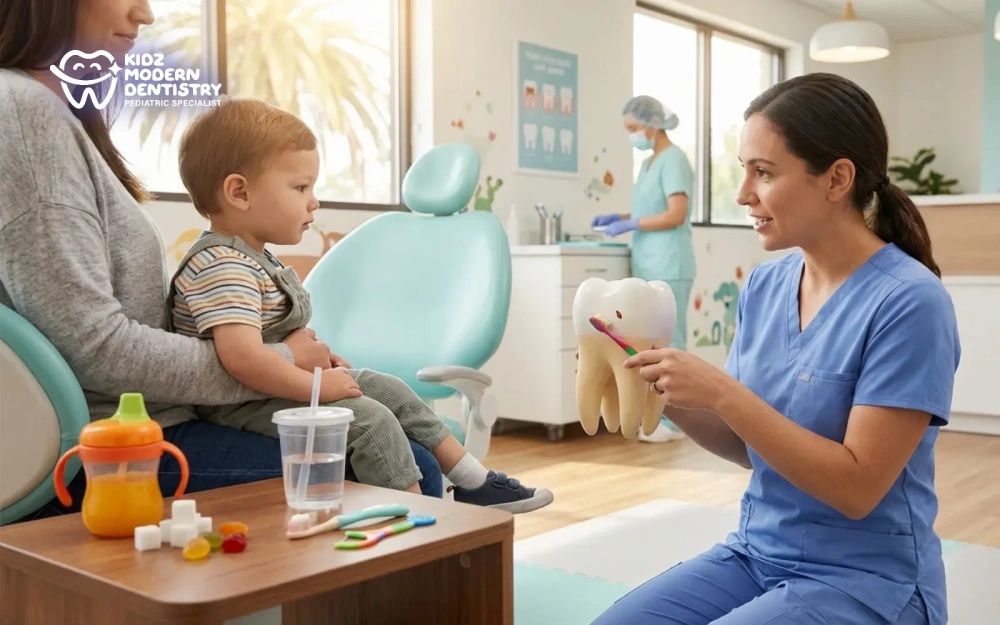
- What should Laguna Niguel parents know about sippy cups and cavities?
- What is early childhood caries and why does it matter?
- How do sippy cups contribute to toddler tooth decay?
- Which drinks and habits raise the risk most?
- How does prolonged sipping of sugary drinks damage enamel in toddlers?
- What are the best cups for toddlers and how can we wean off sippy cups?
- Is water better than juice for kids and how much is appropriate?
- When should a child see a dentist for the first time and what happens at age one?
- How can you prevent cavities in toddlers with daily habits?
- Do fluoride and dental sealants for kids help prevent decay?
- What local and national guidelines apply to families in California?
- What signs of problems should parents watch for and when should you seek help?
- How can nutrition choices protect your child’s smile?
- How do bedtime bottles and pacifiers relate to baby bottle tooth decay?
- What myths about sippy cups and cavities should we rethink?
- How does Kidz Modern Dentistry in Laguna Niguel, CA support your family?
- Where can you find the sources and references for this article?
What should Laguna Niguel parents know about sippy cups and cavities?
Parents often choose sippy cups because they prevent spills and help toddlers transition from bottles. The catch is that frequent sipping, especially of sweet or acidic drinks, can increase the risk of cavities. That is why you may hear about a link between sippy cups and cavities. The risk is not the cup alone, but how it is used and what goes inside it. When children take small sips over long periods, sugars and acids stay on the teeth. Bacteria in dental plaque feed on these sugars and produce acids that weaken enamel. Over time this cycle can lead to toddler tooth decay, also called early childhood caries [2] [3].
Parents in Laguna Niguel, CA can lower that risk with a few practical steps. Offer water between meals, save sweet drinks for mealtimes if offered at all, and encourage open cup drinking as soon as your child is developmentally ready. Combine those routines with consistent brushing, fluoride exposure as recommended by your pediatric dental team, and early professional visits. Many families also benefit from Pediatric preventive dentistry approaches that focus on risk assessment, education, and early interventions that fit everyday life.
What is early childhood caries and why does it matter?
Early childhood caries is a form of tooth decay that affects young children, often appearing in the upper front teeth and back molars. It happens when bacteria use sugars from drinks and foods to produce acids. Those acids pull minerals out of the enamel surface in a process called demineralization. If the cycle continues and minerals are not replenished by saliva and fluoride, the enamel can break down into a cavity [2] [4].
Why it matters is straightforward. Cavities can develop quickly in baby teeth because the enamel is thinner than adult teeth. Untreated decay can cause pain, difficulty eating and sleeping, and infections that sometimes require urgent care. It may also affect speech development, school readiness, and overall wellbeing. National data show that cavities are among the most common chronic conditions in children, which is why prevention during the toddler years is so important [3].
How do sippy cups contribute to toddler tooth decay?
Sippy cups are a helpful transition tool when used for a short time and filled mostly with water. The concern is frequent use with sugary liquids such as juice, sweetened milk, flavored drinks, or sports beverages. Repeated sipping extends the time teeth are bathed in sugars, which feeds cavity causing bacteria. Some sippy cup designs also direct liquid toward the front teeth, which may concentrate exposure in areas where early childhood caries often starts [1] [2].
What to do instead. Use sippy cups briefly as a stepping stone while you guide your child toward straw cups or open cups. Limit juice and sweet beverages, and do not allow your child to carry a cup of sugary liquid around during the day. If your child uses a sippy cup outside of meals, make it water only. For many families, these are core parts of Pediatric preventive dentistry in Laguna Niguel goals that are simple, consistent, and realistic.
Which drinks and habits raise the risk most?
Several specific drinks and routines are linked with higher cavity risk in toddlers:
- Juice between meals can raise cavity risk because natural sugars and acids still affect teeth. Even one hundred percent fruit juice can contribute if it is sipped often rather than consumed with meals [6].
- Sugary drinks such as fruit drinks, sports beverages, flavored milk, and sweetened teas are associated with early childhood caries when offered frequently or used for comfort [2] [3].
- Prolonged sipping sugary drinks keeps teeth in an acid bath and reduces the time saliva has to neutralize acids and repair enamel [1] [2].
- Bedtime or naptime cups filled with anything other than plain water place teeth at significant risk, since saliva flow is lower during sleep and liquids can pool around teeth [4].
- Frequent sticky snacks like fruit snacks or candies can worsen the effect when combined with sweet drinks, since they cling to teeth and feed bacteria longer [2].
How does prolonged sipping of sugary drinks damage enamel in toddlers?
Each time a child sips a sugary or acidic drink, oral bacteria produce acids that lower the pH in the mouth. Enamel begins to lose minerals when the pH falls below a critical level. Saliva helps buffer acids and replace minerals, and fluoride strengthens the enamel crystals that form during remineralization. The problem with frequent sipping is that the mouth never fully recovers before another acid cycle begins. Over time this balance shifts toward damage, leading to enamel erosion in toddlers and, eventually, cavities [3] [13].
Acidic drinks play a role even when sugar is not the main ingredient. Many juices and sports beverages are acidic, and prolonged contact erodes the protective enamel surface. That is why the what, the when, and the how all matter. Offer water for thirst, save sweet drinks for meals if used, and aim for open cup or straw cup use that encourages swallowing without lingering sips [1] [13].
What are the best cups for toddlers and how can wean off sippy cups?
There is no single perfect cup for every child, but certain features support healthier drinking habits:
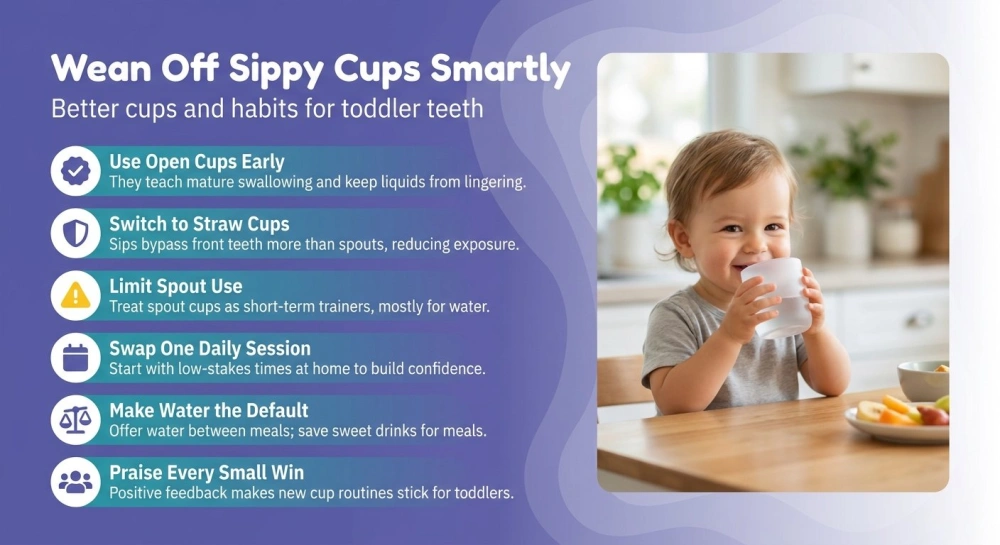
- Open cups help children learn mature swallowing and reduce lingering liquid on teeth. Small training cups are easier for little hands.
- Straw cups encourage sipping and swallowing without pooling around the front teeth as much as spouts may do.
- Spout cups used briefly can be part of a stepwise transition, especially when filled with water and used during specific times like car rides.
To make weaning gentler, replace one daily sippy session at a time with an open or straw cup, starting with low stakes times at home. Use water as the go to option, and reserve juice or sweet beverages for meals on an occasional basis if you choose to offer them. Praise each small success and make it a family routine. The American Dental Association advises that sippy cups are a short term training tool rather than a long term comfort item [1].
Is water better than juice for kids and how much is appropriate?
For thirst and everyday hydration, water is the best choice. If your local water is fluoridated, it can also help protect teeth against decay by strengthening enamel during daily remineralization cycles [8]. You can check community water fluoride levels using national tools and your local supplier resources [9].
When it comes to juice, pediatric guidance recommends limiting amounts by age and focusing on whole fruit whenever possible. The American Academy of Pediatrics recommends avoiding juice for infants and limiting juice for older toddlers, served in a cup during meals rather than for comfort or constant sipping [6]. The Dietary Guidelines for Americans also advise limiting added sugars for young children and choosing nutrient dense foods and beverages first [7]. Water vs juice for kids is a daily decision that becomes easier when water is always available and modeled by adults.
When should a child see a dentist for the first time and what happens at age one?
The first dental visit is recommended by the first birthday or within six months after the first tooth erupts. That early dental home lets your child become comfortable, gives you personalized guidance, and provides preventive care based on your child’s specific risk factors. The visit usually includes a gentle exam, a look at tooth and gum development, guidance on brushing and fluoride, diet counseling around sippy cups and cavities, and a plan for regular checkups. In some cases, topical fluoride varnish may be applied to strengthen enamel [14] [11] [5].
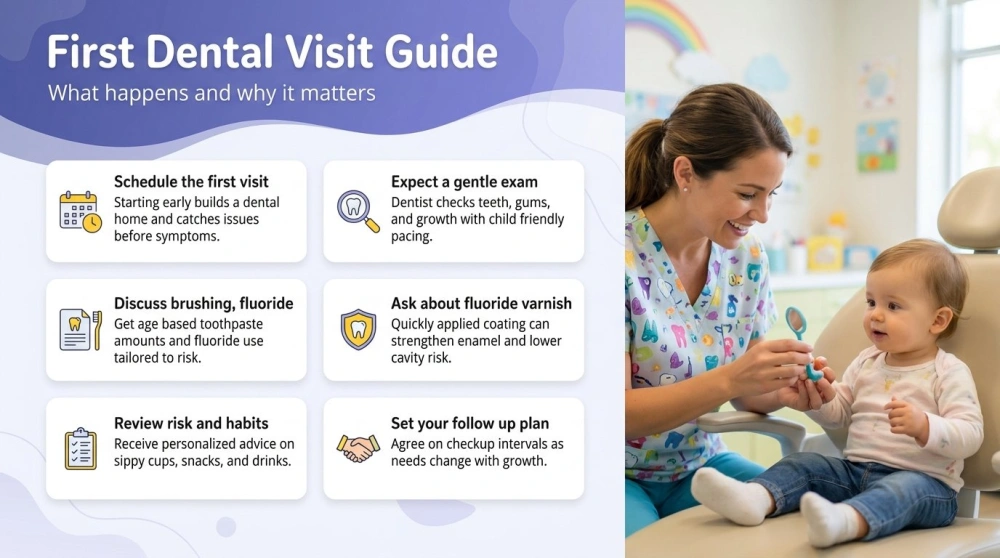
Preventive care is not one size fits all. It changes as your child grows. That is why ongoing checkups and conversations with your care team matter. Pediatric preventive dentistry is designed to fit real schedules and real challenges, whether you are navigating teething, weaning off sippy cups, or encouraging independent brushing.
How can you prevent cavities in toddlers with daily habits?
Simple, consistent habits are the foundation of cavity prevention. A few small routines add up to big protection over time.
- Brush twice daily using a smear the size of a grain of rice of fluoride toothpaste for children under three, and a pea sized amount for ages three to six, unless your dentist recommends otherwise [11].
- Floss once daily wherever teeth touch, which often starts when back teeth arrive.
- Offer water freely and keep juice and sweet drinks to mealtimes only if you choose to offer them [6].
- Limit frequent snacks and choose tooth friendly options like cheese, vegetables, nuts appropriate for age, and whole fruit.
- Avoid bedtime cups with anything but water to prevent baby bottle tooth decay patterns [4].
- Schedule regular checkups so your team can monitor growth, provide fluoride varnish when indicated, and share tailored guidance [5] [11].
Do fluoride and dental sealants for kids help prevent decay?
Fluoride and sealants are well studied tools that help protect children’s teeth. Fluoride varnish, applied in the dental office or during well child medical visits, strengthens enamel and reduces cavities in primary teeth when used as part of a comprehensive plan [5] [11]. Community water fluoridation also reduces decay at the population level and is considered a safe and effective public health measure [8].
Dental sealants are thin protective coatings placed on the chewing surfaces of back teeth where cavities often start. Sealants can be used on permanent molars and, when indicated, on primary molars for children at higher risk. Research shows that sealants can prevent a large proportion of cavities in molars over the next few years, especially when applied soon after the teeth erupt [10] [12]. Your care team can help determine the right timing based on eruption patterns and risk assessment.
What local and national guidelines apply to families in California?
Several evidence based recommendations and public health resources guide families in Laguna Niguel, CA:
- First dental visit by age one is recommended by pediatric dental organizations and supports prevention from the start [14].
- Fluoride varnish for high risk children is recommended by the United States Preventive Services Task Force during primary care visits and in dental settings [5].
- Community water fluoridation information and county level data are available so families can check local fluoride levels and understand options if their water is not fluoridated [8] [9].
- Healthy beverage guidance from national pediatric organizations advises limiting juice and avoiding sugar sweetened beverages in young children [6] [7].
These recommendations align with practical steps that families can take every day to reduce the risk of early childhood caries while still meeting nutrition and hydration needs.
What signs of problems should parents watch for and when should you seek help?
Early signs of decay can be subtle, but quick attention makes a real difference. Look for dull white spots near the gumline, visible brown areas, or small pits on the front teeth or molars. Your child may not complain until a cavity becomes deeper, which is why regular exams matter even for toddlers. Contact a pediatric dentist Laguna Niguel families trust if you notice any of the following:
- White or brown spots that do not brush away, especially near the gums.
- Sensitivity or pain with cold drinks or sweets.
- Swelling or redness of the gums near a tooth.
- Changes in eating or sleeping that could signal discomfort.
If your child has dental pain, swelling, or a facial injury, reach out for same day guidance from your dental team or seek urgent care when appropriate.
How can nutrition choices protect your child’s smile?
Nutrition and oral health are closely linked. Thoughtful beverage choices reduce the fuel that cavity causing bacteria rely on. Balanced meals provide minerals that teeth need for repair. Consider these practical ideas:
- Make water the default by keeping cups available and modeling water at home and on the go [8].
- Serve whole fruit instead of juice when possible to add fiber and reduce concentrated sugar exposure [6] [7].
- Pair snacks with meals so teeth are not exposed to sugars all day long.
- Offer tooth friendly foods like cheese, yogurt without added sugars, vegetables, and proteins that help neutralize acids and support enamel.
- Read labels together as a family activity and talk about choosing drinks without added sugars, which aligns with national dietary guidance for young children [7].
How do bedtime bottles and pacifiers relate to baby bottle tooth decay?
Baby bottle tooth decay is a pattern of cavities seen when infants or toddlers frequently fall asleep with bottles or cups containing liquids other than water. During sleep, saliva flow decreases, and liquids can pool around the front teeth, allowing bacteria to produce acids for longer periods. Even milk contains natural sugars that can contribute to decay if used as a bedtime settling tool. Transitioning away from bedtime bottles and choosing clean pacifiers for soothing, without sweet coatings, lowers risk patterns that mimic prolonged sipping from cups [4] [2].
If your child still needs comfort at bedtime, offer a routine that includes brushing with fluoride toothpaste, reading together, and cuddling. If a bottle or cup is involved, make it water only. These small changes help prevent baby bottle tooth decay while supporting better sleep habits.
What myths about sippy cups and cavities should we rethink?
Separating myths from facts helps parents make confident choices.
- Myth A spill proof cup is automatically tooth friendly. Fact Spills may be contained, but long sipping still exposes teeth to sugars and acids. The goal is to limit frequency and choose water for between meal use [1].
- Myth Juice labeled one hundred percent fruit is harmless for teeth. Fact Natural sugars and acids can still lead to cavities when sipped often. Timing and portion size matter, and whole fruit is preferred for most children [6].
- Myth Only candy causes cavities. Fact Sugary drinks, frequent snacks, and even certain crackers can increase risk by providing simple carbohydrates for bacteria to ferment [2].
- Myth Brushing eliminates the impact of sipping habits. Fact Brushing is essential, but frequent sugar exposure can overpower even good brushing without attention to beverage routines [2] [3].
- Myth Fluoride is unnecessary if kids brush well. Fact Fluoride strengthens enamel and is recommended as part of a comprehensive prevention plan for young children based on risk [5] [11].
How does Kidz Modern Dentistry in Laguna Niguel, CA support your family?
At Kidz Modern Dentistry, we focus on clear guidance, gentle care, and a partnership that helps you prevent cavities in toddlers with practical steps you can use at home. Our team supports families across Laguna Niguel, CA with same day help for urgent needs, comfortable options for anxious little ones, and a calm, child centered environment. You can reach us at +1 949 273 0110 for scheduling and questions.
We design visits around your child’s stage of development. At early visits we assess cavity risk, review sippy cup routines, and share brushing and fluoride tips that match your child’s abilities. When appropriate, we offer in office fluoride varnish and discuss timing for sealants on new molars as they erupt. This approach reflects Pediatric preventive dentistry and a commitment to education first.
For families balancing busy schedules, we aim to make care accessible. We provide clear treatment options, explain each step before we begin, and welcome caregivers chairside. If your child needs extra support, we offer kid friendly sedation with safety focused protocols, and we maintain open communication about benefits and risks so you can make informed choices.
Our practice invests in modern equipment and child friendly spaces to help visits feel positive. We use proven materials for restorations when needed and emphasize minimally invasive options whenever appropriate. We believe prevention is a daily team effort that blends home routines with timely professional care. Families seeking Pediatric preventive dentistry in Laguna Niguel can expect coaching on weaning off sippy cups, beverage choices, and cavity prevention that fits daily life.
As your child grows, we monitor tooth and jaw development, track eruption timing, and coordinate with other health professionals when needed. Many local parents have shared that early guidance on water first habits, juice limits, and bedtime routines made the biggest difference in avoiding early childhood caries. If a cavity does occur, we explain gentle treatment options and outline steps to avoid new problems. Our goal is a positive experience today and confident smiles for years to come.
Where can you find the sources and references for this article?
- Sippy Cups: Spill Proof Does Not Mean Tooth Friendly – American Dental Association
- Policy on Early Childhood Caries: Classifications, Consequences, and Preventive Strategies – American Academy of Pediatric Dentistry
- Children’s Oral Health Facts – Centers for Disease Control and Prevention
- Early Childhood Tooth Decay Information – National Institute of Dental and Craniofacial Research
- Prevention of Dental Caries in Children Younger Than 5 Years – USPSTF Recommendation Statement
- Fruit Juice in Children’s Diet: Current Recommendations – American Academy of Pediatrics
- Dietary Guidelines for Americans 2020 to 2025 – U.S. Departments of Agriculture and Health and Human Services
- Community Water Fluoridation Basics – Centers for Disease Control and Prevention
- My Water’s Fluoride Tool – Centers for Disease Control and Prevention
- Dental Sealants Prevent Cavities – CDC Vital Signs
- Best Practices on Fluoride Therapy – American Academy of Pediatric Dentistry
- Best Practices on Dental Sealants – American Academy of Pediatric Dentistry
- Tooth Erosion Overview – American Dental Association
- Perinatal and Infant Oral Health Care – American Academy of Pediatric Dentistry
Common Questions About This Topic
Find answers to frequently asked questions related to this article.
