
- What do cavities look like in kids teeth?
- How does tooth decay start as white spot lesions in children?
- Which colors and textures suggest a cavity in a baby tooth?
- How can you tell kids cavity vs stain at home safely?
- Where do cavities usually form in baby and new permanent teeth?
- What symptoms like tooth sensitivity to sweets in children should you watch for?
- How do pediatric dentists diagnose early childhood caries without overexposure?
- What treatments are used when a cavity is found in a child?
- How can families prevent cavities with daily routines and smart nutrition?
- What California and local guidance matters for families in Laguna Niguel, CA?
- When should you call a pediatric dentist in Laguna Niguel, CA?
- What questions do parents ask most often about how cavities look in kids teeth?
- How does Kidz Modern Dentistry support your child’s cavity care in Laguna Niguel, CA?
- Where can you find the sources for this guide?
What do cavities look like in kids teeth?
When you picture a cavity, you might think of a small dark hole. In children, tooth decay can be more subtle at first. Early stages may show up as faint chalky white spots near the gumline or along the edges of grooves. As decay progresses, you may notice brown or black areas, a rough texture, or actual pits and holes in teeth. Because baby teeth have thinner enamel than adult teeth, changes in color and texture can happen faster in children than you might expect [1] [2].
If you are searching for what do cavities look like in kids teeth, the short answer is that they range from white spot lesions on kids teeth to visible pits or holes in teeth. In between those stages, you might see brown or black spots on baby teeth, especially on the chewing surfaces or along the gumline of upper front teeth. These changes can appear gradually, and they do not always cause pain at first, which is why routine checkups help catch decay early [1] [3].
Almost half of children and teens in the United States have experienced dental caries by adolescence, and a meaningful portion have untreated decay. According to national data, youth ages 2 to 19 show a high prevalence of caries experience and a notable percentage with untreated disease, which underscores the value of early detection and timely care [4]. If you notice small color changes or rough spots that were not there before, it is reasonable to have a pediatric dentist take a closer look.
How does tooth decay start as white spot lesions in children?
Early childhood caries often begins as demineralization, which looks like dull white or chalky patches on the enamel. These white spots can be dry and matte rather than glossy. They commonly appear where plaque tends to sit longer, like along the gumline, around orthodontic brackets, between teeth, or in the pits and fissures of molars. At this stage, enamel minerals are dissolving faster than they can be replaced. The good news is that very early lesions can be stabilized or even reversed with consistent brushing using fluoride toothpaste, professional fluoride varnish, dietary changes, and better plaque control [1] [3] [5].
Because baby teeth are more vulnerable, these early signs can progress more quickly in toddlers and preschoolers. Nighttime feeding patterns, frequent snacking, and sugary drinks can accelerate the process. Your dental team can review home care and apply preventive treatments that are backed by professional guidelines and systematic reviews of effectiveness [3] [6].
Which colors and textures suggest a cavity in a baby tooth?
What color changes are most common before a hole forms?
Color changes can signal different stages of decay. Here is what to watch for in a cavity in baby tooth as it develops:
- Chalky white patches that look dull rather than shiny can be early demineralization, especially near the gums or along the edges of grooves [1] [5].
- Light brown areas may indicate deeper enamel changes or early dentin involvement, especially in pits and fissures [1].
- Dark brown or black spots can reflect more advanced changes. Not all dark spots are decay, but many are, especially if the surface feels soft or rough [2].
What textures and surface changes should concern you?
- Rough or chalky feel when gently gliding a clean finger or soft brush over the area can signal demineralization [1].
- Pits or holes in teeth suggest cavitation that likely needs restorative care rather than only remineralization approaches [1].
- Shadowing between teeth can indicate hidden decay that may show more clearly on bitewing radiographs [1].
How can you tell kids cavity vs stain at home safely?
It can be hard to tell kids cavity vs stain with the naked eye. Stains from foods or minerals often appear as uniform discolorations that feel hard and smooth. Cavities are more likely to have a chalky edge, a matte look, or a softened area you can feel with a gentle toothbrush. A cavity might also be surrounded by plaque buildup or occur in places where plaque tends to collect, like along the gumline or in deep grooves. Because stains and early decay can look similar, a professional exam and simple imaging can help confirm what you are seeing [1] [2].
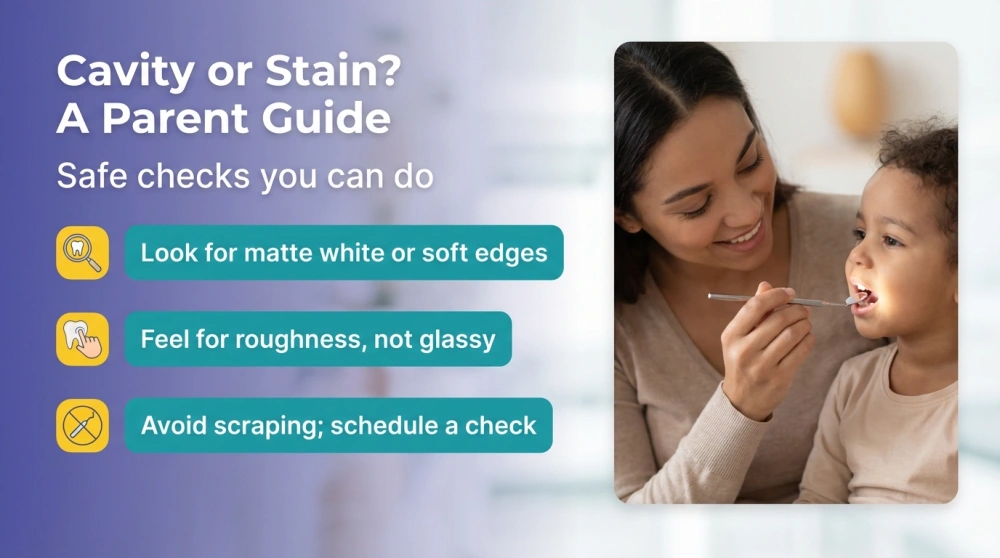
It can be hard to tell kids cavity vs stain with the naked eye. Stains from foods or minerals often appear as uniform discolorations that feel hard and smooth. Cavities are more likely to have a chalky edge, a matte look, or a softened area you can feel with a gentle toothbrush. A cavity might also be surrounded by plaque buildup or occur in places where plaque tends to collect, like along the gumline or in deep grooves. Because stains and early decay can look similar, a professional exam and simple imaging can help confirm what you are seeing [1] [2].
When in doubt, avoid scraping or poking. Keep the area clean, reduce sugary snacks and drinks, and schedule an evaluation. A dentist can use a bright light, magnification, and additional tools to determine whether the area is a stain that can be polished away or an area of decay that needs treatment [1].
Where do cavities usually form in baby and new permanent teeth?
Which spots are high risk in toddlers and young children?
- Along the gumline of upper front teeth in infants who sleep with bottles or drink sugary liquids frequently, a classic pattern associated with early childhood caries [3] [5].
- In the deep grooves of molars where toothbrush bristles and saliva may not clean effectively. Sealants can protect these surfaces once teeth erupt fully [7].
- Between back teeth where food tends to pack and flossing is more challenging for little hands [1].
What about children with mixed dentition when adult molars erupt?
When the first permanent molars erupt around the early school years, their grooves are especially cavity prone. These teeth may trap plaque while they are only partly erupted, and gum tissue can partially cover the biting surfaces, creating a sheltered area for bacteria. Pediatric dentists often recommend sealants and fluoride varnish during this time based on a child’s caries risk level [1] [7].
What symptoms like tooth sensitivity to sweets in children should you watch for?
Visible changes do not always come with pain, but certain symptoms may point to active decay or a deeper problem. Watch for these signs of tooth decay in children and reach out if you notice them:
- Tooth sensitivity to sweets in children that lingers after eating treats can suggest enamel breakdown that has reached dentin [2].
- Sensitivity to cold or heat especially if the sensation lasts more than a moment [2].
- Pain when chewing including avoiding one side of the mouth or refusing certain foods [2].
- Bad breath that does not improve with brushing and flossing, which can accompany advanced decay [2].
- Gum swelling or a pimple near a tooth that can indicate an infection needing prompt care [2].
If your child has any of these symptoms, timely evaluation helps limit discomfort and keep treatment conservative whenever possible. Regular visits for Pediatric preventive dental care fit naturally with this approach, focusing on early identification and action before small problems grow larger.
How do pediatric dentists diagnose early childhood caries without overexposure?
What happens during a visual exam for suspected cavities?
During an exam, the dentist looks for changes in color, texture, and translucency using a bright light and sometimes magnification. Teeth are dried gently so that white spot lesions become more visible. The dentist assesses plaque buildup, gum health, and signs of wear or erosion that can mimic decay. Parents may be asked about diet, snacking habits, nighttime feeding, home hygiene routines, and exposure to fluoride in toothpaste or community water [1] [8].
When are X rays recommended for children?
Radiographs are considered based on individual risk, not on a fixed schedule. For example, bitewing images help find cavities between teeth that are hard to see directly. Professional bodies emphasize selecting X rays only when the expected benefit outweighs the small risk, particularly for young patients. The goal is to confirm what is suspected clinically and guide treatment planning while following evidence based selection criteria [1] [8].
What treatments are used when a cavity is found in a child?
Can very early lesions be managed without a filling?
Yes. If decay has not yet created a hole, the focus is on remineralization and behavior changes. Strategies include professional fluoride varnish, home brushing with fluoride toothpaste in age appropriate amounts, flossing help for tight contacts, and reducing frequent exposure to sugary snacks or drinks. Systematic reviews support fluoride varnish as effective in reducing caries in primary teeth when used as part of a prevention plan [6].
What is SDF and when is it used for children?
Silver diamine fluoride is a topical liquid that can help arrest active decay on certain tooth surfaces. It is noninvasive, quick to apply, and useful for young or anxious children, or as an interim step before definitive restorations. SDF darkens the treated decay site, which lets you and your dentist see where it has been placed. Research supports its ability to arrest caries in primary teeth when used appropriately and monitored over time [9] [10].
When are fillings or crowns recommended for baby teeth?
Once a cavity breaks through enamel and creates a hole, a restoration is typically needed to remove decayed tissue and rebuild the tooth. Small to moderate lesions may be treated with tooth colored fillings. Larger lesions on baby molars may be better protected with pediatric crowns to restore function and hold spacing for developing permanent teeth. Your dentist will consider the tooth’s structure, risk level, and how long the tooth needs to last in the mouth [1] [11].
What if decay reaches the nerve in a baby tooth?
If bacteria reach the pulp, children can develop pain or infection. In those cases, options include pulp therapy to treat the nerve and preserve the tooth when possible, or extraction when a tooth cannot be predictably restored. A space maintainer may be recommended after early loss of a baby molar to help permanent teeth erupt into better positions [1].
How can families prevent cavities with daily routines and smart nutrition?
Which brushing and toothpaste tips make the biggest difference?
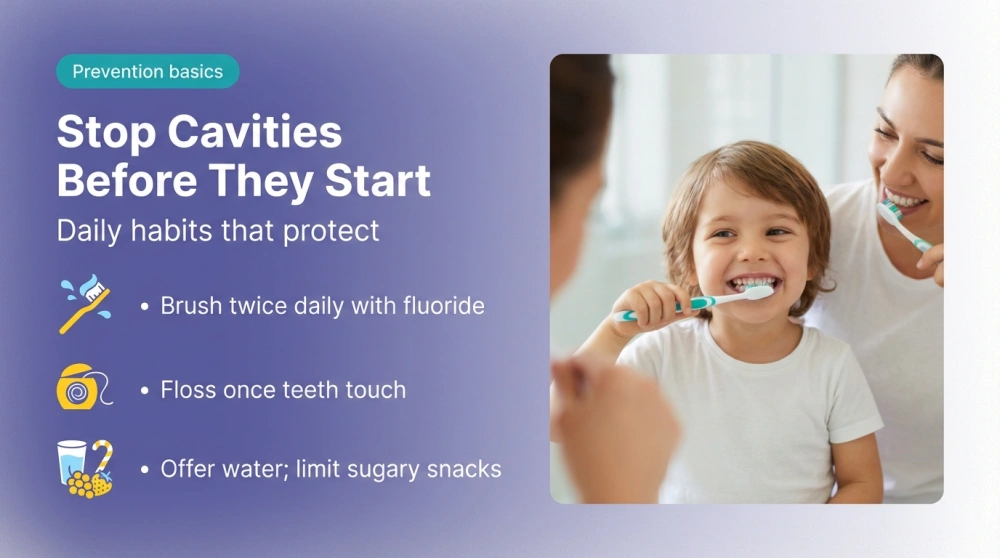
- Brush twice daily with a soft child sized brush and fluoride toothpaste. For children under age 3, a smear the size of a grain of rice is recommended. For ages 3 to 6, a pea sized amount is appropriate. Adults should help or supervise to ensure thorough cleaning and safe spitting [3].
- Floss nightly once teeth touch. Parents can use flossers to make it easier for small mouths and hands [1].
- Schedule routine visits starting by the first birthday or within six months of the first tooth. Regular checkups support Pediatric preventive dental care in a way that is personalized to your child’s risk and needs [3].
What nutrition and hydration habits protect enamel?
- Limit sugary snacks and drinks and keep them with meals rather than constant grazing. Frequent exposure feeds cavity causing bacteria [2].
- Offer water between meals and use cups rather than prolonged bottle feeding when feasible. Avoid allowing milk or juice at bedtime after brushing [3] [5].
- Know your water. Community water fluoridation strengthens enamel and is safe and recommended by major health organizations. Check local fluoridation status if you use mostly tap water [12].
How do sealants and varnish fit into a prevention plan?
- Sealants protect deep grooves on molars that are hard to clean. They are most effective when placed soon after molars erupt and maintained over time [7].
- Fluoride varnish at regular intervals supports remineralization of early white spot lesions and reduces new decay in primary teeth based on systematic reviews [6].
Families in Laguna Niguel, CA often balance busy schedules and active lifestyles. Simple habits like brushing together, keeping water handy, and scheduling checkups ahead of sports seasons keep prevention on track. Many parents also ask about Pediatric preventive dental care in Laguna Niguel during school breaks to align with calendars and minimize missed classes.
What California and local guidance matters for families in Laguna Niguel, CA?
What should you know about California’s kindergarten oral health assessment?
California law encourages early dental checkups through the Kindergarten Oral Health Assessment program. Families are asked to have a dental assessment for children entering kindergarten or first grade and submit a simple confirmation form to the school. The intent is to identify dental concerns, including early childhood caries, at a time when timely care can make a big difference in comfort and learning [8].
How can you check whether your community water is fluoridated?
The Centers for Disease Control and Prevention offers information on community water fluoridation, which is recognized as a safe and effective way to prevent decay across populations. Parents in Laguna Niguel, CA can review state and local fluoridation details and discuss any questions with their child’s dentist [12].
Why is early care coordination helpful for kids in Laguna Niguel, CA?
Coordinating your child’s dental home early helps track changes in color, texture, and spacing over time. Familiarity with a practice supports comfort during visits and creates a record that informs decisions about when to place sealants, when to apply fluoride varnish, and when to monitor versus restore. This is particularly important when you are watching an area that might be a stain today but could turn into decay tomorrow [1] [3].
When should you call a pediatric dentist in Laguna Niguel, CA?
Reach out promptly if you notice any of the following:
- A visible hole or area that looks like a crater on a tooth.
- Brown or black spots on baby teeth that were not there before and appear to be spreading.
- Pain with biting or lingering sensitivity to sweets or cold.
- Swelling or a gum pimple near a tooth that could indicate infection.
- Trauma to a tooth with color change or a chip that catches a fingernail.
If you are searching for a pediatric dentist Laguna Niguel and you are unsure whether a spot is decay, it is appropriate to ask for a quick evaluation. Many offices reserve time for urgent needs and can advise you on the next steps based on what they see.
What questions do parents ask most often about how cavities look in kids teeth?
Why do white spots near the gums on my toddler’s teeth keep coming back after brushing?
White spots can be early demineralization that require more than plaque removal. In addition to careful brushing, your dentist may recommend fluoride varnish and diet changes to shift the balance toward remineralization. Monitoring helps confirm whether those areas are hardening or progressing [3] [6].
Can a dark line in a molar groove be just a stain rather than decay?
Yes, sometimes grooves trap stain even if the enamel underneath is sound. A dentist can test the area, assess the texture, and sometimes place a sealant to protect a clean groove if stain alone is present. If the area is soft or sticky, treatment is more likely needed [7].
How quickly can a cavity grow in a baby tooth?
Progression varies with diet, hygiene, saliva, and fluoride exposure. In high risk situations, demineralization can move from white spot to cavitation within months. That is why short recall intervals and targeted prevention are recommended for children with early childhood caries or multiple risk factors [1] [3].
Do all brown or black spots on baby teeth require fillings?
Not always. The decision depends on whether the spot is active decay, arrested decay, or a stain. Some arrested lesions can be monitored, while active lesions usually need treatment. Options range from fluoride and SDF to minimally invasive restorations, based on your child’s comfort and cooperation [1] [9].
Can fluoride toothpaste really reverse a cavity?
Fluoride toothpaste and varnish can help remineralize early noncavitated lesions but will not rebuild a hole once one has formed. Once there is a cavity with a break in the enamel, a restoration is typically needed to restore form and function [1] [6].
Is there a safe way to check between my child’s teeth for hidden decay?
At home, keep up with flossing to disrupt plaque between teeth and look for shadowing near the contact points. In the office, bitewing images help detect early lesions between teeth so that dentists can act before a cavity gets larger [1].
What is the earliest age to see a dentist for cavity prevention?
Major pediatric and dental groups recommend a first dental visit by the first birthday or within six months after the first tooth appears. Early visits let the team review brushing, fluoride, diet, and habits so that families can prevent early childhood caries from the start [3].
How does Kidz Modern Dentistry support your child’s cavity care in Laguna Niguel, CA?
At Kidz Modern Dentistry, we focus on helping families recognize changes early, understand options clearly, and choose steps that fit each child’s needs and personality. Our team provides Pediatric preventive dental care to track white spot lesions, protect high risk grooves, and guide healthy routines that reduce the chance of new decay. When treatment is needed, we explain the why and the how in simple terms so that you and your child feel ready and supported.
We care for children of all ages in Laguna Niguel, CA and surrounding communities across South Orange County. Families come to us for same day evaluations when something looks off, thoughtful appointment pacing for little ones, and kid friendly sedation choices when appropriate. We coordinate with parents and caregivers to create a plan that makes sense for school, sports, and everyday life.
- Personalized prevention that adapts to your child’s caries risk, from varnish schedules to sealant timing and home hygiene coaching.
- Comfort first with warm communication, child sized tools, and a calm environment that helps visits feel safe and positive.
- Gentle, evidence based care including options like SDF for noninvasive arrest of certain lesions and durable restorations when needed.
- Clear next steps so you know when to monitor, when to treat, and how to keep new spots from appearing.
- Direct access to our pediatric dental team for questions between visits and guidance if symptoms change.
Parents who prefer a proactive path appreciate how we use simple visuals and progress notes to show what we are watching and why. We discuss the difference between a stain that needs polishing and a cavity that needs restoration, and we share photos and images when helpful so you can see changes over time. This approach supports informed decisions and steady progress.
If you have questions about a new white spot, a groove that looks darker, or a sensitive tooth after sweets, our team is happy to help you decide on timing and options. Call us at +1 949 273 0110 to schedule. We serve families in Laguna Niguel, Aliso Viejo, Ladera Ranch, Mission Viejo, and Dana Point, and we welcome new patients who want a friendly, educational home for pediatric dental care.
Where can you find the sources for this guide?
- Policy and Guideline Documents on Caries Management – American Academy of Pediatric Dentistry
- Dental Caries Overview – American Dental Association
- Use of Fluoride in Caries Prevention – American Academy of Pediatric Dentistry
- Dental Caries and Sealant Prevalence in Children and Adolescents 2015 to 2018 – Centers for Disease Control and Prevention
- Tooth Decay Basics – National Institute of Dental and Craniofacial Research
- Topical Fluoride for Preventing Dental Caries in Children and Adolescents – Cochrane Library
- Dental Sealants Frequently Asked Questions – Centers for Disease Control and Prevention
- Kindergarten Oral Health Assessment Program – California Department of Public Health
- Silver Diamine Fluoride and Caries Arrest in Children Systematic Review – PubMed
- Effectiveness of Silver Diamine Fluoride in Arresting Caries in Primary Teeth – PubMed
- Guideline on Pediatric Restorative Dentistry – American Academy of Pediatric Dentistry
- Community Water Fluoridation Basics – Centers for Disease Control and Prevention
Common Questions About This Topic
Find answers to frequently asked questions related to this article.
