
- What are dental sealants and how do they protect kids teeth?
- How often should dental sealants be checked during children’s dental checkups?
- What evidence supports the recommended sealant check frequency?
- Which factors influence how often to check and maintain sealants?
- How long do sealants last and when do they need repair or reapplication?
- What does a pediatric sealant check include at a routine dental exam?
- How do fluoride varnish and dental sealants compare for cavity prevention for kids?
- Which teeth and ages benefit most from pediatric dental sealants?
- How can parents help sealants last longer between visits?
- What problems can occur with sealants and how are they fixed safely?
- How do California programs and guidelines support sealants for children in Laguna Niguel?
- How should families in Laguna Niguel schedule children’s preventive dentistry and recall visits?
- What questions can you ask your pediatric dentist in Laguna Niguel about sealants?
- Are dental sealants safe for children and what do major organizations say?
- When might a dentist delay or avoid placing a sealant on a tooth?
- How do dentists document sealant placement and maintenance for your child?
- How does Kidz Modern Dentistry in Laguna Niguel help you manage sealant maintenance and checkups?
- Where can you find the research and resources cited in this article?
What are dental sealants and how do they protect kids teeth?
Dental sealants are thin protective coatings applied to the chewing surfaces of back teeth where deep grooves can trap food and bacteria. Those grooves, often called pits and fissures, are common sites for early tooth decay in children. A sealant flows into the grooves, is cured to harden, and creates a smooth barrier that is easier to keep clean. When paired with regular brushing, a balanced diet, fluoride exposure, and routine dental exams, pediatric dental sealants can lower the risk of cavities in growing smiles. Public health data show that sealants can reduce decay in permanent molars by up to 80 percent in the first two years after placement and continue to protect for several years after that, and children without sealants have significantly more molar cavities than those with sealants [1].
Parents often ask whether sealants replace daily care. Sealants support tooth decay prevention, especially on chewing surfaces, but they work best alongside healthy habits. That is why children’s preventive dentistry is designed as a complete plan that includes brushing, flossing instruction, nutrition guidance, fluoride exposure, professional cleanings, and kids dental sealants for the right teeth at the right time [2][3].
How often should dental sealants be checked during children’s dental checkups?
The short answer is this. Your child’s dental sealants should be evaluated at each routine dental exam. For many children, that means every six months, while some children may benefit from shorter or longer intervals based on individual cavity risk. Pediatric organizations emphasize that sealants must be monitored and maintained during recall visits so that any wear, partial loss, or microleakage can be found and addressed promptly [2].
Recall timing is personalized. Evidence based guidance notes that the interval between checkups should reflect your child’s specific risk factors, which can range from three months for higher risk patients to longer intervals for lower risk patients. Your pediatric dental team will recommend a schedule that fits your child’s needs and will include a sealant check at each visit [4].
We incorporate Fluoride and sealant treatments for children into a comprehensive recall plan, so sealant checks happen as part of a consistent care rhythm that also includes cleaning, fluoride applications when indicated, and bitewing images when appropriate for caries detection [2][4].
What evidence supports the recommended sealant check frequency?
Several high quality sources guide how we time and perform sealant checks. Clinical practice guidance from pediatric and general dentistry organizations states that sealants need regular evaluation and maintenance to remain effective at preventing occlusal caries in children and adolescents. Those professional recommendations align with public health findings that demonstrate strong caries prevention benefits when sealants are placed and maintained appropriately [1][2][3].
Systematic reviews consistently report that sealing sound or incipient noncavitated occlusal surfaces reduces the incidence of new carious lesions compared with no sealant, and maintaining sealant integrity enhances this protective effect. Cochrane analyses also indicate that sealing can be superior to no sealing, and that ongoing evaluation is necessary because retention declines over time as teeth function and as children grow [5].
Public health surveillance shows two important realities. First, sealants work. Second, many children still do not have them, especially children at higher risk for caries. Expanding and maintaining sealant coverage among eligible children, and checking those sealants consistently at recall, is a practical way to lower preventable tooth decay burden in communities [1][6].
Which factors influence how often to check and maintain sealants?
Sealant check frequency is tailored to your child. During children’s dental checkups, we consider multiple factors to set the right recall cadence and the right maintenance plan for your family.
- Caries risk profile: Past decay, enamel defects, visible plaque, and dietary sugars raise risk and may prompt more frequent reviews [2][4].
- Tooth eruption stage: Partially erupted molars are harder to isolate from moisture, so sealants placed early in eruption are checked closely for retention as the tooth fully erupts [2].
- Oral hygiene habits: Brushing and flossing effectiveness influences caries activity and sealant wear patterns [3].
- Grinding or clenching: Parafunctional habits can accelerate wear on sealant material and may require shorter intervals for inspection [2].
- Diet and fluoride exposure: Frequent snacking, sugary drinks, and low fluoride exposure increase risk and may change how often we check a sealant’s margins [3].
- Material used and placement conditions: Resin based sealants generally show higher long term retention than some glass ionomer options, though glass ionomers can be useful when moisture control is challenging; each material’s characteristics inform follow up timing [2][5].
How long do sealants last and when do they need repair or reapplication?
Sealant lifespan varies, but studies and public health reports show that sealants can continue to protect for years, often with measurable benefit up to four years and with some materials lasting as long as nine years on molars. Because retention and coverage naturally change as teeth function, checks at recall visits help your dentist decide whether to repair a small defect, add material, or reapply the sealant entirely. The goal is to maintain a continuous seal over the pits and fissures that are most prone to decay [1][2][3].
- Repair: If a small area has worn or chipped, adding material to restore full coverage can be efficient and comfortable for the child [2].
- Reapplication: If a sealant has largely lost retention or if margins show staining that suggests microleakage, complete reapplication supports renewed protection [5].
- Monitoring: If the sealant remains intact and margins are sound, continued monitoring at the next recall is appropriate [2].
What does a pediatric sealant check include at a routine dental exam?
Sealant checks are quick, comfortable, and part of a routine visit. They fit smoothly into children’s preventive dentistry appointments alongside cleanings and education.
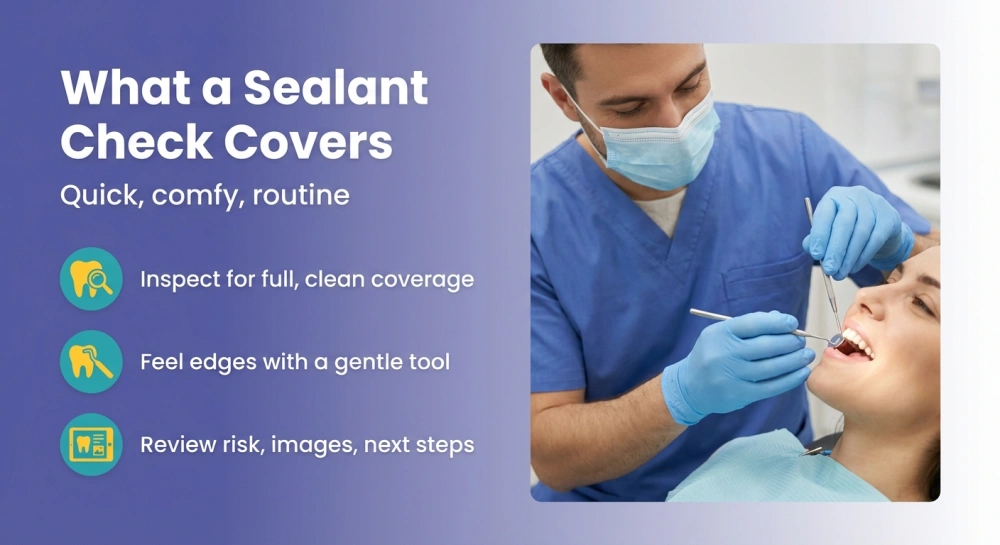
- Visual inspection: The dentist looks for intact coverage, color changes, and any gaps at the edges that could let bacteria in [2].
- Tactile assessment: A gentle explorer assesses margins for roughness or lift, which can signal partial loss [2].
- Caries risk review: The team updates risk factors, diet habits, hygiene, and fluoride exposure to shape next steps [3][4].
- Selective imaging: Bitewing images may be recommended based on age and risk to check for hidden decay that sealants do not cover on smooth surfaces [4].
- Maintenance: Minor repairs or reapplication can often be done at the same visit with child friendly techniques [2].
How do fluoride varnish and dental sealants compare for cavity prevention for kids?
Fluoride varnish and dental sealants both help prevent cavities, but they protect teeth in different ways. Fluoride varnish strengthens the entire tooth surface by promoting remineralization, which helps resist decay on smooth surfaces and around the gumline. Sealants physically block bacteria and food from settling in the deep grooves on chewing surfaces. Studies comparing the two show that each has strengths. Sealants are especially effective at preventing occlusal caries in molars, and fluoride varnish is an important preventive measure for smooth surface caries, especially in young children and those at higher risk. An evidence review comparing sealants with fluoride varnish found that, for occlusal surfaces of permanent molars, sealants can offer greater protection than varnish alone, while combined strategies are often used in practice for comprehensive prevention [5][7].
Clinical recommendations for preschool children emphasize fluoride varnish as a core preventive measure provided at periodic well child dental visits and medical visits, while older children benefit from timely sealant placement on erupting permanent molars. Your pediatric dentist will suggest both options as they fit your child’s age, risk, and tooth eruption pattern [7][3].
Which teeth and ages benefit most from pediatric dental sealants?
Kids dental sealants are commonly recommended for the first and second permanent molars soon after those teeth erupt. First permanent molars usually appear around ages six to seven, and second permanent molars appear around ages eleven to thirteen. Sealing early helps protect the grooves before plaque has a chance to create cavities. Some children at higher risk may also benefit from sealing primary molars or premolars with deep pits and fissures. Your dentist will evaluate caries risk and tooth anatomy to decide which teeth to seal and when to seal them [2][3][6].
Children’s preventive dentistry focuses on timing. When a molar is partially erupted, isolation from moisture can be challenging. In those cases, a glass ionomer option may be considered as an interim step, with a plan to re evaluate and place a resin based sealant when full eruption allows better isolation. That is another reason regular recall visits are so important to keep sealant coverage updated as teeth mature [2].
How can parents help sealants last longer between visits?
You play a big role in sealant success. At home and in daily routines, simple steps help your child’s sealants protect longer.
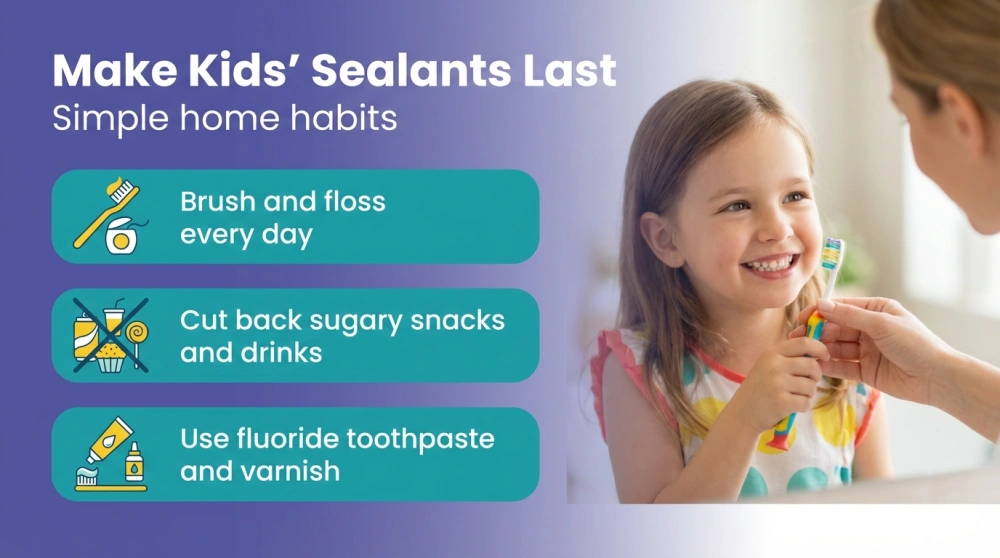
- Keep brushing and flossing daily: Clean teeth and healthy gums support sealant margins and overall oral health [3].
- Limit sugary snacks and drinks: Frequent sugar exposure fuels bacteria and increases caries risk even on sealed teeth [3].
- Use fluoride as directed: Fluoride toothpaste and professional varnish applications strengthen enamel between visits [7].
- Protect against grinding: If your child grinds, ask about strategies to reduce wear on chewing surfaces [2].
- Keep recalls on schedule: Sealant check frequency is part of a plan personalized to your child’s risk factors, so do your best to keep those appointments [4].
What problems can occur with sealants and how are they fixed safely?
Sealants are a conservative prevention tool, and when issues occur they are usually easy to correct at a routine visit.
- Partial loss or wear: Small areas can be repaired by adding material to restore complete coverage [2].
- Microleakage at margins: If staining or gaps appear at the edges, reapplication helps re establish a tight seal [5].
- Debonding on newly erupted teeth: Moisture during placement can reduce retention; interim materials can be used until isolation improves, then a long term resin based sealant is placed [2].
- Occlusal interference: If a bite feels high after placement, gentle adjustment restores comfort while maintaining coverage [2].
How do California programs and guidelines support sealants for children in Laguna Niguel?
California supports prevention through public health initiatives and community programs that include school based dental sealant efforts. The California Oral Health Program engages local partners to expand sealant access for eligible students, especially those at higher risk for tooth decay. These initiatives reflect national guidance that emphasizes prevention and early intervention for children’s oral health [6][1].
Families in Laguna Niguel can ask their school or local health partners about school sealant events and can coordinate with their pediatric dentist to ensure continuity of care. When sealants are placed in community settings, routine follow up at your dental home is still important to verify retention and to plan any needed maintenance so that benefits continue over time [6].
How should families in Laguna Niguel schedule children’s preventive dentistry and recall visits?
Start with a visit schedule based on your child’s caries risk and age, then adjust as needs change. Many families plan children’s dental checkups about every six months, while those with higher risk may return sooner. Each recall should include a sealant review of any previously sealed teeth, and it is also a good time to consider sealing newly erupted molars. If a sealant needs repair or reapplication, your pediatric dental team will guide you through a simple same day plan whenever appropriate [2][4].
For local families, it helps to pair recalls with the school calendar. Consider summer or winter breaks for comprehensive visits that combine cleaning, risk assessment, and sealant maintenance. If new molars erupt mid year, a brief visit can add coverage promptly so the grooves are protected from the start [2].
Families seeking a pediatric dentist in Laguna Niguel can look for a practice that emphasizes preventive education, gentle techniques, and familiarity with children of all ages. Ask how the team evaluates sealant integrity, how they document findings, and how they decide between repair and reapplication at recall [2].
What questions can you ask your pediatric dentist in Laguna Niguel about sealants?
- Which of my child’s teeth are good candidates for sealing now, and which will be monitored for later?
- How often will you check the sealants based on my child’s current caries risk?
- What material will you use and why is that a good fit for my child’s eruption stage?
- If a sealant shows partial loss, will you plan a repair at the same visit or schedule a follow up?
- How will fluoride varnish fit into our child’s prevention plan alongside sealants?
- What home care steps should we focus on to support sealant longevity between visits?
Are dental sealants safe for children and what do major organizations say?
Leading health and dental organizations support the safety and effectiveness of dental sealants when used as directed. Materials for pediatric dental sealants are widely studied, and any potential exposure to substances such as bisphenol A from resin based materials is transient and far below established safety thresholds according to professional reviews. Organizations provide practical steps such as wiping or rinsing after placement to further reduce any trace exposure. For most children, the benefits of preventing cavities in the deep grooves of molars outweigh the minimal risks associated with materials used in sealants [3][8].
When might a dentist delay or avoid placing a sealant on a tooth?
Sealants are most effective on sound or incipient noncavitated occlusal surfaces. A dentist may recommend delaying or avoiding a sealant in specific situations and will explain the plan to you.
- Active cavitated caries present: If decay has progressed into dentin and requires a restoration, the tooth will be treated rather than sealed alone [2].
- Inability to achieve moisture control: If isolation is not possible at that visit, an interim material may be placed with a plan to re evaluate soon [2].
- Shallow fissure anatomy: Teeth without deep grooves may not benefit from sealants and can be managed with fluoride and home care [2][5].
- Behavior considerations that improve with time: If a young child needs a brief pause to allow for more cooperative care at a later visit, the team will support comfort first while maintaining prevention through other measures [2].
How do dentists document sealant placement and maintenance for your child?
Clear documentation helps track which teeth are sealed, how long sealants have been in place, and what maintenance has been completed. At each visit, your child’s chart may include the tooth number, material used, isolation method, date of placement or repair, and notes about margin integrity and coverage. Routine images and caries risk assessments are recorded at intervals supported by guidance. This record keeping makes it easier for families to understand the plan and for dentists to time sealant checks and any future repairs [2][4].
How does Kidz Modern Dentistry in Laguna Niguel help you manage sealant maintenance and checkups?
At Kidz Modern Dentistry, we focus on comfort, education, and preventive care so that families know what to expect at every step. Our team provides same day care for urgent needs when appropriate, child friendly sedation options when recommended, and a calm environment that helps little ones feel at ease. We care for children of all ages and align our approach with guidance from leading professional organizations to support safe and effective prevention for your family.
We maintain a structured sealant evaluation process that fits naturally into routine dental exams. Each visit includes a visual and tactile check of margins and coverage, a personalized caries risk review, and a clear explanation to help you understand whether a sealant is intact, needs a small repair, or is ready for reapplication. When timing is right, we place new sealants on erupting molars so protection begins early.
Our preventive philosophy is practical and collaborative. We help parents build simple at home routines that support sealant longevity, and we explain how fluoride applications and diet guidance fit into your child’s plan. We also coordinate with local schools and health partners when families participate in community sealant initiatives so that follow up at our office keeps everything on track.
We serve families in Laguna Niguel, CA and neighboring communities throughout South Orange County. If you have questions about sealant maintenance, need to plan a visit during school breaks, or want help deciding whether to repair or reapply a sealant, our team is ready to guide you with consistent communication and gentle techniques.
Our approach uses kid friendly technology and efficient workflows for a smooth visit. For example, we prepare teeth for sealing with careful cleaning and isolation, choose materials that fit your child’s eruption stage, and document each step so the next visit is predictable. This attention to detail supports comfortable care and helps parents know how often to check dental sealants for their child based on risk and growth.
We offer Fluoride and sealant treatments for children in Laguna Niguel as part of a comprehensive prevention program that includes education, cleanings, and recall planning. For scheduling or questions, you can reach our friendly front desk at +1 949 273 0110.
Where can you find the research and resources cited in this article?
- Dental Sealants: Preventing Cavities Among School-Aged Children – CDC
- Use of Pit and Fissure Sealants – American Academy of Pediatric Dentistry
- Dental Sealants – National Institute of Dental and Craniofacial Research
- Periodic Oral Evaluation and Recall Intervals – American Dental Association
- Pit and Fissure Sealants for Preventing Dental Decay in Permanent Teeth – Cochrane Library
- California Oral Health Program – California Department of Public Health
- Prevention of Dental Caries in Children Younger Than 5 Years – USPSTF
- Bisphenol A and Dental Materials – American Dental Association
- Sealants Oral Health Topic – American Dental Association
- Pit and Fissure Sealants Versus Fluoride Varnish for Preventing Dental Caries – Cochrane Library
- Sealants Fast Facts – CDC
- School Sealant Programs – CDC
Common Questions About This Topic
Find answers to frequently asked questions related to this article.
