
- What is sedation dentistry for kids and how does it ease complex care?
- Why consider sedation for complex pediatric dental care?
- Which sedation options are commonly used for children?
- How safe is nitrous oxide for kids?
- What happens before, during, and after a child’s sedation visit?
- How do dentists choose the right sedation level for a child?
- Which conditions and procedures benefit most from sedation?
- How is sedation supported for children with special needs?
- What are the risks and side effects parents should know?
- How can parents prepare their child for a sedation appointment?
- What about eating, medications, and illness before sedation?
- Who monitors my child and what equipment is used during sedation?
- How do California rules help protect children during dental sedation?
- How does sedation support emergency and complex dental care without trauma?
- What questions should parents ask before choosing sedation?
- How does insurance typically handle sedation for children?
- Why choose Kidz Modern Dentistry for pediatric sedation in South Orange County?
- References
What is sedation dentistry for kids and how does it ease complex care?
Sedation dentistry uses carefully selected medicines to help children relax, feel calm, and cope with dental treatment. For many families, it can transform a stressful visit into a comfortable and successful one. Professional organizations describe sedation along a continuum from minimal relaxation to general anesthesia. Understanding this spectrum helps parents know what to expect and how decisions are made for safety and comfort [3].
Pediatric sedation dentistry is designed with children’s growth, communication, and medical needs in mind. It can reduce anxiety, help a child sit still for accurate care, and lower the chance of developing negative memories of dental visits. Clinicians follow evidence based guidelines for patient selection, dosing, monitoring, and recovery to support safety at every step [1] [2]. Pediatric sedation dentistry can be especially helpful when a child needs multiple procedures, has strong dental anxiety, or has a medical or behavioral condition that makes routine care challenging [4].
Why consider sedation for complex pediatric dental care?
Sedation can make complex pediatric dental care easier for kids and families by improving comfort, cooperation, and efficiency. When a child is calm and relaxed, the dentist can complete precise work in fewer visits, which limits time away from school and work for caregivers. Sedation may also reduce the need for physical stabilization and can support a more positive experience for future checkups and cleanings [1] [4].
- Comfort for the child Sedation reduces fear and helps limit awareness of dental sights and sounds.
- Quality of treatment A relaxed child allows the clinician to complete delicate procedures predictably.
- Fewer appointments Multiple steps can often be combined into one visit, which many families prefer.
- Emotional well being A calmer experience can support healthier attitudes toward oral care long term [1].
Which sedation options are commonly used for children?
Different approaches are tailored to your child’s health history, temperament, and the complexity of care. The goal is to choose the lowest level that safely meets the need [2] [3] [5].
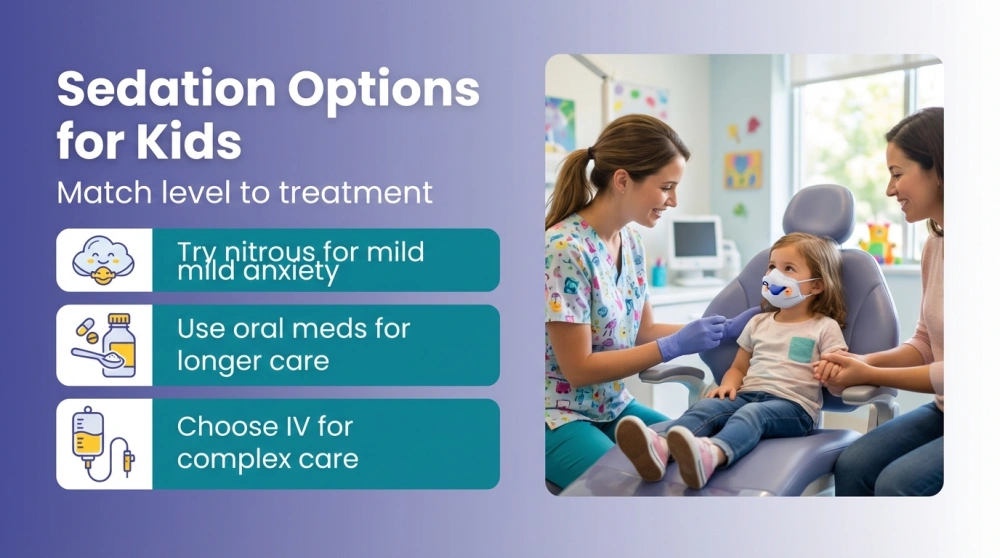
What is nitrous oxide and when is it helpful?
Nitrous oxide, sometimes called laughing gas, is a blend of nitrous oxide and oxygen that your child breathes through a small mask. It provides minimal to mild relaxation, reduces anxiety, and often lessens a sensitive gag reflex. The effects begin quickly and wear off soon after the gas is stopped, which is why many families prefer it for routine fillings or cleanings in anxious children [4]. Your child remains awake, responsive, and able to communicate with the dental team.
What is oral conscious sedation for children?
Oral conscious sedation uses an age appropriate medicine taken by mouth to create deeper relaxation than nitrous alone. Your child stays responsive but may feel drowsy or nap lightly. This option is useful for longer visits or when nitrous oxide is not sufficient. Care teams follow detailed guidelines for dosing, fasting, monitoring, and discharge criteria to help protect your child’s safety [2] [1].
What is IV sedation with a pediatric team?
Intravenous sedation provides a deeper level of relaxation, often delivered by an anesthesiologist or a dentist with advanced training and permits when required by state rules. IV therapy allows precise, moment to moment control and is chosen for significant anxiety, special health care needs, or time intensive procedures. When used, the team employs continuous monitoring and recovery protocols that meet professional standards [3] [6].
How safe is nitrous oxide for kids?
When administered by trained clinicians, nitrous oxide has a long record of safe use in dentistry. It has a quick onset, is titratable during the visit, and typically clears rapidly after breathing room air or oxygen, allowing many children to return to usual activities soon after the appointment. Professional associations provide practice parameters for patient selection, equipment checks, scavenging systems, and monitoring to help minimize side effects such as nausea [4] [1].
What happens before, during, and after a child’s sedation visit?
What should we expect at the pre visit assessment?
Your child’s dentist will review medical history, medications, allergies, developmental considerations, past experiences with anesthesia or sedation, and recent illnesses. You will receive clear instructions on eating and drinking, what to bring, and how to plan for the ride home. This preparation step helps the team tailor the plan to your child and reduce the chance of delays or cancellations [2].
What monitoring occurs during the appointment?
Continuous observation is essential. Depending on the sedation level, clinicians may track breathing, heart rate, blood pressure, oxygen saturation, and responsiveness throughout the visit. The team is trained to recognize and respond to changes promptly, with equipment and emergency readiness that meet professional standards [2] [3].
What is the recovery process like?
After treatment, your child will rest in a recovery area where the team confirms that breathing, alertness, and protective reflexes have returned to safe levels. Written instructions explain what to watch for at home, when to restart meals and activities, and how to reach the office with questions. A follow up call or message helps the team check on your child’s comfort and healing [2].
How do dentists choose the right sedation level for a child?
Clinicians use a stepwise approach. The decision balances the child’s medical status, age, temperament, and the complexity and length of care. The aim is to select the least invasive method that allows high quality treatment with meaningful comfort. The sedation continuum acknowledged by anesthesiology standards guides this process so teams can match the technique to the need, and adjust if required during the visit [3] [5].
- Minimal relaxation Reduces anxiety while your child stays fully awake and interactive.
- Moderate relaxation Increases comfort and may lead to drowsiness, but responses are purposeful.
- Deep relaxation Produces very low awareness and responses to repeated or gentle prompts.
- General anesthesia Reserved for specific cases in hospital or surgery center settings under specialized teams [3].
Pediatric sedation dentistry offers an adaptable framework, allowing the team to meet your child where they are and to maintain a vigilant focus on safety and communication throughout [2].
Which conditions and procedures benefit most from sedation?
Sedation can help many children complete care predictably. Your pediatric dentist will recommend it when the benefits of reduced stress and greater cooperation outweigh the risks. Examples include time intensive or technically delicate procedures, as well as visits where motion control is essential for safety and precision [1] [4].
- Pediatric tooth extraction sedation Supports comfort and gentle control for planned and emergency removals.
- Pediatric root canal sedation Eases longer appointments for baby teeth pulp therapy or complex restorations.
- Comprehensive care Allows multiple fillings, crowns, or cleanings in a single coordinated visit.
- Dental anxiety in children Provides a calmer experience for young patients with strong fears of dental care.
- Special needs pediatric dentistry sedation Adapts care to sensory, developmental, or medical needs so children can receive essential treatment [1].
How is sedation supported for children with special needs?
Children with special health care needs may face sensory sensitivities, communication differences, muscle tone variations, or medical complexities that make routine dentistry difficult. A compassionate, tailored plan can include desensitization strategies, scheduling adjustments, longer visits, or the use of sedation to reduce stress and movement. Professional guidance emphasizes a case by case approach, ongoing communication with the child’s medical team, and readiness to adjust the plan to keep care safe and humane [1] [4].
What are the risks and side effects parents should know?
All medical care carries some risk, and your team will discuss these clearly. For minimal methods such as nitrous oxide, temporary side effects like nausea or dizziness can occur. With deeper methods, drowsiness may last longer and strict monitoring is required. Protocols for screening, fasting, medication selection, and recovery checks help reduce risk. Emergency preparedness and continuous training help teams respond quickly if anything unexpected occurs [2] [3].
- Common short term effects Sleepiness, mild nausea, or headache that typically resolves the same day.
- Less common concerns Motion sickness or vomiting, especially when fasting instructions are not followed.
- Rare events Breathing or airway changes that trained teams are prepared to manage promptly [2].
How can parents prepare their child for a sedation appointment?
Preparation improves comfort and safety. Offer simple, reassuring language that matches your child’s age and personality. Describe what they will see and feel without adding extra worry. Plan soothing activities for the ride and recovery period. Let your dental team know about your child’s favorite comfort items or shows so the visit can feel familiar and calm [4].
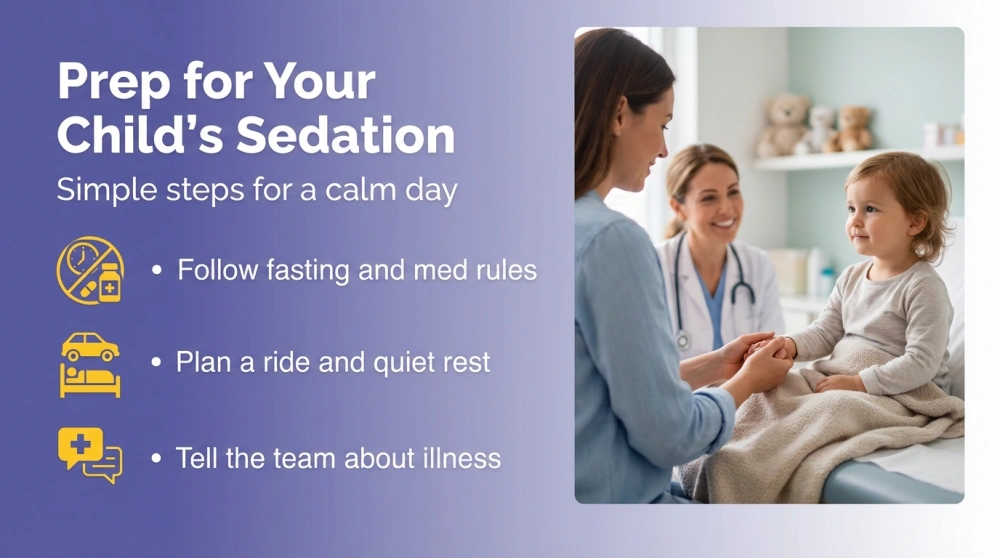
- Follow instructions exactly Adhere to fasting and medication guidance to reduce risk and prevent rescheduling.
- Dress for comfort Choose loose clothing so monitors can be placed easily and your child stays cozy.
- Plan the day Keep the schedule light, arrange safe travel home, and prepare quiet recovery time.
- Share updates Tell the team about any recent cold, fever, or medication changes before the visit [2].
What about eating, medications, and illness before sedation?
Fasting and medication instructions are tailored to the planned sedation level and your child’s health. These directions support a safe airway and reduce nausea. If your child has a cough, fever, or congestion near the appointment date, call the office early so the team can advise whether to proceed or reschedule. The goal is always to balance timely care with safe timing and conditions [2] [5].
Who monitors my child and what equipment is used during sedation?
During sedation, trained clinicians remain at chairside to observe breathing, color, and responsiveness, and to manage the airway if needed. Depending on the technique, your child may be connected to devices that track heart rate, blood oxygen, blood pressure, and breathing patterns. Teams maintain emergency equipment, medications, and written checklists for readiness. These steps align with current professional standards and guidelines [2] [3].
How do California rules help protect children during dental sedation?
In California, dentists must meet specific education, training, and permitting requirements to provide moderate sedation, deep sedation, or general anesthesia. Offices must keep appropriate monitoring equipment, maintain current life support certifications, and follow written protocols for emergencies and recovery. Parents can ask their dentist which permits they hold and how the team meets state requirements. The Dental Board of California publishes information on permits and standards for anesthesia related care [6].
How does sedation support emergency and complex dental care without trauma?
Emergency pediatric dentist visits can be overwhelming when a child is in pain or frightened. Sedation can make treatment possible without adding emotional trauma by reducing anxiety, softening memory of the event, and allowing careful, efficient work. For complex pediatric dental care, sedation supports precision and comfort in one coordinated visit whenever appropriate and safe [1] [4].
Pediatric sedation dentistry can be a bridge to restore comfort and function while preserving a positive relationship with oral health. When a child experiences a calm, supportive environment, they are more likely to return for regular care and enjoy healthier habits at home [1].
What questions should parents ask before choosing sedation?
Open conversation helps families feel confident and informed. Consider bringing this checklist to your consultation.
- Which sedation option do you recommend and why Ask how it matches your child’s health, temperament, and the procedure plan.
- What are the benefits and risks for my child Request a clear explanation in everyday language.
- What training and permits does the team hold Inquire about certifications and how state rules are met [6].
- How will you monitor my child Discuss equipment, staffing, and recovery criteria [2].
- What do we do the night before and the day of Review fasting, medications, clothing, and arrival time.
- What happens if my child is ill Clarify when to call and how decisions are made about rescheduling.
- What is the plan for aftercare Ask about pain control, diet, activity, and who to call with questions.
How does insurance typically handle sedation for children?
Coverage for child dental sedation varies by plan, the procedure, and the sedation method. Many plans consider minimal methods such as nitrous oxide differently than deeper techniques. When sedation is chosen to allow medically necessary treatment that could not be completed otherwise, some plans may provide benefits, but pre authorization is often helpful. Families can call their insurer and the dental office team for a personalized estimate and to understand any pre visit steps needed.
How does this apply to families in Laguna Niguel and nearby South Orange County communities?
Parents in Laguna Niguel and South Orange County often balance busy school and activity schedules with the need for timely, comfortable dental care. Sedation options can help children complete complex treatment efficiently and with less stress. If your family lives in Aliso Viejo, Laguna Hills, Laguna Beach, Mission Viejo, or San Juan Capistrano, ask how scheduling, coordination, and sedation choices can reduce repeat visits and keep kids on track with learning and sports.
Pediatric sedation dentistry in Laguna Niguel is supported by clear professional standards that guide patient selection, monitoring, and recovery. Your local pediatric dentist can explain how those standards translate into everyday care and how the team personalizes each plan for your child [2] [3].
What age specific considerations influence sedation planning?
Age, growth, and communication skills affect how children respond to dental visits. Infants and toddlers may benefit from short appointments and minimal techniques. Preschoolers and early grade school children often respond well to nitrous oxide paired with behavioral coaching. Older children may handle longer visits and oral conscious sedation when appropriate. Throughout, the team will consider airway development, medical history, and how best to keep your child comfortable and safe [1] [4].
How do behavior guidance and sedation work together?
Behavior guidance strategies build trust and help children understand what is happening in simple steps. When combined with the right level of relaxation, these tools can make care smoother and reduce the need for repeat visits. Many children who begin with sedation transition over time to routine care without it as confidence grows. This is a central goal of pediatric care models that emphasize prevention, positive reinforcement, and parent partnership [1].
How do teams maintain emergency preparedness and ongoing training?
Ongoing training and rehearsal are essential. Teams maintain certifications in life support, complete continuing education, and use checklists to prepare for uncommon events. Offices track equipment maintenance and medication readiness and conduct drills so that every team member knows their role. These systems align with professional standards in dentistry and anesthesiology and are designed to support rapid, coordinated responses if needed [2] [3] [5].
How can parents support a calm experience on the day of care?
Parents play an important role. Staying calm, offering simple encouragement, and bringing a favorite blanket or playlist can make a big difference. Plan easy meals after the appointment as guided, and set aside quiet time for rest and observation. If questions arise at any point, contact the office team for help. Your presence and preparation work hand in hand with clinical care to support a smooth, child centered visit.
Which real world scenarios show how sedation can help families?
- Multiple fillings in one visit A child with several small cavities may complete them in a single appointment with nitrous oxide, reducing stress and saving time for families balancing school and sports.
- Severe dental anxiety A child who avoids opening their mouth can gradually gain confidence using minimal relaxation or oral conscious sedation paired with behavior guidance and desensitization.
- Urgent toothache A child in significant pain may receive prompt relief with the aid of sedation, allowing careful treatment without compounding fear or discomfort.
- Special health care needs A sensory sensitive child may complete vital care using a tailored environment, noise control, weighted blankets, and an appropriate sedation plan developed with parents and clinicians together.
How can you start the conversation with your pediatric dentist today?
Share what worries your child, what comforts them, and what has or has not worked in the past. Ask your dentist to outline two or three options, including the benefits and tradeoffs of each. Clarify how the team follows current best practices from pediatric dentistry and anesthesiology, and ask how decisions will be made if your child needs a different approach during the visit [1] [3].
Pediatric sedation dentistry provides a safe, well studied path to complete needed care with less worry. Families can expect clear instructions, ongoing communication, and a recovery plan that supports comfort at home [2] [4].
Where can families in South Orange County find supportive care for anxious kids?
Families in Laguna Niguel, Aliso Viejo, Laguna Hills, Laguna Beach, Mission Viejo, and San Juan Capistrano can look for a kid friendly dentist who offers a full range of sedation options, modern monitoring, and a child centered environment. Ask about same day help for urgent concerns, flexible scheduling, and how the team coordinates with pediatricians and specialists when needed.
How do local needs shape sedation choices for our community?
In communities across South Orange County, active family schedules and a strong focus on school success make efficient care important. Sedation can reduce repeat visits for complex treatment and support a calm, predictable experience. With clear professional standards and state level requirements guiding care, families can partner with their pediatric dentist to choose the safest, most appropriate path for each child [5] [6].
How does this connect to your next steps as a parent?
Pediatric sedation dentistry can be the turning point that helps a child complete essential treatment and rebuild confidence in dental care. If you have questions about nitrous oxide for kids, oral conscious sedation for children, or when IV sedation pediatric dentist services are considered, a consultation can help you compare options and understand how safety is supported at every stage [2] [4].
Why choose Kidz Modern Dentistry for pediatric sedation in South Orange County?
We care for children and families across Laguna Niguel, Aliso Viejo, Laguna Hills, Laguna Beach, Mission Viejo, and San Juan Capistrano with a focus on comfort, communication, and clinical excellence. Our team offers same day support for urgent needs, a welcoming environment, and personalized plans that may include nitrous oxide, oral conscious sedation, or coordination for advanced care when appropriate. We are here to help you understand options and choose a path that fits your child.
- Child centered approach We combine behavior guidance with relaxation techniques to create calmer visits and help kids build lasting confidence in oral care [1].
- Clinical standards Our protocols for monitoring, equipment checks, and recovery align with respected professional guidance in dentistry and anesthesiology [2] [3].
- Clear communication We explain each step in practical language so you know what to expect before, during, and after treatment.
- Same day support For urgent dental concerns, we prioritize comfort and timely care while maintaining safety and a calm environment.
- Local access Conveniently located to serve families throughout South Orange County, including Laguna Niguel and neighboring communities.
Pediatric sedation dentistry helps many children complete complex care comfortably. If you wonder whether your child would benefit, we invite you to schedule a consultation. We will review your goals, your child’s health history, and the treatment plan together so you can choose with confidence.
To speak with our team or request a visit, call 949 273 0110. We are honored to support your family with thoughtful, evidence informed care and a friendly environment that puts children at ease.
How does Kidz Modern Dentistry uniquely support your family’s next steps?
Kidz Modern Dentistry provides comprehensive care for children of all ages, from preventive services to complex restorative procedures, with a steady focus on comfort and safety. Our methodology brings together modern monitoring, ongoing team training, and child friendly communication to make visits smoother for both kids and parents.
- Personalized care planning We build a stepwise plan around your child’s health history, temperament, and dental needs, beginning with the least invasive options that can do the job well.
- Integrated monitoring During sedation, your child’s vital signs are observed continually by trained team members, with equipment and checklists aligned to professional guidance [2] [3].
- Coordinated complex care For advanced cases, we coordinate across specialties to complete care efficiently, reducing the number of visits where possible.
- Support for special needs We adapt the environment and communication for sensory or developmental differences and collaborate with your child’s medical team when helpful [1].
- Local commitment We serve Laguna Niguel and surrounding South Orange County communities and embrace the schedules and priorities of busy families in our area.
Families often tell us their child’s first successful relaxed visit opens the door to easier care in the future. Our goal is to create that turning point with patient, empathetic care and a clear emphasis on safety. To learn how sedation might fit into your child’s plan, reach out to our team for a conversation tailored to your family.
Pediatric sedation dentistry supports children who need a calmer path to complete important care. Our team is ready to answer questions about nitrous oxide for kids, oral conscious sedation for children, and options for complex pediatric dental care. Together, we can design a plan that fits your child and supports a healthy, confident smile.
References
- Oral Health Policies and Recommendations – American Academy of Pediatric Dentistry
- Monitoring and Management of Pediatric Patients Before, During, and After Sedation for Diagnostic and Therapeutic Procedures – American Academy of Pediatric Dentistry
- Standards and Guidelines – American Society of Anesthesiologists
- Anesthesia and Sedation – National Institute of Dental and Craniofacial Research
- Anesthesia and Sedation Resources – American Dental Association
- Anesthesia Permits and Requirements – Dental Board of California
Common Questions About This Topic
Find answers to frequently asked questions related to this article.
