
- Why does early baby tooth loss matter for growing smiles in Laguna Niguel?
- How do space maintainers work to prevent crowding and malocclusion?
- Which types of space maintainers are commonly used for children?
- When is a space maintainer needed and when might it be unnecessary?
- What risks arise if a missing baby tooth space is not preserved?
- How do dentists evaluate timing and guide permanent tooth eruption?
- What should your child expect during a space maintainer visit?
- How are comfort, behavior guidance, and kid friendly sedation managed safely?
- How do you care for a dental space maintainer at home?
- How long will my child wear a space maintainer and how is it removed?
- What does a space maintainer cost and how does insurance typically help?
- What California and professional guidelines apply to pediatric space maintenance?
- How do space maintainers fit within interceptive orthodontics and future braces planning?
- Where can parents find trustworthy timelines for permanent teeth?
- When should parents call a pediatric dentist in Laguna Niguel for early tooth loss?
- How does Kidz Modern Dentistry support families after early baby tooth loss?
- Where can you review the sources used in this article?
Why does early baby tooth loss matter for growing smiles in Laguna Niguel?
Baby teeth do much more than help with chewing. They guide jaw growth, hold space for adult teeth, and support clear speech. When a baby tooth is lost earlier than expected because of a cavity, trauma, or other reasons, the neighboring teeth can drift into the open space. That movement can block the path for the permanent tooth underneath and may lead to crowding or bite problems later on [1]. More than half of children ages 6 to 8 have had a cavity in at least one baby tooth, so this is a common situation parents face [5].
As parents in Laguna Niguel, you want to do what is best for your child today while keeping an eye on their long term smile. Understanding why premature tooth loss matters helps you make timely, informed decisions. We will walk through how dentists evaluate the space, when a space maintainer might help, and what home care looks like, all in clear steps.
How do space maintainers work to prevent crowding and malocclusion?
When a primary tooth is lost before the usual time, the teeth nearby may tip or slide into the gap, which narrows the space for the growing permanent tooth. A space maintainer is a small custom appliance that holds that space open until the adult tooth is ready to erupt. By holding room, it helps reduce the chance of crowding and can support healthier alignment [1].
Space maintainers are designed to be simple, low profile, and easy to clean. They do not move teeth like braces. Instead, they act like a gentle placeholder to keep things steady while nature runs its course. Many are fixed in place, which means your child does not have to remember to take them in and out.
Space maintainers are a well established part of pediatric dentistry, and they are used based on exam findings, X rays, your child’s growth stage, and the position of the developing permanent tooth [1][10].
Space maintainers
Which types of space maintainers are commonly used for children?
Different designs are chosen based on which tooth was lost, whether one or both sides are affected, and how many teeth are missing. Your pediatric dentist will explain the option that matches your child’s needs. Common types include [1]:
- Band and loop space maintainer This fixed appliance is used when one baby molar is missing. A small band fits around a nearby tooth, and a loop holds the space where the tooth was lost.
- Crown and loop space maintainer If the supporting tooth is heavily restored, a stainless steel crown may be used to anchor the loop instead of a band.
- Lower lingual holding arch This fixed appliance is used on the lower jaw when several baby molars are missing or to stabilize the position of lower teeth as adult teeth erupt.
- Nance appliance This upper jaw appliance uses molar bands and an acrylic button on the palate to help hold the space and stabilize the arch.
- Removable space maintainer This is similar to a retainer. It can be taken out for cleaning but relies on excellent wear habits, which can be tough for young children.
Your child’s dentist will base the choice on the tooth location, your child’s age and cooperation, hygiene, and how close the permanent tooth is to erupting [1].
When is a space maintainer needed and when might it be unnecessary?
Not every early baby tooth loss calls for a space maintainer. Dentists consider several factors:
- Which tooth was lost Primary molars are key space holders for adult premolars. Losing them early usually carries a higher risk of space loss than losing a front baby tooth.
- Child’s age and growth stage Younger children have more time before adult teeth erupt, so space is at greater risk in the meantime.
- Eruption timing on X rays If the permanent tooth is close to the surface, a maintainer may not be needed. If the adult tooth is a long way off, holding space can be important [1].
- Overall bite and crowding risk If early signs of crowding or bite shift are present, space maintenance often helps reduce complications [10].
Your pediatric dentist will review these points, show you radiographs, and explain the benefits and limitations of each choice using guidance from professional standards [1].
What risks arise if a missing baby tooth space is not preserved?
Leaving a high risk space open can allow neighboring teeth to drift and tip. That shift can lead to crowding, crossbite, or midline shifts that are harder to correct later. Some children may bite the cheek or gum where the gap has narrowed. Over time, this may increase the need for more complex orthodontic treatment, though every child is different and outcomes vary [1][10].
Parents often ask about future braces. Space maintenance does not replace orthodontics. It is one part of a larger plan known as interceptive orthodontics, aimed at reducing avoidable problems and supporting natural eruption paths [10].
How do dentists evaluate timing and guide permanent tooth eruption?
Timing decisions come from a combination of clinical exam and radiographs. Dentists use child specific radiographic guidelines to limit exposure while gathering the information needed to make safe decisions [7]. Your child’s eruption pattern is compared to trusted eruption charts and professional norms. If the permanent tooth is erupting soon and there is sufficient space, a maintainer may not be recommended. If the tooth is far from erupting and there is risk of space loss, holding the space is often advised [1].
Follow up visits are important. The dentist checks that the appliance remains clean and intact, that soft tissues are healthy, and that the permanent tooth is progressing on schedule. If a maintainer is no longer needed, it is removed to let the adult tooth come in.
What should your child expect during a space maintainer visit?
The process is usually simple:
- Evaluation and planning The dentist confirms which tooth was lost, reviews X rays, and discusses goals and options with you.
- Impressions or scans A mold or digital scan is taken to fit the appliance precisely.
- Fitting and cementation At a follow up appointment, the maintainer is adjusted and bonded or cemented in place. Your child will be shown how to keep the area clean.
- Checkups Short follow up visits confirm that the device is stable, comfortable, and that the adult tooth is on track.
Most children adapt quickly. If your child has dental anxiety, your pediatric team can use behavior guidance and, when appropriate, minimal sedation options following strict safety guidelines [2][3].
How are comfort, behavior guidance, and kid friendly sedation managed safely?
Comfort and cooperation are top priorities in children’s dentistry. Pediatric teams use tell show do, positive reinforcement, distraction, and short visits to help kids feel at ease [2]. If your child is very anxious or has special health care needs, minimal or moderate sedation may be considered. Sedation is used to reduce anxiety and help a child tolerate care, not to make procedures longer or more complex. When used, it follows joint safety guidance from pediatric medical and dental organizations that outline presedation evaluation, dosing, monitoring, recovery, and emergency preparedness [3].
In California, dentists must meet specific training, permitting, and equipment requirements when providing sedation to children. The Dental Board of California publishes rules and information for parents about anesthesia and sedation, which your pediatric practice will follow [4]. Parents are encouraged to ask questions about options such as nitrous oxide and how monitoring keeps children safe [8].
How do you care for a dental space maintainer at home?
Daily care helps protect gums and the appliance:
- Keep it clean Brush twice daily and floss near the banded tooth as instructed. A small interdental brush can help around bands and loops.
- Watch the diet Avoid sticky candies and very hard foods that could loosen or bend the device.
- Check the fit Look for redness, sores, or any looseness and call if you notice changes.
- Protect from damage Ask your dentist about mouthguards for active sports to avoid harmful impacts.
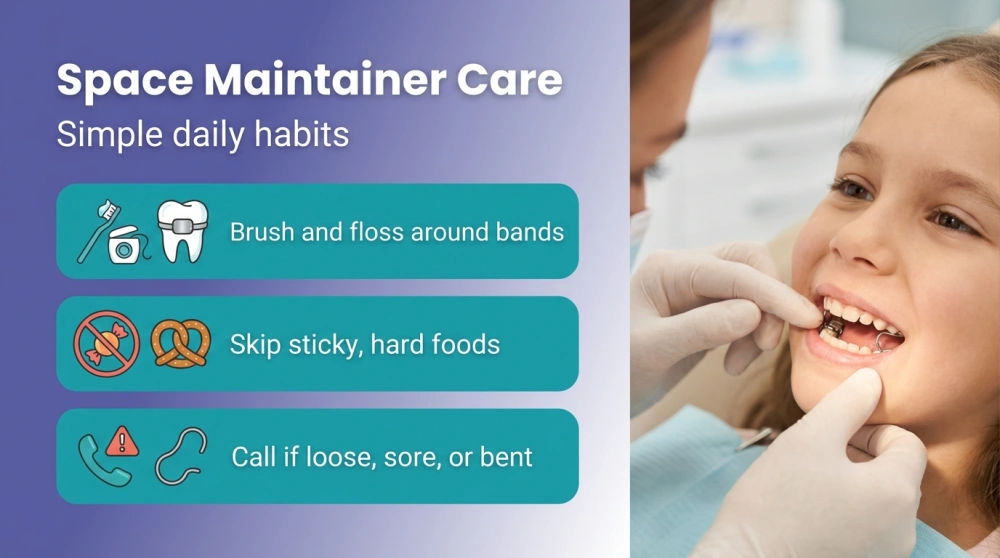
Healthy gums and teeth support the success of the appliance. Fluoride toothpaste and, when appropriate, professionally applied fluoride can help reduce the risk of new cavities near bands and loops [9].
How long will my child wear a space maintainer and how is it removed?
Most children wear a maintainer until the permanent tooth begins to emerge through the gum and the space is stable. This period can range from several months to a few years, depending on your child’s age and which tooth was lost. Removal is usually quick. The dentist gently breaks the cement bond or slides out the appliance, then cleans the tooth surface and retests the bite.
Space maintainers in Laguna Niguel
What does a space maintainer cost and how does insurance typically help?
Costs vary based on the type of appliance, number of visits, imaging, and whether other services are needed. Many dental benefit plans cover part of the fee for a dental space maintainer when it is considered medically necessary for premature tooth loss. Coverage differs by plan and provider, and prior authorization may be needed. Your dental team can provide a written estimate, explain benefits, and discuss payment options. Public programs may have specific coverage rules for children, which offices can help verify.
If you have questions about what is included in the fee, ask for a clear itemization. Transparency helps you compare options and plan next steps without surprises.
What California and professional guidelines apply to pediatric space maintenance?
Clinical decisions for space maintenance follow professional standards on developing dentition, bite assessment, and growth tracking from pediatric dental organizations [1]. Radiographic decisions follow national recommendations that balance diagnostic value with minimal exposure, tailored to a child’s risk and age [7]. For comfort and cooperation, behavior guidance and any use of sedation in children follow detailed clinical guidelines and state level permit and monitoring requirements [2][3][4][8].
Parents in California can review sedation and anesthesia information from the state dental board to understand permits, monitoring standards, and informed consent expectations for minors [4].
How do space maintainers fit within interceptive orthodontics and future braces planning?
Space maintainers are part of interceptive orthodontics. They do not straighten teeth, but they support healthier eruption paths and help prevent crowding that can complicate later treatment. Pediatric dentists coordinate with orthodontists to monitor growth. An initial orthodontic check by about age seven is often recommended so that eruption problems can be identified early and the need for interceptive steps can be discussed [10]. This does not mean every child will begin braces early. Instead, it helps the team decide which children benefit from early steps and which are fine to monitor.
When the time for braces arrives, preserved space can make treatment more efficient. Holding space can reduce the need for moving teeth large distances later, though each case is unique and final plans are made by your orthodontist.
Where can parents find trustworthy timelines for permanent teeth?
Parents often want a reliable eruption timeline to compare with their child’s progress. Eruption charts from professional organizations can help you visualize the usual ages and sequence of adult teeth. Keep in mind that every child is unique and a healthy range exists. Your pediatric dentist will confirm eruption patterns with a clinical exam and, when needed, X rays [6][7].
If your child seems early or late compared to a chart, that does not always signal a problem. The best next step is a checkup so your dentist can evaluate growth and answer questions with your child’s specific images and measurements.
When should parents call a pediatric dentist in Laguna Niguel for early tooth loss?
Reach out promptly if your child loses a baby molar earlier than expected, if a tooth is knocked out or fractured, or if you notice shifting teeth, chewing discomfort, or gum irritation near a gap. Rapid evaluation helps determine whether a maintainer is indicated and gives you a clear plan.
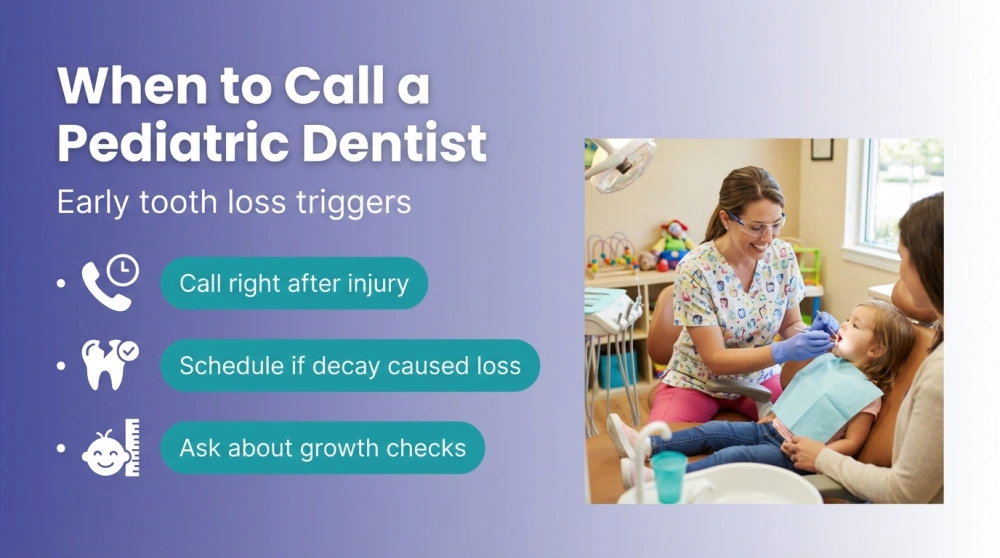
- Call quickly after injury Early assessment helps protect the developing tooth bud and plan for space if needed.
- Schedule if decay caused the loss The dentist will treat any remaining decay and protect neighboring teeth from future problems [5][9].
- Ask about growth checks If your child is nearing age seven, consider an interceptive orthodontic evaluation to review eruption and bite [10].
If you are seeking a pediatric dentist Laguna Niguel families often look for offices that combine gentle care with evidence based planning and clear communication about timing, costs, and follow up.
How does Kidz Modern Dentistry support families after early baby tooth loss?
At Kidz Modern Dentistry in Laguna Niguel, our pediatric team helps parents understand when a child may benefit from a space maintainer and what to expect at each step. We serve families across Laguna Niguel and nearby Orange County communities with same day emergency access, kid friendly sedation when appropriate, and comprehensive children’s dentistry grounded in current guidelines. Our goal is to make visits positive while explaining choices in plain language so you can decide confidently.
- Clear next steps We explain whether a space maintainer is indicated, which design fits the tooth position, and how long it might be needed, using images and simple visuals.
- Coordinated care We monitor growth, share updates with your orthodontist when needed, and time removal as the permanent tooth erupts.
- Comfort focused visits Our team uses behavior guidance and, when appropriate, nitrous oxide or other minimal sedation options following AAPD and California rules, always with informed consent and continuous monitoring.
- Modern tools We use digital imaging protocols based on national recommendations to support accurate planning with a child specific approach to exposure and frequency.
- Experienced clinicians Our pediatric dentist and support team bring years of combined experience in interceptive care, including band and loop, crown and loop, lower lingual holding arch, and Nance appliance options.
- Personalized attention We offer direct access to qualified professionals who know your child’s case and can answer questions by phone at +1 949 273 0110.
- Supportive track record Families tell us they value our friendly approach, clear estimates, and practical home care coaching that helps kids keep appliances clean and comfortable.
- Community focused As an OC pediatric dentist resource, we welcome questions from parents who want to learn about eruption timing, malocclusion prevention, and how to prevent crowding with simple, proactive steps.
Where can you review the sources used in this article?
- Management of the Developing Dentition and Occlusion in Pediatric Dentistry – American Academy of Pediatric Dentistry
- Behavior Guidance for the Pediatric Dental Patient – American Academy of Pediatric Dentistry
- Guidelines for Monitoring and Management of Pediatric Patients Before, During, and After Sedation – American Academy of Pediatrics and American Academy of Pediatric Dentistry
- Anesthesia and Sedation for Dental Treatment Frequently Asked Questions – Dental Board of California
- Children’s Oral Health Fast Facts – Centers for Disease Control and Prevention
- Tooth Eruption Charts – American Dental Association MouthHealthy
- Dental X rays and Radiographic Examinations – American Dental Association
- Use of Nitrous Oxide for Pediatric Dental Patients – American Academy of Pediatric Dentistry
- Prevention of Dental Caries in Children Younger Than 5 Years – U.S. Preventive Services Task Force
- First Orthodontic Check up by Age 7 – American Association of Orthodontists
Common Questions About This Topic
Find answers to frequently asked questions related to this article.
