
- What does a gray tooth after trauma actually mean?
- Why can a tooth change color after an injury?
- Is a gray tooth always a sign that the tooth is dead?
- How common are dental injuries in children?
- What should you watch for after a child’s tooth turns gray?
- Does it matter if it is a baby tooth or a permanent tooth?
- When is a gray tooth a pediatric dental emergency?
- What should you do right after a tooth injury?
- How do dentists evaluate tooth discoloration after injury?
- What treatment might be needed for a gray tooth after trauma?
- Can a gray baby tooth get better on its own?
- What rules and standards apply in California?
- How can parents help lower the risk of future tooth injuries?
- How can Kidz Modern Dentistry help families in Laguna Niguel?
- References
What does a gray tooth after trauma actually mean?
If your child bumps a tooth and it later looks darker, duller, or clearly gray, it can be alarming. Many parents immediately worry that the tooth is lost or that something has gone seriously wrong. A gray tooth after trauma can mean that the inside of the tooth changed after an injury, but the exact reason is not always obvious without a dental exam.
In simple terms, tooth discoloration after injury often happens because blood products, tissue changes, or nerve related changes occurred inside the tooth after the impact. The American Academy of Pediatric Dentistry notes that primary teeth can change color after trauma, and that color change may follow bleeding inside the tooth or changes to the pulp, which is the soft tissue in the center of the tooth [1]. The International Association of Dental Traumatology also explains that traumatic dental injuries can affect the pulp and supporting tissues in ways that are not always visible right away [2].
That means a child tooth turns gray for a reason, but the shade alone does not tell the whole story. Some teeth stay symptom free and stable. Others develop pain, swelling, infection, or damage to the pulp. Because of that, a change in color should be treated as a sign to schedule an examination, especially if the tooth was recently hit.
For parents in Laguna Niguel, California, it helps to think of this as a follow up issue after an accident rather than only a cosmetic concern. Even when your child seems comfortable, the color change can provide an early clue that the tooth needs monitoring.
Why can a tooth change color after an injury?
Teeth are not solid white blocks. They contain enamel on the outside, dentin underneath, and pulp in the center. After a fall, sports collision, playground bump, or face injury, the tissues inside the tooth can react in several ways. That reaction is one of the main reasons a tooth may look gray, yellow, pink, or brown after trauma.
Common reasons include the following:
- Bleeding inside the tooth can stain the dentin and change the tooth’s color over time [1].
- Pulp injury may occur when the tooth nerve and blood supply are disrupted by impact [2].
- Pulp canal obliteration can make a tooth look more yellow as hard tissue forms inside the canal after trauma [2].
- Pulp necrosis may happen in some cases, which means the pulp no longer remains vital [2].
This is why parents often search terms like gray tooth after trauma, tooth nerve damage, or dead tooth symptoms. The visible color is often the first thing you notice, but the underlying issue may involve blood flow, tissue response, or the pulp’s health.
Timing matters too. A tooth may look normal right after the accident and become darker days or weeks later. The AAPD guidance on acute dental trauma emphasizes that children who experience dental injuries need follow up because complications may appear later, not just on the first day [3].
Is a gray tooth always a sign that the tooth is dead?
No. This is one of the most important points for parents to understand. A gray tooth is not automatically proof that the tooth is nonvital. It does raise concern for pulp changes, but color alone cannot confirm whether the tooth is healthy, healing, or no longer vital.
The AAPD explains that discoloration of a traumatized primary incisor may appear after hemorrhage inside the pulp, and some discolored teeth remain symptom free without infection [1]. The International Association of Dental Traumatology also recommends ongoing clinical and radiographic follow up because the pulp response after trauma can evolve over time [2].
In practical terms, a gray tooth may be associated with dead tooth symptoms, but it may also be a tooth that is simply showing evidence of past bleeding or injury. Your child’s dentist looks at more than color, including:
- Pain when biting or touching the tooth
- Swelling in the gum above or around the tooth
- Mobility beyond what would be expected
- Gum pimple or drainage that may suggest infection
- X ray findings involving the root or surrounding bone
So if your child tooth turns gray, it is reasonable to be concerned, but not to panic. The better next step is timely evaluation.
How common are dental injuries in children?
Dental trauma in children is common enough that many parents will face it at some point. According to the Centers for Disease Control and Prevention, emergency department visits for sports and recreation related traumatic brain injuries and other facial injuries show just how often children get hurt during normal activities, which is one reason mouth and tooth injuries remain an important pediatric issue [4]. Dental organizations also recognize traumatic dental injuries as a frequent part of childhood care.
A review published in Dental Traumatology reported that traumatic dental injuries in primary and permanent teeth are common worldwide, affecting a substantial portion of children and adolescents during growth years [5]. The World Health Organization and oral health researchers have also highlighted oral conditions and injuries as significant public health concerns for children and families [6].
For parents, these numbers matter because they remind us that a baby tooth injury or injury to a new permanent tooth is not unusual. Falls while learning to walk, slipping near a pool, collisions at school, bike accidents, and sports contact are all common scenarios. When a front tooth suddenly looks gray after one of these events, you are not overreacting by calling a dentist.
What should you watch for after a child’s tooth turns gray?
After a dental injury, the first few hours are important, but the next several weeks matter too. Some problems show up gradually. If you notice tooth discoloration after injury, keep an eye on your child’s comfort, chewing, and the gum tissue around the tooth.
Call a dentist sooner if you notice any of the following:
- Pain that does not improve or pain that starts days later
- Swelling of the gum or lip near the injured tooth
- A pimple on the gum which may indicate infection
- Fever with oral swelling which needs prompt attention
- Difficulty biting or the tooth feeling “high” or out of place
- Bleeding that continues from the gum area
- Looseness that seems significant
- Darkening that worsens instead of stabilizing
The ADA’s emergency guidance recommends contacting a dentist promptly for dental injuries, especially when teeth are loose, displaced, painful, or broken [7]. That advice fits many situations where a gray tooth appears after trauma, even if the child seems mostly fine.
A common mistake is waiting because the child says the tooth does not hurt. Pain is only one part of the picture. With tooth nerve damage, symptoms can be delayed.
Does it matter if it is a baby tooth or a permanent tooth?
Yes, it matters a great deal. Management differs because a primary tooth sits close to the developing permanent tooth underneath it. A baby tooth injury has to be evaluated not only for the current tooth, but also for the possible effect on the adult tooth that has not erupted yet.
The AAPD states that trauma to primary teeth can affect the developing permanent successor, depending on the child’s age and the type of injury [1]. This is one reason pediatric evaluation matters, especially for toddlers and preschool aged children with front tooth trauma.
In a baby tooth, the dentist may choose observation, follow up imaging, or treatment depending on the injury, symptoms, and risk to the permanent tooth. In a permanent tooth, the goal often includes preserving pulp vitality and long term tooth function whenever possible [2].
For parents asking when to see a dentist for tooth injury, the answer is usually sooner rather than later for both tooth types, but especially if the injured tooth is pushed inward, loosened significantly, or darkens after impact.
Many families in Laguna Niguel seek care because they are unsure whether a gray front tooth is “just a baby tooth” and therefore less important. In reality, baby teeth help with eating, speech, spacing, and guidance for permanent teeth [8]. They are worth assessing carefully.
When is a gray tooth a pediatric dental emergency?
Not every gray tooth requires an immediate same hour visit, but some situations do qualify as a pediatric dental emergency. If the color change follows a recent injury and your child also has swelling, bleeding, severe pain, difficulty closing the mouth, or a displaced tooth, contact a dental office right away.
Urgent evaluation is especially important when:
- The tooth was knocked loose or moved
- The tooth was pushed into the gum
- A permanent tooth was knocked out
- The child cannot bite normally
- There is facial swelling
- There is a cut that may need additional medical attention
- Your child is very young and cannot explain symptoms clearly
The AAPD and ADA both stress prompt care for traumatic dental injuries because early assessment can identify displacement, fractures, pulp injury, and complications that may not be obvious at home [3][7].
If there was head injury, vomiting, loss of consciousness, unusual sleepiness, confusion, or suspected jaw fracture, medical evaluation should also be sought immediately. Dental care is important, but those signs raise broader injury concerns.
When families search for Pediatric dental emergencies after a playground or sports incident, they are often trying to decide whether to wait overnight. If the tooth changed color and the injury was recent, it is wise to call.
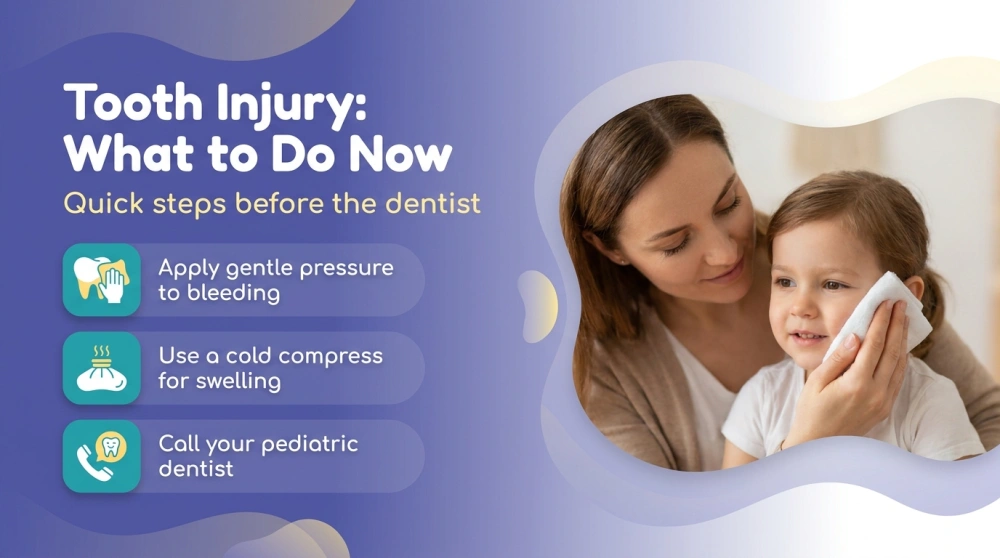
What should you do right after a tooth injury?
The first steps at home can make the situation easier to manage while you arrange care. Stay calm, comfort your child, and check for lip, tongue, and gum injuries. A frightened child may focus more on the shock than on the tooth itself.
- Look for bleeding and apply gentle pressure with clean gauze if needed.
- Use a cold compress on the outside of the mouth or cheek to help with swelling.
- Offer a soft diet until the tooth is evaluated if chewing seems tender.
- Keep the area clean with gentle brushing if tolerated.
- Save any broken tooth fragment and bring it to the visit if you can.
- If a permanent tooth is completely knocked out follow emergency guidance immediately because timing matters greatly [7].
The ADA advises prompt dental contact for injuries involving broken, loose, or displaced teeth [7]. For a permanent tooth that is avulsed, immediate action is especially important. For a baby tooth, do not try to reinsert it at home.
If the tooth is still in place but later becomes darker, make note of when the injury occurred, whether there was bleeding from the mouth, and when you first noticed the color change. Those details help the dentist interpret what may be happening inside the tooth.
How do dentists evaluate tooth discoloration after injury?
When you bring your child in for evaluation, the dentist usually starts with the story of the injury. The timing, direction of impact, immediate bleeding, and whether the tooth loosened or moved all matter. A visual exam follows, and in many cases dental imaging is recommended.
An evaluation may include:
- Clinical exam to check the tooth, gum, bite, and surrounding tissues
- Mobility assessment to see whether the tooth is unusually loose
- Percussion and palpation to check tenderness
- Radiographs when indicated to assess root position, surrounding bone, and the developing permanent tooth
- Follow up monitoring because the pulp response may change over time [2][3]
The U.S. Food and Drug Administration recommends that dental X rays be taken only when necessary for diagnosis and treatment planning, which supports the common dental approach of using imaging based on the child’s situation rather than routinely for every minor bump [9]. When imaging is needed after trauma, it can be a key part of figuring out whether the tooth is healing or developing complications.
In many pediatric settings, Digital X-Rays are used to support diagnosis while keeping the imaging process efficient and child friendly. In Laguna Niguel Pediatric dental emergencies often involve children who are scared, sore, or overwhelmed, so a calm exam process matters just as much as the findings.
What treatment might be needed for a gray tooth after trauma?
Treatment depends on the child’s age, whether the tooth is primary or permanent, the type of injury, symptoms, and what follow up exams show. There is no one size fits all answer.
Possible approaches include the following:
- Observation and follow up if the tooth is stable and your child has no signs of infection
- Monitoring with repeat exams to watch for changes in color, swelling, or radiographic findings
- Pulp related treatment if the pulp has been significantly damaged in a way that requires care
- Extraction in some primary tooth cases if infection, pain, or risk to the permanent tooth is present
- Restorative care if there is a fracture in addition to discoloration
For some injured primary teeth, the dentist may recommend watchful follow up rather than immediate intervention, especially if the tooth is not causing pain and there are no signs of pathology [1]. For certain cases involving significant pulp changes, Pulp therapy may become part of the discussion, but that decision depends on an individualized exam.
Parents often want a quick answer to whether the tooth can be “fixed” right away. Sometimes yes, but often the safest approach is careful monitoring. A tooth’s response after trauma may continue to evolve over weeks or months.
Can a gray baby tooth get better on its own?
Sometimes a discolored baby tooth remains comfortable and functional without needing active treatment. That said, “better” can mean different things. The color may stay gray even if the tooth remains symptom free, or the color may lighten somewhat over time. The bigger question is whether the tooth stays free of infection and whether the permanent tooth underneath remains protected.
The AAPD guidance for primary teeth supports follow up because some discolored teeth remain asymptomatic, while others later show signs of pulp necrosis or infection [1]. That is why parents should avoid assuming that a lack of pain means the issue is resolved.
If your child tooth turns gray after a fall, the right mindset is cautious observation with professional guidance, not panic and not neglect. This is especially true in toddlers who cannot reliably describe tenderness, pressure, or changes while eating.
Parents sometimes ask whether they should wait for the baby tooth to fall out naturally. That depends on the child’s age, the tooth involved, and the exam findings. A dentist can help you understand whether watchful follow up is reasonable or whether there are signs that treatment is safer.
What rules and standards apply in California?
For families in Laguna Niguel, California, pediatric dental care is shaped by state licensing and professional standards, along with nationally recognized trauma guidance. Dentists practicing in California are regulated by the Dental Board of California, which oversees licensure and scope of practice [10]. Radiation use in dental settings is also regulated through state and federal safety frameworks, while clinical decision making is guided by professional recommendations and the patient’s needs.
Relevant standards include the following:
- California licensure oversight through the Dental Board of California [10]
- Professional pediatric dental guidance from the AAPD on trauma and follow up [1][3]
- International trauma recommendations from the International Association of Dental Traumatology [2]
- Radiation safety principles supported by the FDA for appropriate use of dental imaging [9]
These standards matter because they support an evidence informed approach. In other words, if your child needs evaluation for tooth discoloration after injury in Laguna Niguel, California, the exam should be based on the type of injury, current symptoms, and accepted pediatric trauma guidance rather than guesswork.
How can parents help lower the risk of future tooth injuries?
Not every accident can be prevented, especially with active kids, but there are practical ways to reduce risk. Prevention matters because repeat trauma can increase the chance of long term damage to both primary and permanent teeth.
- Use helmets and age appropriate safety gear for biking, scootering, and similar activities.
- Ask about sports mouth protection for activities with contact or falls.
- Childproof hard corners in homes with toddlers learning to walk.
- Supervise pool and playground time closely when slips are more likely.
- Keep up with regular dental visits so your child’s dentist can discuss injury prevention and oral development.
The Centers for Disease Control and Prevention and dental organizations continue to support injury prevention strategies for children because falls and sports related impacts are major sources of oral and facial trauma [4][7].
Regular checkups also matter. The AAPD advises establishing dental care early, with the first visit by age one, which helps families build a relationship with a dental team before emergencies happen [8]. That way, if you are later wondering when to see a dentist for tooth injury, you already know where to call.
How can Kidz Modern Dentistry help families in Laguna Niguel?
Kidz Modern Dentistry serves children and families in Laguna Niguel, California, with a focus on making pediatric dental visits clear, calm, and supportive. When parents notice a gray tooth after trauma, our role is to help evaluate what may be going on, explain the findings in understandable terms, and outline appropriate next steps within pediatric dental care.
Our services relate closely to this topic because dental trauma in children often requires prompt assessment, follow up monitoring, and a kid centered environment. We offer same day emergency availability when possible, comprehensive pediatric care, kid friendly sedation options when appropriate, and diagnostic tools that support careful evaluation of injured teeth. When a child is anxious after a fall or sports accident, that approach can make the visit easier for both the child and the parent.
Our team works with families from Laguna Niguel and nearby communities who need guidance after a baby tooth injury, front tooth discoloration, or other childhood dental accident. We emphasize communication, gentle care, and age appropriate exams. Rather than rushing parents through a confusing situation, we focus on helping you understand what the color change might mean, what signs we are watching for, and how follow up can protect your child’s oral health.
We also use a modern workflow that may include digital imaging, clinical photography, and structured recheck scheduling when trauma follow up is needed. That kind of process helps us document changes over time and explain them clearly. If treatment is needed, we tailor it to the child’s age, comfort, and developmental stage.
Parents often appreciate direct access to qualified pediatric dental professionals who can assess whether a darker tooth appears stable or needs closer attention. That is especially important when the issue is not just appearance, but possible tooth nerve damage or signs that the pulp has changed after impact.
At Kidz Modern Dentistry, we aim to make visits feel approachable for children of all ages while staying grounded in accepted pediatric dental standards. If your child has a gray tooth after trauma or another urgent dental concern in Laguna Niguel, you can contact our office at +1 (949) 273-0110 to ask about a pediatric evaluation.
References
- Management of Acute Dental Trauma Guideline for Primary Teeth – American Academy of Pediatric Dentistry
- International Association of Dental Traumatology Guidelines for the Management of Traumatic Dental Injuries – Dental Traumatology
- Dental Trauma Recommendations – American Academy of Pediatric Dentistry
- HEADS UP Data and Statistics on Sports and Recreation Injuries – Centers for Disease Control and Prevention
- Global Burden of Traumatic Dental Injuries in Children and Adolescents – Dental Traumatology
- Oral Health Fact Sheet – World Health Organization
- Dental Emergencies – American Dental Association
- Frequently Asked Questions for Parents – American Academy of Pediatric Dentistry
- Dental X Ray Safety – U.S. Food and Drug Administration
- Dental Board of California – State of California
Common Questions About This Topic
Find answers to frequently asked questions related to this article.
