- What age do wisdom teeth usually start to develop and erupt?
- When should my teen have a first wisdom teeth evaluation?
- Why is the late teen window often recommended for evaluation?
- What signs could mean my teen needs a third molar evaluation sooner?
- What imaging is used to check wisdom teeth and is it safe for teens?
- How do dentists predict if wisdom teeth will erupt normally or become impacted?
- What are the pros and cons of early removal compared with watchful monitoring?
- What problems can impacted wisdom teeth cause if they are not treated?
- Does orthodontic treatment change when to evaluate wisdom teeth?
- How often should wisdom teeth be re evaluated during the teen years?
- How is comfort and safety managed if a teen needs wisdom teeth removal?
- What should South Orange County parents know about local referrals and care coordination?
- What questions should I ask at my teen wisdom teeth check?
- How can families prepare for a wisdom teeth consultation and aftercare?
- Why choose Kidz Modern Dentistry for teen wisdom teeth evaluations in South Orange County?
- References
What age do wisdom teeth usually start to develop and erupt?
Wisdom teeth, also called third molars, are the last adult teeth to develop. In many teens, the roots begin forming in mid adolescence, and eruption commonly starts between ages 17 and 25. Some people have all four, some have fewer, and a few have none at all. Timing can vary by individual biology, growth patterns, and space in the jaws. Authoritative health sources describe this general timeline and note that impaction, where a tooth remains trapped under gum or bone, is common in this age range [1] [2].
For parents, the key takeaway is that the late teen years are a common period to check positioning and development, even if a teen has no pain. A single panoramic X ray or a set of appropriate images can show whether wisdom teeth are likely to erupt normally or require monitoring or referral [5] [6].
When should my teen have a first wisdom teeth evaluation?
Most families ask about the best age for a wisdom teeth evaluation. A practical window is often the mid to late teen years, commonly around ages 16 to 19, because tooth buds and roots are far enough along to forecast eruption paths, yet not so developed that any needed surgery becomes more complex. Professional associations emphasize that timing should be individualized based on clinical exam and radiographic findings, not age alone [3] [4] [5].
In a typical teen dental checkup, your pediatric dentist assesses the back of the mouth for signs of developing third molars and checks for tenderness, swelling, plaque traps, or gum changes near the lower second molars. If there are clinical findings suggesting limited space or unusual angulation, an image is prescribed following evidence based selection criteria to decide if referral or closer monitoring is appropriate [5] [6].
Why is the late teen window often recommended for evaluation?
The late teen years allow your dental team to balance two important factors. First, the wisdom teeth are usually developed enough for accurate prediction of eruption or impaction. Second, if removal is indicated, earlier removal in younger patients is associated with fewer surgical risks and shorter recovery compared with waiting until full root formation in adulthood. This age related difference in morbidity and healing is discussed in oral surgery position papers and clinical literature [4].
At the same time, leading dental and surgical organizations advise that decisions be based on the presence or risk of disease, not age alone. If wisdom teeth appear healthy, fully erupted, and easy to keep clean, careful observation with periodic exams and imaging may be appropriate. Evidence reviews have not found strong proof that removing disease free, asymptomatic wisdom teeth always prevents future problems, which is why individualized evaluation is essential [2] [8].
What signs could mean my teen needs a third molar evaluation sooner?
While many evaluations happen routinely during a teen visit, certain symptoms or exam findings should prompt a focused third molar evaluation sooner. Call your pediatric dentist if your teen has any of the following near the back molars:
- Pain or tenderness that comes and goes near the back of the jaw or ear region [1] [3].
- Swelling, redness, or a bad taste which can suggest gum inflammation or infection around a partially erupted tooth, often called pericoronitis [3].
- Food trapping and difficulty cleaning behind the second molars, which increases cavity and gum disease risk [3].
- Recurrent cheek biting or jaw stiffness in the area of developing third molars [1].
- Shifting of nearby teeth or new crowding that coincides with eruption pressures, which may warrant imaging to understand the cause [3].
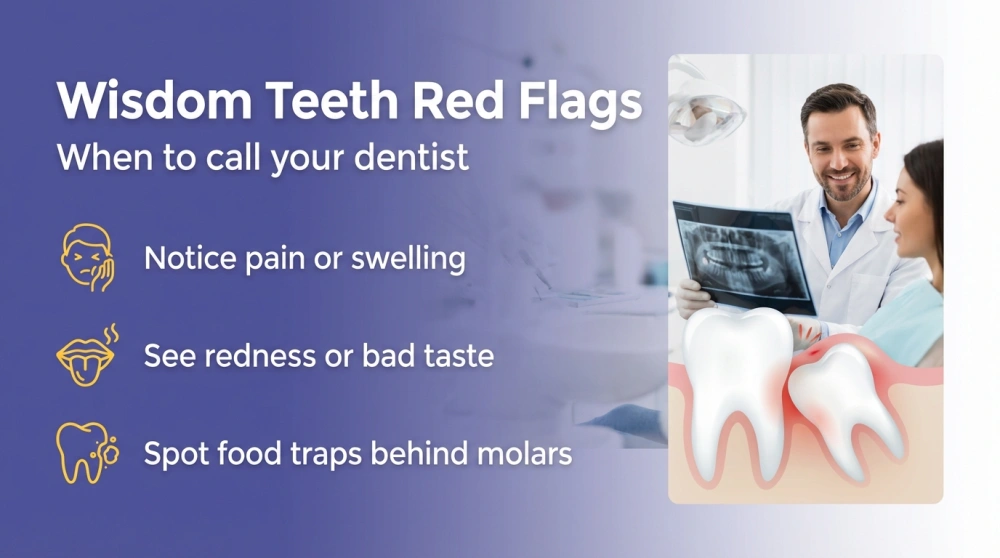
These signs do not always mean a tooth must be removed, but they do signal the need for a targeted exam and an image if clinically justified by professional guidelines [5] [6].
What imaging is used to check wisdom teeth and is it safe for teens?
For most teens, a panoramic radiograph is the first choice to view developing wisdom teeth. It captures the entire upper and lower jaws in a single image, helping your dentist evaluate the number of third molars present, their angulation, root development, and proximity to vital structures. Select periapical or bitewing images may be used to look closely at the second molar region if there are concerns about cavities or gum health. Cone beam computed tomography is reserved for specific surgical planning questions and is not routinely needed in every case [5] [6].
Our team follows national recommendations that prioritize the lowest radiation dose necessary to make a clear diagnosis. Dental care providers adhere to the ALARA principle, meaning radiation exposure is kept as low as reasonably achievable. Professional guidance from the American Dental Association and the Food and Drug Administration outlines when to prescribe images and how to limit exposure with modern sensors, collimation, and protective measures [6] [7].
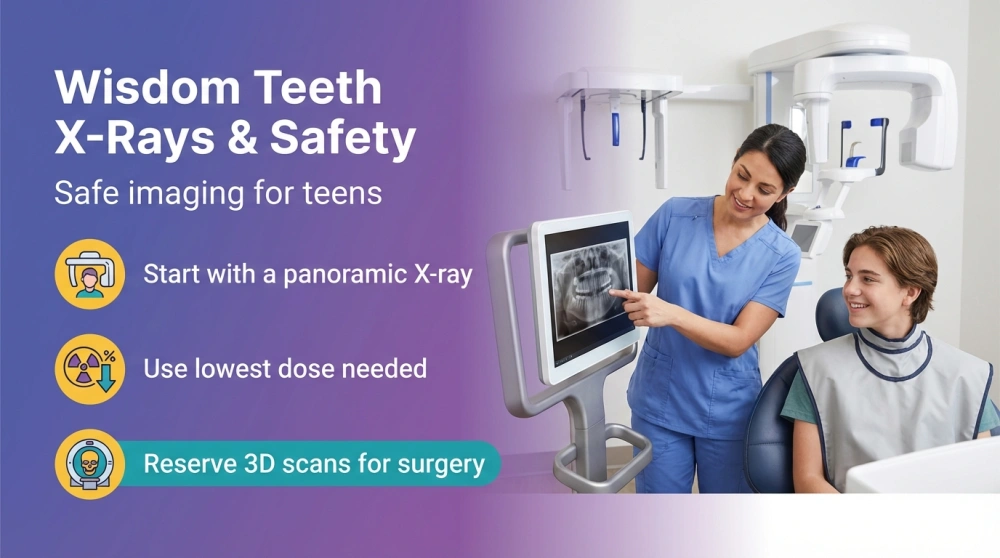
When we evaluate teens, we use Pediatric digital X-rays to visualize third molar development clearly while keeping exposure conservative and aligned with pediatric best practices [5] [6].
For families close to our practice, we offer Pediatric digital X-rays in Laguna Niguel so you can see positioning and discuss options with a pediatric dentist you know and trust before any oral surgeon referral is considered [5] [6].
How do dentists predict if wisdom teeth will erupt normally or become impacted?
Prediction blends clinical exam and imaging. During the visit, we evaluate jaw growth, spacing behind the second molars, gum health, and the teen’s oral hygiene habits. On imaging, we review:
- Angulation and position such as upright, tipped forward, or horizontal. Forward tipping reduces the chance of full eruption and increases the risk of pressure against second molars [3].
- Available space measured from the back of the second molar to the ascending ramus on a panoramic view. Limited space raises the likelihood of impaction [5].
- Root formation stage since early to mid root development can indicate a window where extraction, if needed, may be simpler than after full root formation [4].
- Relationship to nerves and sinus especially the inferior alveolar nerve in the lower jaw and the maxillary sinus in the upper jaw, which matters for surgical planning and risk assessment [3].
These findings are balanced with the teen’s symptoms and risk of disease. If the risk is low and hygiene is excellent, observation with periodic reviews can be reasonable. If there is evidence of pathology or high risk of damage to nearby teeth, referral to an oral and maxillofacial surgeon is recommended for consultation [3] [8].
What are the pros and cons of early removal compared with watchful monitoring?
What are the potential benefits of earlier removal when indicated?
- Lower surgical complexity because roots are shorter and bone is often more flexible in younger patients, which can reduce operative time and postoperative discomfort [4].
- Fewer complications in younger patients with literature suggesting lower rates of certain postoperative issues when third molars are removed earlier rather than later in life, once removal is indicated [4].
- Prevention of recurrent infections when partially erupted teeth repeatedly trap bacteria and food debris around a tissue flap called the operculum [3].
What are the reasons to monitor instead of removing teeth that have no disease?
- Evidence based caution because high quality studies have not proven a universal benefit to removing symptom free, disease free third molars in every case. Close observation can be appropriate for some teens and young adults [8] [2].
- Lower immediate risk profile by avoiding surgery unless there is a clear clinical or radiographic reason, while maintaining regular evaluations to detect any changes early [2] [5].
The decision is individualized and shared. We discuss the clinical findings, evidence, and your teen’s health and preferences, then coordinate with an oral surgeon if removal is advised. Whether the plan is removal or monitoring, routine dental visits and hygiene support are essential to protect the adjacent second molars and gums [2] [3].
What problems can impacted wisdom teeth cause if they are not treated?
Not all impacted third molars become troublesome, but potential problems include:
- Gum disease around back molars where partially erupted wisdom teeth create deep pockets that are difficult to clean, raising the chance of inflammation and periodontal defects near the second molars [3] [4].
- Cavities in second and third molars caused by trapped plaque and food, often on the back side of the second molars where cleaning is challenging [3].
- Recurrent infection such as pericoronitis that can cause pain, swelling, and limited opening [1] [3].
- Cysts or other pathology although less common, a tooth sac can enlarge and damage bone or adjacent teeth. Suspicious findings are evaluated with imaging and specialist referral [3].
Regular third molar evaluation gives your dental team a chance to catch these issues early and recommend preventive steps or timely referral when appropriate [3] [5].
Does orthodontic treatment change when to evaluate wisdom teeth?
Orthodontic care and third molar evaluation often overlap in the teen years. During or after braces, your dentist and orthodontist coordinate to monitor space behind the second molars. If braces are planned, a panoramic image may be part of the records process and can also reveal the presence and position of wisdom teeth. If removal is recommended for disease or risk reasons, the team sequences care to support your teen’s bite and smile goals without unnecessary disruption [5] [6].
Parents sometimes ask whether wisdom teeth cause relapse of crowding after braces. Research has not established wisdom teeth as the sole cause of late crowding. Retainers remain the best way to maintain alignment after orthodontic treatment, while third molars are evaluated on their own merits for health and risk factors [8].
How often should wisdom teeth be re evaluated during the teen years?
For teens with developing third molars and no signs of disease, your pediatric dentist typically reassesses at routine checkups, looking for changes in eruption, hygiene access, and gum health. Imaging intervals are based on clinical findings and evidence based selection criteria rather than the calendar. In other words, X rays are taken only when needed to inform care decisions, not at every visit. This approach follows national recommendations designed to protect children and teens while supporting accurate diagnosis [5] [6].
If a teen has symptoms, deep gum pockets behind the second molars, or high risk for decay, imaging and re evaluation may happen sooner. When a tooth is clearly impacted with increasing risk to nearby structures, timely referral helps families plan next steps before college, sports seasons, or other life events [3].
How is comfort and safety managed if a teen needs wisdom teeth removal?
Wisdom teeth removal for teens is usually performed by an oral and maxillofacial surgeon. Options for comfort range from local anesthesia to various levels of sedation. The choice depends on the teen’s health, anxiety level, and the complexity of the procedure. Pediatric dentistry and medical organizations publish detailed guidance for safe sedation, including preoperative screening, fasting instructions, continuous monitoring, and recovery criteria. Your care team follows these standards to support safety at every step [10].
In California, dentists who provide advanced anesthesia services must hold the appropriate permits and meet training and equipment requirements. Families can review permit categories and safety information with the state dental board to understand how providers are regulated and what questions to ask before a procedure [11].
Your pediatric dentist will also discuss home care, pain control strategies, nutrition during recovery, and follow up scheduling so you know exactly what to expect before the day of treatment. If sedation is planned, both the dentist and the oral surgeon coordinate instructions to keep your teen comfortable and confident [10].
What should South Orange County parents know about local referrals and care coordination?
Parents in Laguna Niguel, Aliso Viejo, Laguna Hills, Mission Viejo, Laguna Beach, and San Juan Capistrano often prefer to begin with their pediatric dentist. We perform the initial third molar evaluation, discuss findings in plain language, and coordinate any oral surgeon referral when needed. For many families, a teen wisdom teeth X ray and a discussion of eruption patterns provide enough clarity to decide whether to watch or consult with a specialist.
If referral is appropriate, your child’s records and imaging go directly to a trusted oral surgery partner so your consultation can focus on next steps rather than repeating tests. This collaborative approach helps minimize appointments and supports continuity of care through the teen years [3] [5].
We also understand school and activity schedules. When timing removal, many families choose school breaks or lighter sports periods. If your family is exploring wisdom teeth evaluation Laguna Niguel or wisdom teeth consultation Aliso Viejo options, we help you plan an evaluation timeline that works for your teen’s calendar while prioritizing oral health. We also welcome neighbors seeking wisdom teeth evaluation Mission Viejo and nearby communities throughout South Orange County.
What questions should I ask at my teen wisdom teeth check?
Bring this list to your teen’s appointment so you leave with clear next steps:
- What do you see on the exam and how do the gums and second molars look near the wisdom teeth [3]?
- Is imaging needed now or should we wait based on national prescription guidelines for radiation safety [5] [6]?
- Are the teeth likely to erupt or do positioning and space suggest impaction [3]?
- What are the risks of waiting and what signs would prompt earlier referral [3]?
- If removal is advised, what type of surgeon is recommended and how should we time the consultation [3]?
- How will comfort be managed and what safety standards govern sedation for teens [10] [11]?
- What home care steps should we take to protect the gums behind the second molars while we monitor [2]?
How can families prepare for a wisdom teeth consultation and aftercare?
What should we do before the consultation?
- Gather health information including medications, allergies, and relevant medical history to share with your providers.
- Confirm imaging and bring or request transfer of recent images. Your pediatric dentist can share appropriate views with the oral surgeon [5].
- List questions and priorities such as school events, sports seasons, or travel plans that could affect timing.
How do we plan for the day of removal if it is recommended?
- Review preoperative instructions including fasting and medication guidance if sedation will be used. These are based on pediatric safety guidelines [10].
- Arrange transportation and support since teens need an adult to drive them home and help during the first day of recovery.
- Prepare soft foods and supplies such as cold packs, gauze, and over the counter pain relief as directed by your care team [1].
What does aftercare look like?
- Follow written instructions on rest, diet, oral hygiene, and activity. These steps help reduce swelling and protect healing sites [1].
- Watch for red flags such as increasing pain, fever, or unusual bleeding, and contact your providers if you have any concerns [1].
- Return for checkups to monitor healing and reinforce long term gum health behind the second molars [3].
Why choose Kidz Modern Dentistry for teen wisdom teeth evaluations in South Orange County?
Parents deserve clear guidance and a calm plan for their teen’s wisdom teeth. At Kidz Modern Dentistry, we begin with a thorough third molar evaluation and a conversation about your goals. We have designed our approach to make each step understandable and manageable for families across Laguna Niguel, Aliso Viejo, Laguna Hills, Mission Viejo, Laguna Beach, and San Juan Capistrano.
How do our services help you understand next steps?
- Stepwise evaluation starting with a targeted clinical exam and evidence based imaging only when needed. We explain what we see and why it matters for your teen’s health [5] [6].
- Coordinated referrals to trusted oral and maxillofacial surgeons when removal is indicated, so you move from evaluation to consultation without delays [3].
- Comfort planning that outlines anesthesia options provided by the surgical specialist, aligned with pediatric safety standards [10] [11].
Where do we operate and who do we serve?
- Local focus Serving Laguna Niguel, Aliso Viejo, Laguna Hills, Mission Viejo, Laguna Beach, and San Juan Capistrano with convenient scheduling and family friendly hours.
- Accessible communication Reach our team at +1 949 273 0110 for appointment support and guidance.
What is our unique approach for teens and families?
- Kid friendly environment that reduces anxiety and helps teens feel heard and respected during discussions about third molar evaluation.
- Same day attention for concerns when symptoms appear between checkups, so you get timely advice and a plan to address pain or swelling.
- Collaborative planning that respects school, sports, and family schedules while maintaining a focus on oral health.
Do we use tools that support clarity and comfort?
- Modern imaging with careful prescription and technique to gather the information your providers need with conservative exposure [5] [6].
- Clear visuals to explain positioning, angulation, and space so you can see what we see and feel confident in the plan.
How do leadership and experience benefit your family?
- Experienced pediatric team with years of combined experience guiding parents through teen dental milestones, from preventive care to specialty referrals.
- Evidence guided decisions grounded in recommendations from professional associations and current research, with transparent discussion of benefits and tradeoffs [2] [4] [8].
What kind of service and access can you expect?
- Personalized communication so your questions are answered in plain language and your teen feels included in decisions.
- Direct coordination with local oral surgeons and orthodontists, reducing repeat visits and keeping your records organized.
What results have families experienced with our guidance?
- Clear next steps after a single visit, whether that means continued monitoring with improved home care or a timely referral for consultation.
- Smoother recovery planning when removal is indicated, thanks to early scheduling and coordinated pre and post op instructions aligned with pediatric safety guidelines [10].
Whether you are researching when to evaluate wisdom teeth, looking for a teen wisdom teeth X ray, or ready to connect with a local surgeon, our team is here to help you move forward confidently and comfortably. Call +1 949 273 0110 to schedule a visit in Laguna Niguel or ask about appointment options for nearby communities.
Learn More
- Teen Dental Care (Ages 13+)
- When Do Kids Need Dental X-Rays?
- Extra Teeth in Children: When Should They Be Removed?
References
- Impacted tooth – MedlinePlus Medical Encyclopedia
- Wisdom Teeth – American Dental Association MouthHealthy
- Wisdom Teeth – American Association of Oral and Maxillofacial Surgeons
- Management of Third Molar Teeth (White Paper) – American Association of Oral and Maxillofacial Surgeons
- Prescribing Dental Radiographs for Infants, Children, Adolescents, and Individuals With Special Health Care Needs – AAPD
- X-Rays/Radiographs – American Dental Association
- The Selection of Patients for Dental Radiographic Examinations – U.S. Food and Drug Administration
- Surgical removal versus retention for the management of asymptomatic disease-free impacted wisdom teeth – Cochrane Database of Systematic Reviews (PubMed)
- Adolescent Oral Health Care – American Academy of Pediatric Dentistry
- Monitoring and Management of Pediatric Patients Before, During, and After Sedation – AAPD
- Changes to Anesthesia and Sedation Permits – Dental Board of California
- Dental X-ray Providers – Radiologic Health Branch, California Department of Public Health
Common Questions About This Topic
Find answers to frequently asked questions related to this article.